
Major Grape Diseases: Symptoms, Causes, Prevention and Management in Vineyards
Grapes are among the most economically important horticultural crops worldwide and are grown for fresh consumption, raisins, juice, processing and wine production. Successful grape production, however, depends heavily on maintaining healthy vines and protecting leaves, shoots and clusters from diseases throughout the growing season.
Grapevines can be affected by a wide range of pathogens, including fungi, oomycetes, bacteria, viruses and plant-parasitic nematodes. Some grape diseases primarily reduce leaf area and vine vigor, while others directly damage flowers and berries, reduce fruit quality, delay ripening or lead to serious yield losses.
Among the most important grapevine diseases are grape powdery mildew, downy mildew, Botrytis bunch rot, summer bunch rot, grapevine fanleaf disease and grapevine leafroll disease.
Correct identification is essential because diseases that produce similar symptoms may have completely different causes and require different management strategies.
Why Grape Disease Management Is Important
Disease management in vineyards should begin before visible symptoms become severe.
Some pathogens survive from one growing season to another in dormant buds, infected shoots, fallen leaves, mummified berries or plant debris. Others are introduced through infected propagation material or spread by insect and nematode vectors.
Environmental conditions are also extremely important. Temperature, humidity, rainfall, canopy density, irrigation system, soil drainage and vine nutrition can strongly influence disease development.
For this reason, modern grape disease management should combine:
healthy planting material, vineyard sanitation, canopy management, good drainage, balanced fertilization, disease monitoring, vector management and, where necessary, properly selected registered crop-protection products.
This integrated approach helps reduce disease pressure while also supporting more sustainable vineyard management.
Grape Powdery Mildew
Grape powdery mildew is one of the most widespread and economically important fungal diseases of grapevines.
The disease is caused by Erysiphe necator, historically also known as Uncinula necator.
Unlike many fungal diseases, grape powdery mildew does not require prolonged leaf wetness for secondary disease development. Moderate temperatures can promote rapid disease development once infections have become established.
According to UC IPM, the pathogen can survive between growing seasons in dormant infected buds or as overwintering fruiting structures. Once conditions become favorable, new infections develop and spores can spread the disease throughout the vineyard.
Symptoms of Grape Powdery Mildew
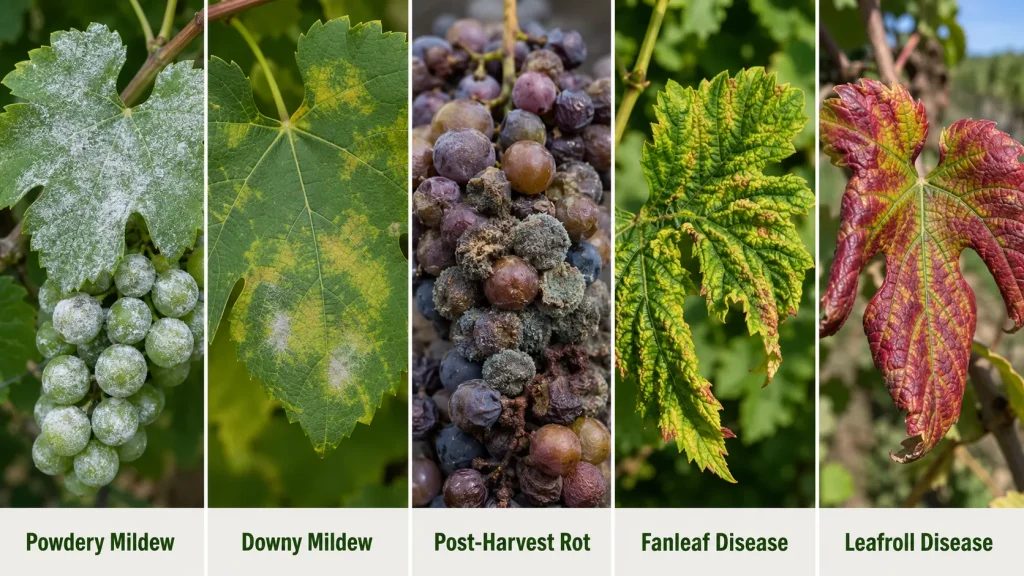
Early symptoms may appear as pale or chlorotic areas on grape leaves. As the disease develops, white to gray fungal growth becomes visible on the surface of affected tissues.
Typical symptoms include:
white or powdery fungal growth on leaves,
white-gray colonies on shoots and cluster stems,
powdery growth on young berries,
distorted or stunted young shoots in severe infections,
and brown or web-like scarring on berries following earlier infection.
UC IPM reports that the fungus may colonize the berry surface and rachis, while mature fruit may develop brown-to-black web-like scars representing previous powdery mildew colonies.
Young berries are particularly important to protect because infection during early fruit development can reduce fruit quality and predispose berries to cracking and secondary bunch rots.
Powdery mildew can therefore affect both the marketability and storage potential of table grapes.

Conditions Favoring Grape Powdery Mildew
Disease development is strongly influenced by temperature and the presence of susceptible green tissues.
UC IPM reports that temperatures around 70–85°F, approximately 21–29°C, are particularly favorable for rapid powdery mildew development. Very high temperatures can slow pathogen growth.
Dense canopies can further increase disease risk because they create shaded areas, limit air circulation and make disease monitoring and spray coverage more difficult.
Excessive nitrogen fertilization should also be avoided because it may encourage excessive vegetative growth and produce dense, highly susceptible canopies.
Management of Grape Powdery Mildew
An effective powdery mildew management program begins with vineyard design and canopy management.
Vines should receive adequate sunlight and airflow. Excessive shoots and foliage should be managed so that the fruit zone does not remain excessively dense.
Early detection is particularly important. Growers should inspect basal leaves, young shoots and developing clusters from the beginning of the growing season rather than waiting until berries are heavily infected.
Removal of basal leaves around clusters can improve airflow and fungicide coverage. UC IPM reports that appropriate leaf removal around the fruit zone can also contribute directly to powdery mildew suppression.
Chemical control, when required, should be based on locally registered fungicides, weather conditions, disease pressure and growth stage.
Sulfur is one of the traditional active ingredients used in grape powdery mildew management. Other fungicide groups used internationally include DMI fungicides and QoI/strobilurin fungicides.
Products containing active ingredients such as sulfur, penconazole and selected strobilurin fungicides may therefore form part of an integrated powdery mildew program where they are registered for grape.
For the Behavaran product portfolio, relevant products may include Behavaran Sulfur 80%, Behavaran Penconazole (Topas) and Strobi, subject to the approved product label and local registration.
Repeated reliance on fungicides with the same mode of action should be avoided because resistance can develop. Rotation between appropriate FRAC groups should be incorporated into the disease-management program.
Grape Downy Mildew
Grape downy mildew is another serious grapevine disease, especially in vineyards exposed to warm, humid and rainy conditions.
It is caused by Plasmopara viticola, an oomycete or water mold rather than a true fungus.
The pathogen can infect leaves, young shoots, tendrils, inflorescences and developing berries.
Rainfall, wet foliage and high humidity play a much greater role in downy mildew epidemics than they do in grape powdery mildew.
UC IPM states that the disease is favored by factors that increase moisture in the soil, air and plant canopy and that rainfall and irrigation practices can play major roles in epidemic development.
Symptoms of Grape Downy Mildew
One of the most characteristic early symptoms is the appearance of pale yellow or yellow-green lesions on the upper surface of grape leaves.
These lesions are often described as oil spots.
As infection develops, lesions may become angular because their expansion is limited by leaf veins. Under humid conditions, white to gray cotton-like sporulation often develops on the underside of the leaf opposite the oil spots.
This distinction is useful when separating downy mildew from powdery mildew.
Powdery mildew commonly develops as powdery colonies on the plant surface, whereas downy mildew typically produces oily lesions above and whitish sporulation mainly on the underside of infected leaves.
Young shoots may also become infected. In severe cases, shoot tips can thicken and curl before turning brown and dying.
Young grape berries are highly susceptible. Infected berries can initially appear grayish and may become covered with pathogen sporulation. As berries mature, symptoms may change and affected berries can remain firm, become discolored and fall from the cluster.
Conditions Favoring Grape Downy Mildew
Downy mildew outbreaks are strongly associated with moisture.
Rain, prolonged humidity, wet foliage and irrigation practices that repeatedly wet the canopy can increase disease pressure.
According to UC IPM, disease development is particularly favorable under warm and wet growing conditions, with an optimum temperature range around 20–25°C.
Vineyards in regions with rainy springs or humid growing seasons should therefore be monitored carefully for the first appearance of oil spots.
Management and Control of Grape Downy Mildew
Good vineyard drainage is one of the most important preventive measures.
Canopy management should encourage airflow and faster drying of leaves and clusters after rainfall or irrigation.
Where possible, irrigation systems that minimize repeated wetting of grape foliage can help reduce favorable conditions for infection.
Infected plant material and fallen leaves may contribute to overwintering inoculum. Vineyard sanitation can therefore form part of the management strategy.
UC IPM recommends reducing overwintering inoculum, improving drainage, increasing airflow and limiting unnecessary leaf wetness as preventive measures.
Where chemical protection is required, locally registered preventive or curative fungicides can be integrated according to disease pressure and local recommendations.
Copper-based fungicides like Copper Oxychloride Behavaran are among the traditional materials used for downy mildew prevention, while other active ingredients and mixtures are available depending on national registration.
Captan and copper-based fungicides may also contribute to programs against certain grape diseases, but product selection should always follow the registered crop and target disease listed on the label.
Botrytis Bunch Rot or Gray Mold of Grapes
Botrytis bunch rot, also known as gray mold, is caused by the fungus Botrytis cinerea.
It is an important disease of grape flowers and berries and can become particularly serious near ripening and harvest.
The fungus can infect flowers, leaves, shoots and fruit. Some infections begin during flowering but remain relatively inactive until berries begin to ripen.
UC IPM explains that Botrytis can overwinter in infected canes and mummified berries. Under wet conditions, spores are produced and spread to susceptible plant tissues.
Symptoms of Botrytis Bunch Rot
Affected berries may turn brown or reddish, soften, shrivel and decay.
When humidity remains high, characteristic gray fungal growth and masses of spores may develop on infected berries.
Disease can spread rapidly inside compact grape clusters where airflow is restricted.
Penn State Extension notes that Botrytis bunch rot is particularly associated with ripe or nearly ripe grapes and is favored by cool, damp conditions.
Berry wounds caused by insects, birds, physical injury, cracking or other grape diseases can also increase the risk of bunch rot.
Powdery mildew is especially important in this context because damaged or cracked berries may become more vulnerable to secondary rot pathogens.
Management of Botrytis Bunch Rot
Canopy management is a major component of Botrytis control.
Shoot thinning, hedging and appropriate leaf removal can increase cluster exposure and improve airflow around berries.
UC IPM reports that basal leaf removal around berry set can significantly reduce disease incidence and severity, although excessive exposure in hot climates can increase the risk of sunburn.
Excessive nitrogen fertilization and unnecessary irrigation should also be avoided because they may promote overly dense vegetative growth.
Preventing berry injuries is another important strategy. Management of insects and other diseases that damage berry skins can indirectly reduce bunch-rot risk.
Summer Bunch Rot and Sour Rot of Grapes
Not all rotting grape clusters are caused by Botrytis.
As berries mature and accumulate sugar, injured grapes become susceptible to a wide range of microorganisms.
UC IPM lists fungi including species of Alternaria, Aspergillus, Penicillium, Rhizopus and Botrytis among organisms associated with summer bunch rot.
Berry injury may be caused by:
insect feeding,
bird damage,
mechanical injury,
fruit cracking,
powdery mildew lesions,
or other physiological and disease-related damage.
Once the berry skin is compromised, microorganisms can colonize the damaged tissues.
Sour rot is particularly complex because bacteria, yeasts and other microorganisms may be involved, and vinegar flies can contribute to spread within affected clusters.
For this reason, controlling berry injury before ripening is an important component of bunch-rot management.
Post-Harvest Diseases of Grapes
Disease management does not end at harvest.
Fresh table grapes remain susceptible to fungal decay during handling, transportation and storage.
Post-harvest symptoms may include berry softening, discoloration, skin breakdown, shriveling and the development of gray, green, blue, brown or black fungal growth depending on the organisms involved.
The risk begins in the vineyard. Grapes harvested with injuries, cracks, Botrytis infections or damaged berries are more likely to experience problems after harvest.
Careful harvesting is therefore essential.
Clusters should be handled gently to minimize berry injury, and diseased or damaged fruit should be separated from marketable clusters.
Rapid cooling, appropriate cold-chain management, good sanitation and proper ventilation during storage and transportation are key components of post-harvest disease management.
Storage conditions and any approved post-harvest treatment should be selected according to grape cultivar, intended storage period, destination market and local food-safety regulations.
Grapevine Fanleaf Disease
Grapevine fanleaf disease, also known as fanleaf degeneration, is one of the most important viral diseases of grapevines.
It is primarily associated with Grapevine fanleaf virus (GFLV).
The virus can affect both vegetative growth and fruit production.
Typical symptoms may include:
malformed or fan-shaped leaves,
yellow mosaic patterns,
yellowing along or near leaf veins,
abnormal shoot development,
short or irregular internodes,
poor fruit set,
small clusters,
and uneven berry development.
UC Davis information on the vector Xiphinema index reports that GFLV infection can cause leaf malformation, abnormal shoot branching, small bunches, poor fruit set, irregular ripening and yellow mosaic or vein-banding symptoms.
Severe infection may substantially reduce vine productivity.
How Grapevine Fanleaf Virus Spreads
The disease can be introduced into a vineyard through infected propagation material.
In established vineyards, an important biological vector is the dagger nematode Xiphinema index, which can transmit GFLV while feeding on grape roots.
This makes fanleaf management particularly difficult because treating the visible vine alone does not remove the virus from an infected plant.
There is no conventional fungicide that can cure a virus-infected grapevine.
Management therefore depends mainly on prevention.
Management of Grapevine Fanleaf Disease
The most important strategy is establishing vineyards with healthy, tested propagation material from reliable nurseries.
When infection is confirmed, management decisions may include removing infected vines and preventing the movement of infected plant material.
Where vector nematodes are present, vineyard replanting plans may also need to consider soil and root-zone management under the supervision of qualified crop and plant-health professionals.
Because nutrient disorders, herbicide injury and other viruses may produce similar leaf symptoms, diagnosis based only on visual symptoms can be unreliable.
Laboratory testing is recommended before major removal or replanting decisions are made.
Grapevine Leafroll Disease
Grapevine leafroll disease is caused by a group of grapevine leafroll-associated viruses (GLRaVs).
Among them, GLRaV-3 is particularly important in commercial vineyards.
Leafroll disease can reduce vine performance, delay berry ripening and negatively affect fruit color, sugar accumulation, yield and overall grape quality.
UC IPM identifies leafroll among the important viral diseases of grapevine and notes that viral infection may delay fruit ripening and reduce both yield and fruit quality.
Symptoms of Grapevine Leafroll Disease
Symptoms vary depending on grape cultivar, virus combination and environmental conditions.
Leaves commonly begin to roll downward at their margins.
In red-fruited cultivars, areas between the major veins may turn red while the veins remain relatively green.
White-fruited cultivars may instead develop yellow or chlorotic discoloration.
OSU Extension describes leaf discoloration, rolling of leaf margins, reduced berry color, impaired ripening and yield reduction as important symptoms associated with grapevine leafroll viruses.
These symptoms can sometimes resemble nutritional deficiencies, especially potassium-related symptoms.
Visual diagnosis alone is therefore insufficient for confirming grapevine leafroll disease.
How Grapevine Leafroll Disease Spreads
Infected propagation material is an important source of long-distance spread.
Within vineyards, some leafroll-associated viruses can be transmitted by mealybugs and scale insects.
GLRaV-3 is particularly associated with this type of vector transmission.
UC IPM reports that GLRaV-3 can be transmitted by mealybugs and scale insects, while OSU Extension identifies several mealybug species capable of contributing to leafroll spread in vineyards.
Vine mealybug (Planococcus ficus) is especially important because it is both a damaging vineyard pest and a vector of grapevine leafroll-associated viruses.
Management of Grapevine Leafroll Disease
As with other grapevine viruses, there is no fungicide treatment that eliminates the virus from an infected vine.
Prevention is therefore critical.
New vineyards should be planted using tested and certified propagation material whenever possible.
Vineyards should also be monitored for both virus symptoms and potential vectors such as mealybugs.
When infection is confirmed, removing infected vines may help limit disease reservoirs, particularly when infection incidence remains relatively low.
Vector management should be integrated with vineyard sanitation and the use of clean planting material rather than considered as a stand-alone solution.
How to Distinguish Powdery Mildew From Downy Mildew in Grapes
Powdery mildew and downy mildew are often confused, but they have several important differences.
Powdery mildew usually produces white, powder-like colonies on grape leaves, shoots, rachises and berries. It is strongly influenced by moderate temperatures and does not depend on prolonged rainfall for secondary spread.
Downy mildew typically produces yellow or oily lesions on the upper surface of leaves and white-gray sporulation primarily on the underside. Wet foliage, rainfall and high humidity are much more important for disease development.
Accurate identification matters because the two pathogens belong to different biological groups and disease-control programs may differ.
Integrated Disease Management in Vineyards
The best grape disease management program is not based on a single fungicide or one spraying date.
Successful vineyard disease management combines prevention, monitoring and targeted intervention.
Start with healthy planting material and select vineyard sites with good drainage, adequate sunlight and sufficient airflow.
Maintain a balanced canopy through pruning, shoot thinning and appropriate leaf management.
Avoid excessive nitrogen that creates dense vegetative growth.
Monitor vines frequently from bud break through fruit development and ripening.
Remove diseased plant material where appropriate and prevent unnecessary berry injury.
Manage insect and nematode vectors where they contribute to virus spread.
When fungicides are required, choose products registered for the specific grape disease and rotate appropriate modes of action as part of a resistance-management strategy.
Weather conditions, grape variety, vine growth stage, disease history and intended market should all be considered before selecting a disease-management program.
Choosing Fungicides for Grape Diseases
There is no single “best fungicide for grapes” that controls every grape disease.
Fungicide selection should always be based on the pathogen.
For grape powdery mildew, sulfur and registered systemic or translaminar fungicides from appropriate FRAC groups may be used within an integrated program.
For grape downy mildew, preventive products including registered copper-based materials and other oomycete-targeted fungicides may be appropriate depending on local registration.
For Botrytis bunch rot, products with activity against Botrytis cinerea may form part of a program when disease risk justifies treatment.
In contrast, fungicides do not cure Grapevine fanleaf virus or grapevine leafroll-associated viruses.
This distinction is extremely important because unnecessary fungicide use cannot solve a viral disease problem.
Any pesticide used in vineyards should be applied strictly according to its approved label, crop registration, pre-harvest interval, resistance-management recommendations and applicable local regulations.
Frequently Asked Questions About Grape Diseases
What causes white powder on grape leaves?
White powder on grape leaves is commonly associated with grape powdery mildew caused by Erysiphe necator. The fungus may infect leaves, shoots, cluster stems and berries.
What are oil spots on grape leaves?
Yellowish or translucent oil-like spots on the upper leaf surface are characteristic early symptoms of grape downy mildew. Under humid conditions, white sporulation may appear on the underside of the same lesion.
Why are grape berries rotting before harvest?
Pre-harvest grape rot can be associated with Botrytis bunch rot, summer bunch rot, sour rot or secondary microorganisms entering damaged berries. High humidity, compact clusters, fruit injury and previous powdery mildew infection can increase risk.
Why are grape leaves curling downward?
Downward leaf rolling may occur with grapevine leafroll disease, but similar symptoms may also be associated with nutrient disorders, water stress or other problems. Laboratory diagnosis may be necessary when a virus is suspected.
Can fungicides cure grapevine viral diseases?
No. Fungicides target fungal or fungus-like pathogens and cannot eliminate viruses such as Grapevine fanleaf virus or grapevine leafroll-associated viruses from infected vines.
How can grape diseases be prevented?
Disease prevention begins with healthy planting material, suitable vineyard location, good drainage, balanced nutrition, canopy ventilation, sanitation, regular monitoring and control of disease vectors. Fungicides can then be used selectively when appropriate.
Conclusion
Grapevines are susceptible to several important diseases that can affect leaves, shoots, flowers, clusters and harvested fruit.
Among the most important are grape powdery mildew, grape downy mildew, Botrytis bunch rot, summer bunch rot, Grapevine fanleaf disease and grapevine leafroll disease.
Powdery mildew is recognized primarily by its white powdery growth, while downy mildew commonly produces yellow oil spots and whitish sporulation beneath leaves. Botrytis and other bunch rots become especially important as berries mature and can directly reduce fruit quality and storage potential.
Viral diseases require a different approach. Grapevine fanleaf and leafroll cannot be cured with fungicides, so prevention through healthy planting material, removal of confirmed infection where appropriate and management of vectors becomes essential.
A successful vineyard disease-management program combines accurate diagnosis, sanitation, canopy management, balanced fertilization, irrigation management, regular monitoring and responsible use of registered crop-protection products.
By identifying grapevine diseases early and understanding the conditions that favor them, growers can protect vine health, improve fruit quality and reduce avoidable yield losses.