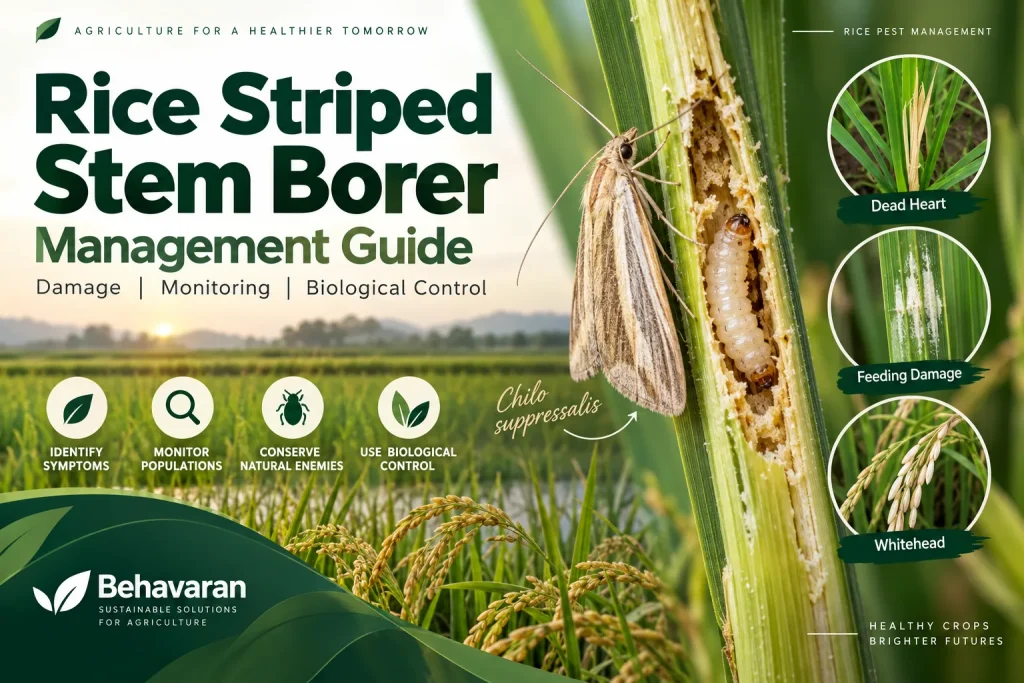
The rice striped stem borer (Chilo suppressalis Walker) is one of the important insect pests of rice and can attack the crop from the nursery stage through maturity. Larval feeding may damage leaves, leaf sheaths and stems, producing characteristic symptoms such as parenchymal feeding marks, sheath yellowing, dead hearts and whiteheads.
Effective rice striped stem borer management depends on accurate field monitoring, proper identification of damage symptoms, conservation of natural enemies and timely use of biological control methods such as Trichogramma parasitoids. This article explains the major symptoms of infestation and the monitoring and biological management practices described for rice fields.
What Is the Rice Striped Stem Borer?
The rice striped stem borer, scientifically known as Chilo suppressalis (Walker), is one of the major pests affecting rice production.
The insect can attack rice plants from the nursery stage until crop maturity. Although the pest occurs in different rice-growing regions, the source document notes that its greatest economic importance is associated with Asia and that it is an important pest of rice paddies in northern Iran and some other regions of the country.
The most serious damage is caused by the larval stage. Larvae feed on different tissues of the rice plant and may eventually penetrate the stem, where their feeding disrupts normal plant development.
Main Symptoms of Rice Striped Stem Borer Damage
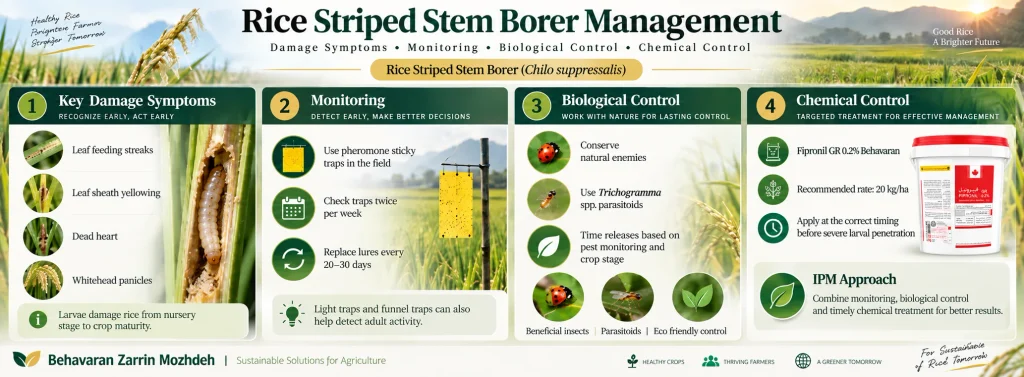
Four major types of damage are described in infested rice plants.
1. Parenchymal Feeding Damage
Young larvae may feed on the surface tissues of rice leaves during the nursery stage and after transplanting into the main field.
This type of feeding produces characteristic parallel whitish streaks or lines on the leaves as the larvae damage the leaf parenchyma.
These early symptoms can provide an important warning that striped stem borer larvae are present in the crop.
2. Leaf Sheath Damage
Early-instar larvae may also feed on the internal tissues of the rice leaf sheath.
The affected sheath can gradually turn yellow, and symptoms may become visible approximately two to three weeks after transplanting into the main field.
Regular inspection of leaf sheaths is therefore useful during early crop establishment.
3. Dead Heart Symptoms
As older larvae enter the main stem and feed internally, the central shoot may become yellow, dry and eventually die.
This symptom is commonly referred to as “dead heart.”
Dead heart symptoms mainly occur during the vegetative growth stage of rice.
The presence of dead hearts in a rice field is one of the most recognizable signs of stem borer infestation.
4. Whitehead Symptoms
Damage caused later in the season may become visible when rice plants enter the reproductive stage.
Larval feeding inside the stem interferes with movement of plant sap and prevents normal grain filling.
As a result, rice panicles may become white, empty or poorly filled. These affected panicles are known as whiteheads.
White panicles are often easily distinguished from healthy panicles because they remain upright and visibly pale within the field.
Monitoring Rice Striped Stem Borer Populations
Field monitoring plays an important role in determining pest occurrence and choosing the correct timing for management practices.
Using Delta Pheromone Traps
According to the source, delta traps equipped with sticky cards and pheromone lures can be used to monitor adult rice stem borers.
The traps are installed in rice fields at approximately 70-meter intervals.
Monitoring should begin early in the rice-growing season and trap catches should be checked twice per week until the end of adult flight activity.
Sticky surfaces must also remain effective. The source recommends replacing sticky cards when they become dry or ineffective and replacing pheromone lures approximately every 20–30 days.
Light Traps and Funnel Traps
In addition to pheromone traps, light traps and funnel-type traps can also be used to detect adult insects and evaluate pest population levels in rice fields.
Combining visual crop inspection with trap monitoring can improve understanding of pest activity throughout the season.
Rice paddies naturally support many organisms that help suppress rice pests.
Important natural enemies mentioned in the source include:
- Predators of eggs
- Predatory insects
- Frogs
- Dragonflies
- Damselflies
- Bats
- Spiders
- Egg parasitoids
- Entomopathogenic bacteria
- Entomopathogenic fungi
The document particularly identifies Trichogramma wasps as important egg parasitoids of rice pests.
Conserving these beneficial organisms can contribute significantly to sustainable pest management.
Biological Control with Trichogramma Wasps
One of the important biological approaches described for controlling rice stem borer is the release of Trichogramma parasitoid wasps.
These very small parasitoids attack the eggs of rice pests, including rice stem borers, preventing the development of many larvae before they enter rice stems.
For best results, the timing of parasitoid release should correspond with adult pest activity and egg-laying.
How to Determine the Best Time for Trichogramma Release
Monitoring is essential before parasitoid release.
The source recommends installing:
- Light traps
- Delta pheromone traps
- Funnel traps
from the beginning of pest emergence in the rice field.
Trap information, together with rice crop growth stage and pest biology, can then be used to determine the most appropriate release timing.
Trichogramma Release in Rice Nurseries
For control of the first generation of rice stem borer, the document describes parasitoid releases in rice nurseries after removal of plastic nursery covers.
Approximately 100 Trichocards per hectare are used, with cards distributed about 10 meters apart.
However, release timing should still be adjusted according to local pest monitoring and crop development.
Trichogramma Release in the Main Rice Field
Before releasing parasitoids in the main field, growers should evaluate:
- Pre-flight pest activity
- Peak adult flight
- Post-flight conditions
- Rice plant growth stage
The final release decision should be based on monitoring information and local pest development.
The document again refers to approximately 100 Trichocards per hectare, placed around 10 meters apart, for management of the first generation.
Managing the Second Generation of Rice Stem Borer
Management of the second generation is particularly important because infestation may coincide with panicle formation and grain development.
The source describes a second parasitoid release approximately 7–10 days after the first release, depending on adult flight activity and rice phenology.
In higher pest populations, at least three releases may be recommended for second-generation control.
The exact number and timing of releases should therefore be adapted according to pest population density.
Protecting Natural Enemies in Rice Fields
The source emphasizes that rice ecosystems contain a wide variety of beneficial organisms capable of contributing to biological pest control.
For this reason, management practices should aim to protect beneficial insects and other natural enemies and encourage environmentally compatible pest-management approaches.
This approach is consistent with the principles of Integrated Pest Management (IPM), where monitoring, biological control and conservation of beneficial organisms are combined to reduce unnecessary pest-control interventions.
Key Points for Rice Striped Stem Borer Management
Effective rice striped stem borer management begins with early detection.
Growers should regularly inspect rice plants for:
- Whitish feeding lines on leaves
- Yellowing of leaf sheaths
- Dead hearts during vegetative growth
- Whiteheads during reproductive growth
Pheromone and light traps can help identify periods of adult activity, while Trichogramma releases can target the egg stage before larvae penetrate the rice stem.
Because natural predators, parasitoids and pathogens already occur in rice paddies, protecting these organisms should also be an important part of long-term pest management.
Chemical Control of Rice Stem Borer
Chemical control may be considered when monitoring shows that rice stem borer populations have reached a level requiring intervention. Because the larvae eventually penetrate the rice stem, timing of treatment is critical. Control measures are generally more effective when applied before large numbers of larvae enter and become protected inside the stem.
For rice stem borer management, Fipronil GR 0.2% Behavaran is a granular insecticide formulated for field application in rice paddies.
Fipronil GR 0.2% Behavaran
Fipronil GR 0.2% Behavaran is a granular insecticide containing fipronil as its active ingredient. The granular formulation allows the product to be distributed across the rice field, where it can help control stem borer larvae during susceptible stages of pest development.
For rice stem borer control, the registered application rate provided for this product is:
20 kg/ha
Application should be based on pest monitoring, crop growth stage and local recommendations. For best results, treatment timing should correspond with larval emergence and should be carried out before extensive larval penetration into rice stems.
Why Timing Matters
After hatching, young larvae initially move and feed on external or more accessible plant tissues before entering rice stems. Once larvae penetrate the stem, they become more difficult to reach with insecticide treatments.
For this reason, growers should combine chemical control with:
- regular field scouting,
- pheromone-trap monitoring,
- observation of adult flight activity,
- detection of early larval damage,
- and local pest-warning information.
This helps ensure that insecticide applications are made only when necessary and at the most effective time.
Integrating Fipronil into an IPM Program
Fipronil should be used as part of an Integrated Pest Management (IPM) program rather than as the only control method.
An effective program may combine:
- pest monitoring,
- conservation of natural enemies,
- biological control with Trichogramma parasitoids,
- appropriate crop-management practices,
- and properly timed chemical control when required.
This approach can improve rice stem borer management while reducing unnecessary pesticide applications.
Product: Fipronil GR 0.2% Behavaran
Target pest: Rice stem borer
Formulation: Granule (GR)
Application rate: 20 kg/ha
Important Note
Always follow the approved product label, local pesticide regulations and recommendations from agricultural experts before application. Application rate, timing and method may vary according to local registration requirements and field conditions.
Conclusion
The rice striped stem borer (Chilo suppressalis) can damage rice from the nursery stage to maturity, but the type of injury changes as both the insect and crop develop.
Recognizing characteristic symptoms such as dead hearts and whiteheads, monitoring adult populations with traps, and correctly timing Trichogramma releases can improve pest-management decisions.
Successful management should be based on pest population monitoring, rice growth stage and conservation of the natural enemies already present within the rice ecosystem.