
What Is Citrus Impietratura Disease?
Citrus Impietratura disease is a graft-transmissible, virus-like disorder of citrus that can cause serious quantitative and qualitative losses in fruit production. The disease is especially important because infected trees may appear relatively healthy while their fruits develop characteristic rind lesions, internal gum deposits, reduced size, hardness, and premature fruit drop. The exact causal agent of Impietratura has not yet been identified, but its transmission through infected propagation material and grafting has been established.
For citrus growers, the disease is particularly important because citrus is commonly propagated vegetatively. Once infected budwood or scion material is used for grafting, the disease can be transferred from an infected mother tree to new plants. This makes the use of healthy and certified planting material one of the most important measures for Citrus Impietratura management.
Why Is Impietratura Considered a Graft-Transmissible Disease?
Impietratura is considered a graft-transmissible citrus disease because the disease can move from infected citrus material to healthy plants through grafting. In citrus production, commercial cultivars are commonly propagated by grafting desirable scions or buds onto suitable rootstocks. This process creates vascular connections between the rootstock and the scion, allowing graft-transmissible disease agents to move from infected plant tissue into the new tree.
The source document notes that transmission by insect vectors or ordinary horticultural tools has not been confirmed for Impietratura. Instead, movement of infected citrus cultivars and infected propagation material is considered the main pathway for the spread of the disease between orchards and regions.
This is why the selection of healthy budwood, virus-free citrus nursery plants, and reliable mother trees is central to preventing the introduction of Impietratura into new citrus orchards.
Which Citrus Species Can Be Affected?
Symptoms of Citrus Impietratura disease have been reported in several commercially important citrus types. According to the source, characteristic fruit symptoms may occur in:
- Sweet orange
- Grapefruit
- Mandarin
- Lemon
The disease can therefore affect a wide range of citrus orchards rather than being limited to a single cultivar or species.
The severity and visibility of symptoms may vary among cultivars. In some infected trees, fruit symptoms are obvious, while in others the infection may remain less noticeable. This makes careful inspection of fruit, young leaves, and propagation sources especially important in citrus disease management.
Symptoms of Citrus Impietratura Disease
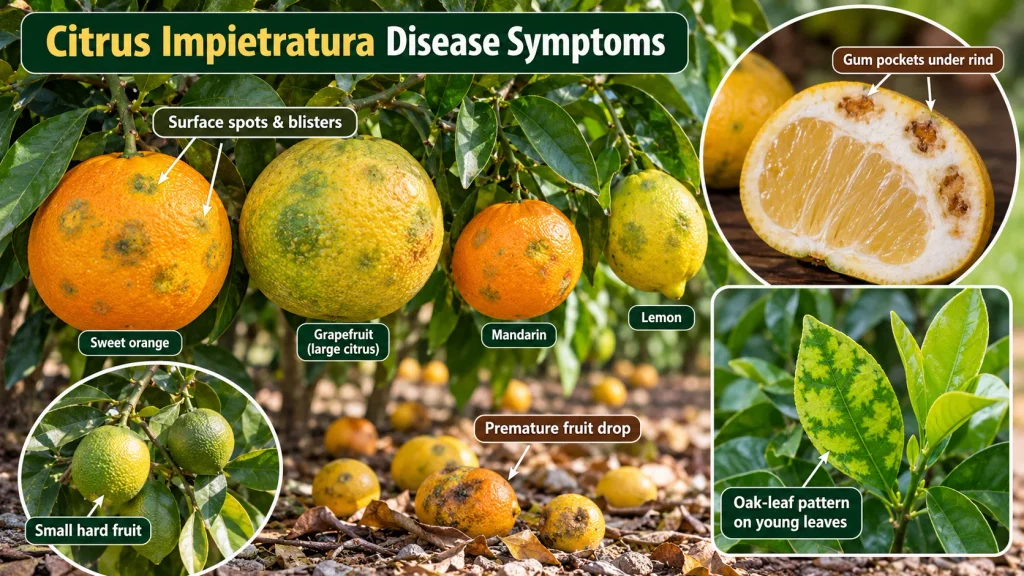
The most recognizable symptoms of Citrus Impietratura develop on the fruit. However, symptoms may also appear on young leaves and fruiting branches. External rind discoloration, blister-like lesions, gum formation beneath the rind, small and hardened fruits, premature fruit drop, and an oak-leaf-like pattern on young leaves are among the most useful diagnostic signs.
Because some symptoms may resemble nutritional disorders or other citrus problems, growers should evaluate several symptoms together rather than relying on only one sign.
Spots and Blisters on the Fruit Surface
One of the most characteristic signs of Impietratura is the appearance of round or irregular spots and blister-like areas on the fruit rind. These areas may differ in color from the surrounding healthy peel and may occur individually or in multiple patches across the fruit surface. تالار- بیماری شبه ویروس مرکبات …
The images in the source show both circular and irregular lesions on affected citrus fruits. In some cases, the lesions are clearly visible on green fruit, while later in fruit development their appearance may become less obvious.
For this reason, early and mid-season observation can be useful for detecting Impietratura symptoms in citrus fruit before the fruit reaches full maturity.
Gum Pockets Beneath the Rind
A second highly important symptom is the formation of gum pockets beneath the citrus rind, especially in the white inner rind layer known as the albedo. These gum deposits are usually located beneath the areas where external rind symptoms are visible.
In some fruits, the gum pockets become visible only after removing a thin layer of peel or cutting the fruit. In advanced cases, gum may be extensive enough to become visible from the outside.
This sub-rind gumming is one of the most useful field indicators for distinguishing Citrus Impietratura from many superficial rind disorders.
Small, Hard and Poor-Quality Fruits
Impietratura can significantly reduce both fruit size and fruit quality. Fruits from infected citrus trees may remain small, unusually hard, and poorly developed compared with healthy fruit. The rind may become less flexible, particularly in symptomatic areas.
These physical changes can reduce the commercial value of the crop. Even if the fruit remains on the tree until harvest, its size, texture, and appearance may make it unsuitable for fresh-market sale.
From an economic perspective, this reduction in fruit marketability is one of the most serious consequences of Citrus Impietratura disease.
Premature Fruit Drop
Another major symptom of Impietratura is premature fruit drop. Infected trees may shed fruits before they reach normal harvest maturity, especially when the disease is severe.
The source reports that fruit drop associated with Impietratura has become more severe in some citrus-growing areas.
Premature drop directly reduces marketable yield and can be especially damaging when combined with small fruit size and poor fruit quality. In orchards where unexplained early fruit drop occurs together with rind lesions and internal gum formation, Impietratura should be considered as a possible cause.
Gum Exudation from Fruiting Branches
In more advanced cases, gum exudation may also occur on fruiting branches. The source describes gum production on branches connected to fruits showing severe Impietratura symptoms, particularly during summer.
Affected branches may develop bark cracking together with gum exudation. These symptoms are not as common or as diagnostically specific as fruit symptoms, but when they occur together with characteristic fruit damage they can provide additional evidence of disease.
Growers should therefore inspect not only affected fruits but also the branches bearing severely symptomatic fruit.
Oak-Leaf Pattern on Young Citrus Leaves
Impietratura may also produce a distinctive mosaic-like symptom known as the oak-leaf pattern on young citrus leaves. This pattern resembles the outline or venation pattern of an oak leaf and is most easily observed on young flushes during cooler periods.
However, the oak-leaf pattern is not unique to Impietratura. The source notes that similar symptoms can also occur in other graft-transmissible citrus disorders such as concave gum and cristacortis. Therefore, this leaf symptom should be considered a useful indicator rather than definitive proof of Impietratura infection.
When the oak-leaf pattern appears together with typical fruit lesions and sub-rind gum pockets, the suspicion of a graft-transmissible citrus disease becomes much stronger.
How Does Impietratura Damage Citrus Fruit?
Citrus Impietratura damage affects both crop yield and fruit quality. Infected trees may produce smaller fruits, fruits with hardened rind areas, unattractive surface lesions, internal gum deposits, and fruits that fall before harvest.
The combined result is lower marketable yield, reduced fruit quality, and decreased economic value of citrus production.
Reduction in Fruit Size
One of the most important effects of Impietratura is reduced citrus fruit size. Fruits on infected trees may remain noticeably smaller than those on healthy trees.
In some cases, the external rind symptoms become less visible as the fruit enlarges and changes color. Therefore, trees carrying many unusually small fruits should still be considered suspicious even when obvious rind spots are limited.
Cutting or peeling a sample of suspicious fruits can help reveal the internal gum deposits associated with the disease.
Loss of Fruit Quality and Marketability
Impietratura can severely reduce citrus fruit quality and marketability. Affected fruits may be small, firm, misshapen, or marked by visible rind lesions. Hard areas of peel and internal gumming further reduce their commercial quality.
The source specifically notes that fruits from infected trees may lose their suitability for market because of their small size and hard rind.
For commercial citrus growers, this means that the disease may cause losses even when fruit production continues, because a significant portion of the crop may not meet market quality standards.
Increased Premature Fruit Drop
Premature fruit drop represents another direct source of yield loss in orchards affected by Impietratura. Fruits may detach before reaching full maturity, reducing the quantity of harvestable fruit.
When premature drop occurs together with small, hard fruits and characteristic rind symptoms, it can indicate substantial disease pressure.
For this reason, monitoring fruit drop patterns, fruit size, rind symptoms, and sub-rind gumming together can help growers identify suspicious trees earlier and avoid using them as sources of budwood or propagation material.
Which Citrus Fruits Are Affected by Impietratura?
Citrus Impietratura disease is not limited to a single citrus species. The source reports typical fruit symptoms in sweet orange, grapefruit, mandarin, and lemon, making the disease relevant to a broad range of commercial citrus orchards. The main symptoms include discolored spots or blister-like areas on the rind, gum pockets beneath the peel, reduced fruit size, hardening of the rind, and premature fruit drop.
The source does not provide a separate symptom profile for each citrus species, so the descriptions below reflect the common Impietratura symptoms reported across affected citrus fruits rather than species-specific differences.
Symptoms in Sweet Orange
Sweet orange is one of the citrus types in which Impietratura symptoms are clearly documented. Affected fruits may develop round or irregular discolored areas on the rind, sometimes with a blister-like appearance.
Beneath these visible areas, gum pockets may form in the white inner rind tissue, or albedo. In more advanced cases, gum accumulation may become severe enough to be detected externally.
Affected oranges may also remain small and hard, lose market value, and drop before normal harvest. These characteristics make fruit inspection especially important in orchards where unexplained fruit hardening or premature drop occurs.
Symptoms in Grapefruit
The publication lists grapefruit among citrus fruits that can show the characteristic symptoms of Impietratura. These may include abnormal coloration, surface spots or blister-like lesions, and gum formation beneath the rind.
Because the disease can affect fruit quality as well as size, suspicious grapefruit should be examined not only externally but also internally. Removing part of the peel or cutting the fruit can reveal sub-rind gum deposits that are not always visible from the outside.
Symptoms in Mandarin
Mandarin trees can also be affected by Citrus Impietratura. Fruit symptoms may include rind discoloration, hard areas, gum accumulation beneath the peel, small fruit size, and reduced marketability.
The source also documents gum symptoms in mandarin propagation material affected by advanced disease, showing that the disorder can also be associated with gum formation in woody tissues.
Symptoms in Lemon
Lemon is included among the citrus types in which Impietratura symptoms have been observed. As with other affected citrus fruits, growers should look for unusual rind discoloration, blister-like lesions, firmness, sub-rind gumming, and abnormal fruit development.
Since symptom intensity can vary, diagnosis should be based on a combination of fruit symptoms and, when needed, additional biological testing rather than on rind appearance alone.
How to Distinguish Impietratura from Boron Deficiency
One of the important diagnostic challenges in citrus orchards is distinguishing Citrus Impietratura disease from boron deficiency. Both conditions may involve gum formation inside the fruit, which can lead to confusion during field diagnosis.
The publication emphasizes that the location and pattern of gum accumulation, together with the overall condition of the tree and nutritional testing, can help separate the two problems. تالار- بیماری شبه ویروس مرکبات …
Differences in Gum Formation
In Impietratura, gum deposits are characteristically associated with the albedo beneath visible rind lesions. The gum pockets often correspond closely to surface spots or blister-like areas on the fruit.
In contrast, boron deficiency can also cause internal gum formation, but the pattern of gumming in the fruit differs. The source specifically notes that the distribution of gum within the fruit flesh can help distinguish boron deficiency from Impietratura.
Therefore, when gum is found inside a citrus fruit, its location and association with rind lesions should be carefully evaluated before diagnosing Impietratura.
Why Soil and Nutrient Tests Matter
Nutritional testing can support the differential diagnosis. The source notes that trees affected by Impietratura often maintain a relatively normal appearance and growth, which helps distinguish them from trees suffering from nutritional stress.
If boron deficiency is suspected, soil and nutritional analysis can help determine whether the symptoms are related to a mineral imbalance. When boron deficiency is not supported by testing and the fruit shows typical rind lesions and sub-rind gum pockets, Impietratura becomes a stronger diagnostic possibility.
How Is Citrus Impietratura Diagnosed?
Diagnosis of Citrus Impietratura disease relies mainly on visible symptoms and biological indexing because the exact causal agent remains unknown.
The publication states that fruit symptoms and the oak-leaf pattern on young leaves can be used for field diagnosis, while biological indexing with indicator plants is the confirmatory method.
Diagnosis Based on Fruit Symptoms
Fruit inspection is one of the most practical methods for identifying suspected Impietratura.
Important diagnostic signs include:
- Round or irregular discolored rind lesions
- Blister-like surface symptoms
- Gum pockets beneath the rind
- Small and unusually hard fruits
- Reduced marketability
- Premature fruit drop
Because external symptoms can become less obvious as fruits enlarge and color, suspicious fruits may need to be peeled or cut to check for internal gum deposits.
Diagnosis Using Oak-Leaf Pattern
Another useful field symptom is the oak-leaf pattern on young citrus leaves. This mosaic-like pattern resembles the shape or venation of an oak leaf and is most easily observed on young shoots during cooler periods.
However, the source clearly notes that this symptom is not specific to Impietratura. Similar patterns may also occur in concave gum and cristacortis. Therefore, oak-leaf pattern should be treated as a diagnostic indicator rather than definitive confirmation.
Biological Indexing with Indicator Plants
Because the causal agent of Impietratura has not been identified, biological indexing with indicator plants is used for confirmation.
The source mentions sensitive citrus indicators including:
- Madam Vinous sweet orange
- Pineapple sweet orange
- Dweet tangor
These indicator plants are graft-inoculated with suspected infected material and maintained under cool greenhouse conditions. Young shoots are then monitored for the development of the characteristic oak-leaf pattern.
Fruit-bearing grafts from healthy sources can also be placed on infected indicator plants and later examined for sub-rind gum formation.
Why Molecular and Serological Tests Are Not Available
The main limitation in laboratory diagnosis is that the causal agent of Citrus Impietratura remains unidentified.
For this reason, the publication states that standard serological and molecular diagnostic methods are not available for this disease. Instead, biological indexing with indicator plants remains the confirmatory approach.
This makes field symptom recognition and the use of clean propagation material particularly important in practical disease management.
How Is Citrus Impietratura Spread?
Impietratura is primarily spread through infected citrus propagation material. The disease is graft-transmissible, meaning that infected budwood, scions, and nursery plants can carry the disorder from one tree or region to another.
The movement of infected cultivars is considered a major reason for the historical spread of the disease.
Transmission Through Infected Budwood
Infected budwood is one of the most important sources of Citrus Impietratura spread.
When budwood is collected from an infected mother tree and grafted onto healthy rootstock, the disease can be transferred to the new plant. Because infection may be hidden in some cultivars, apparently healthy propagation material may still present a risk.
This is why the health status of budwood sources is critical in citrus propagation programs.
Role of Grafting in Disease Spread
Grafting is the main propagation method for many commercial citrus cultivars. During grafting, vascular continuity develops between the rootstock and the scion, allowing graft-transmissible disease agents to move from infected tissue into healthy plants.
Therefore, infected scions or buds can introduce Impietratura into newly established orchards and maintain the disease in existing production areas.
Why Infected Nursery Plants Are a Major Risk
Nursery plants represent a major pathway for long-distance disease spread because infected material can be distributed to many orchards.
The publication highlights the risk associated with plants supplied by unregulated sellers, seasonal vendors, and unreliable nurseries. It emphasizes that citrus trees for new orchards should be obtained from reliable, licensed, and reputable nurseries.
Using healthy nursery stock is especially important because graft-transmissible diseases can remain in plant material and become established in a new orchard before obvious symptoms appear.
Is Impietratura Spread by Insects or Pruning Tools?
According to the source, transmission of Impietratura by insect vectors or horticultural tools has not been confirmed.
The main confirmed pathway is the movement of infected citrus material through grafting and propagation. –
For this reason, management should focus primarily on clean budwood, healthy nursery plants, and prevention of infected propagation material entering new orchards.
Why Topworking Can Increase the Risk of Impietratura
Topworking can contribute significantly to the persistence and local spread of Impietratura when grafting material is taken from infected citrus trees.
The publication identifies topworking as an important route through which graft-transmissible citrus diseases, including Impietratura, can survive and spread within affected regions. تالار- بیماری شبه ویروس مرکبات …
What Is Topworking in Citrus?
Topworking is a technique used to change or renew a citrus variety by grafting a desired cultivar onto the trunk or main branches of an established tree.
It may be used to:
- Change cultivars
- Rejuvenate old or low-yielding orchards
- Restore trees damaged by frost, snow, or breakage
The technique is common in citrus-growing regions, including Iran and Mediterranean countries.
How Infected Budwood Spreads the Disease Within Orchards
If budwood used in topworking is taken from an infected source, the disease can be introduced directly into an otherwise healthy tree.
The risk is greater when growers obtain budwood from informal or unverified sources. The source therefore stresses the importance of selecting healthy rootstocks and confirmed healthy budwood when renovating citrus orchards.
How to Prevent Citrus Impietratura Disease
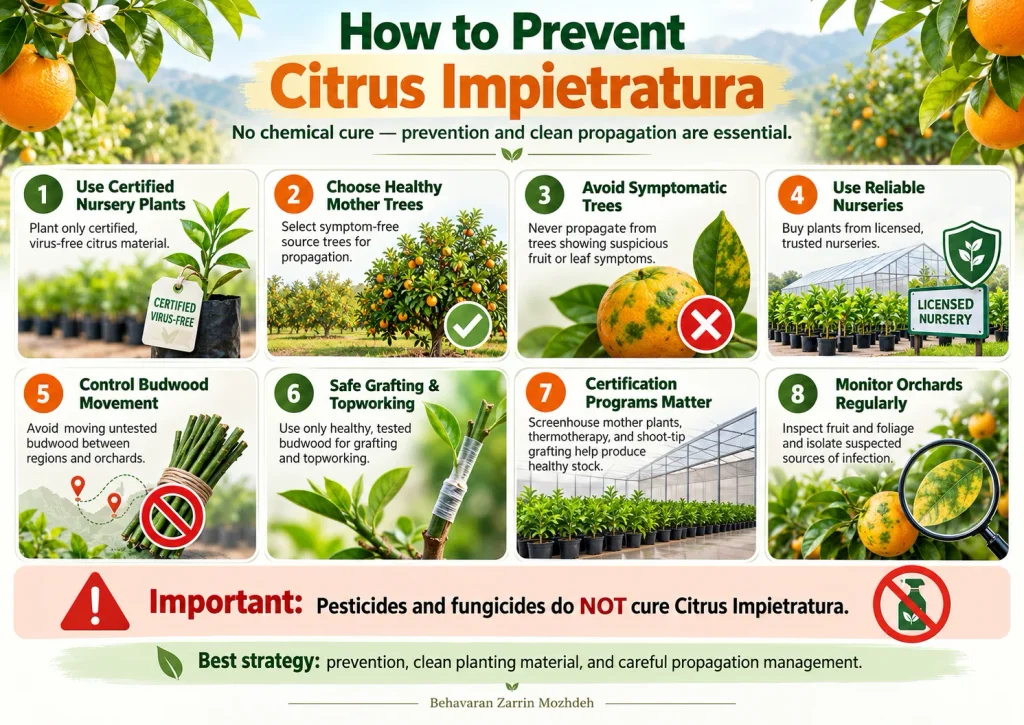
Because there is no specific pesticide treatment for Impietratura, prevention is the foundation of disease management.
The most effective strategy is to prevent infected plant material from entering healthy orchards and to avoid propagation from infected trees.
Use Certified and Virus-Free Nursery Plants
New citrus orchards should be established with certified, healthy, and virus-free nursery plants whenever possible.
Certified planting material reduces the risk of introducing graft-transmissible diseases such as Impietratura into new production areas.
Select Healthy Mother Trees
Mother trees used as sources of budwood should be vigorous, healthy, and preferably obtained from controlled and reliable sources.
The source emphasizes that both the budwood donor tree andتالار- بیماری شبه ویروس مرکبات …
Avoid Propagation from Symptomatic Trees
Trees showing typical Impietratura symptoms should never be used as sources of propagation material.
This includes trees with:
- Rind lesions
- Sub-rind gum deposits
- Small hard fruits
- Premature fruit drop
- Oak-leaf patterns on young leaves
Avoiding propagation from suspicious trees is one of the simplest ways to reduce disease spread.
Use Reliable and Licensed Nurseries
The publication specifically recommends sourcing citrus nursery trees from reliable, licensed, and reputable nurseries.
Cases of graft-transmissible diseases have been associated with informal sellers and unregulated nursery sources, which increases the risk of distributing infected plant material.
Control the Movement of Budwood Between Regions
Movement of budwood and scion material between orchards and regions should be carefully controlled.
Because movement of infected citrus cultivars is considered a major pathway for Impietratura spread, restricting unverified propagation material can help prevent introduction into disease-free areas.
Role of Certified Citrus Planting Material
Certified planting material is one of the most important tools for managing graft-transmissible citrus diseases.
Certification programs help ensure that budwood and nursery plants originate from tested, healthy mother plants and are produced under controlled conditions.
Why Certification Programs Are Important
The source refers to citrus certification programs used in major citrus-producing countries.
Under these systems, mother plants are selected, tested, sanitized when necessary, and carefully maintained before their budwood is used for nursery propagation. Such programs have helped reduce the incidence of graft-transmissible diseases in citrus production.
For growers, certified material provides greater confidence that newly planted trees are less likely to carry hidden infections.
Screenhouse Production of Healthy Mother Plants
Healthy mother trees used for budwood production may be maintained in specialized screenhouses.
These structures are protected with insect-proof screens and are designed to safeguard important propagation sources from external contamination.
Although insect transmission has not been confirmed for Impietratura itself, maintaining mother plants in protected facilities is part of broader citrus sanitation and certification programs.
Thermotherapy and Shoot Tip Grafting
The source identifies two methods for sanitizing infected citrus germplasm:
Thermotherapy and Shoot Tip Grafting (STG).
After sanitation, healthy primary sources can be maintained and multiplied under controlled conditions. Budwood from these sources can then be propagated through mother blocks before certified nursery plants are ultimately supplied to growers.
This clean-stock approach is especially important for diseases such as Citrus Impietratura, where prevention through healthy propagation material is far more effective than attempting to manage the disease after it has already entered an orchard.
How Is Citrus Impietratura Diagnosed?
Diagnosing Citrus Impietratura disease relies mainly on careful observation of characteristic fruit and leaf symptoms together with biological indexing. The source explains that although the disease is clearly graft-transmissible, its causal agent has not yet been identified. As a result, diagnosis is based primarily on visible orchard symptoms and biological tests rather than routine molecular or serological assays
Diagnosis Based on Fruit Symptoms
Fruit symptoms are among the most practical and important indicators of Impietratura in citrus. Affected fruits may develop round or irregular discolored spots or blister-like areas on the rind. Beneath these visible lesions, gum pockets can form in the white inner rind tissue, or albedo.
Infected fruits may also remain small and hard and may fall before harvest. Because the external symptoms can become less obvious as the fruit enlarges and colors, suspicious fruits may need to be peeled or cut to check for internal gum deposits.
For field diagnosis, the combination of rind lesions, sub-rind gumming, fruit hardening, reduced fruit size, and premature fruit drop provides stronger evidence than any single symptom alone.
Diagnosis Using Oak-Leaf Pattern
Another useful sign is the oak-leaf pattern that may appear on young citrus leaves. This symptom consists of mosaic-like markings that resemble the shape or venation of an oak leaf and can be observed more clearly on young flushes during cooler periods.
However, the oak-leaf pattern is not unique to Impietratura. The source notes that similar leaf symptoms can also occur in other graft-transmissible citrus disorders such as concave gum and cristacortis. Therefore, it should be considered a useful diagnostic clue rather than a definitive confirmation of Impietratura.
Biological Indexing with Indicator Plants
Because the causal agent is still unknown, biological indexing with indicator plants remains the confirmatory method described in the source.
Sensitive citrus indicators such as Madam Vinous sweet orange, Pineapple sweet orange, and Dweet tangor may be graft-inoculated with suspected infected material. The plants are then maintained under cool greenhouse conditions and monitored for the development of oak-leaf symptoms on young shoots.
The source also describes grafting a branch bearing immature fruit from a healthy source onto infected indicator plants and later examining the developing fruit for characteristic internal gum formation.
Why Molecular and Serological Tests Are Not Available
Routine molecular and serological tests are not available for Citrus Impietratura because the exact causal agent has not yet been identified.
The source states that, despite advances in biological sciences, the nature of the pathogen remains unknown. Therefore, standard laboratory diagnosti
For this reason, field symptoms and biological indexing remain especially important in the diagnosis of suspected Impietratura infections.
How to Prevent Citrus Impietratura Disease
Since Impietratura is spread mainly through infected citrus propagation material, prevention is the most important management strategy.
The source emphasizes that preventing the introduction of infected material into disease-free areas, producing healthy nursery plants, and avoiding propagation from infected trees are the foundations of Impietratura management.
Use Certified and Virus-Free Nursery Plants
New citrus orchards should be established using certified and healthy nursery plants obtained from reliable sources.
Because Impietratura is graft-transmissible and may remain hidden in some cultivars, planting apparently healthy but infected nursery trees can introduce the disease into an orchard at the time of establishment.
Using certified planting material greatly reduces this risk and also helps limit the introduction of other graft-transmissible citrus diseases.
Select Healthy Mother Trees
Mother trees used to produce budwood should be carefully selected for health, vigor, and known origin.
The source stresses that both the trees supplying scion material and the trees receiving grafts should be selected from vigorous and healthy plants, preferably from reliable sources.
This is particularly important because infected mother trees can serve as a long-term source of contaminated budwood for many nursery plants.
Avoid Propagation from Symptomatic Trees
Trees showing typical Impietratura symptoms should not be used as sources of budwood or scion material.
Suspicious signs include:
- Discolored or blistered fruit rind
- Gum pockets beneath the rind
- Small and hardened fruits
- Premature fruit drop
- Oak-leaf patterns on young leaves
- Gum exudation from fruiting branches
Avoiding propagation from symptomatic trees is one of the most direct ways to reduce the spread of the disease.
Use Reliable and Licensed Nurseries
The source highlights the importance of obtaining citrus plants from reliable, licensed, and reputable nurseries.
It notes that cases of graft-transmissible diseases have been found among plants offered by seasonal sellers, intermediaries, and unregulated nurseries.
For growers, choosing a reputable nursery is therefore not only a matter of plant quality but also an important disease-prevention measure.
Control the Movement of Budwood Between Regions
Movement of unverified budwood is a major risk for spreading graft-transmissible diseases between orchards and regions.
The source attributes much of the worldwide spread of Impietratura to the movement and propagation of infected citrus cultivars.
Controlling the movement of budwood, especially from orchards with unknown health status, is therefore essential for protecting disease-free citrus production areas.
Role of Certified Citrus Planting Material
Certified citrus planting material is a central component of managing graft-transmissible citrus diseases.
Certification systems aim to ensure that budwood and nursery plants originate from healthy primary sources that have been tested, sanitized when necessary, and carefully maintained before propagation.
Why Certification Programs Are Important
Certification programs help reduce the risk of distributing infected budwood and nursery trees.
The source refers to citrus-producing countries where structured certification programs are used to manage graft-transmissible diseases. In these systems, mother plants are selected and maintained under controlled conditions before their budwood is released for propagation. تالار- بیماری شبه ویروس مرکبات …
For commercial orchards, certified trees provide a more reliable foundation for long-term orchard health and productivity.
Screenhouse Production of Healthy Mother Plants
Healthy mother trees may be maintained in specialized screenhouses equipped with protective screening.
The source describes these structures as part of programs designed to protect important mother plants and clean propagation sources.
Maintaining elite mother plants in protected facilities helps preserve their sanitary status and supports the production of healthier budwood and nursery stock.
Thermotherapy and Shoot Tip Grafting
The source identifies thermotherapy and Shoot Tip Grafting (STG) as methods used to sanitize infected citrus germplasm.
After sanitation, healthy primary sources can be maintained and multiplied through controlled mother blocks. Budwood from these sources can then be supplied to nurseries for the production of certified citrus trees.
This clean-stock approach is particularly important for diseases such as Impietratura, where prevention through healthy propagation material is far more effective than attempting to manage the disease after infection has already occurred.
Is There a Chemical Treatment for Citrus Impietratura?
There is no specific pesticide treatment described for Citrus Impietratura.
The source explains that for graft-transmissible viral and virus-like citrus diseases, management is based primarily on preventing their spread rather than on chemical control.
Why Pesticides Cannot Cure the Disease
Impietratura is a graft-transmissible disorder associated with infected plant tissue, not a disease that can be eliminated by applying a conventional fungicide or insecticide.
Because the causal agent is unknown and is associated with infected propagation material, chemical treatments are not considered a curative solution.
For the same reason, applying fungicides to symptomatic trees should not be expected to eliminate the infection or make infected budwood safe for propagation.
Why Prevention Is the Main Management Strategy
Prevention is the main management strategy because once infected material is established in an orchard, there is no source-supported chemical treatment that can cure the disease.
The most important preventive measures are:
- Use healthy, certified nursery plants
- Obtain budwood from verified mother trees
- Avoid propagating symptomatic trees
- Purchase planting material from reliable nurseries
- Limit movement of unverified scion material between regions
- Use clean-stock and certification programs
These practices directly address the principal documented route of disease spread: infected propagation material.
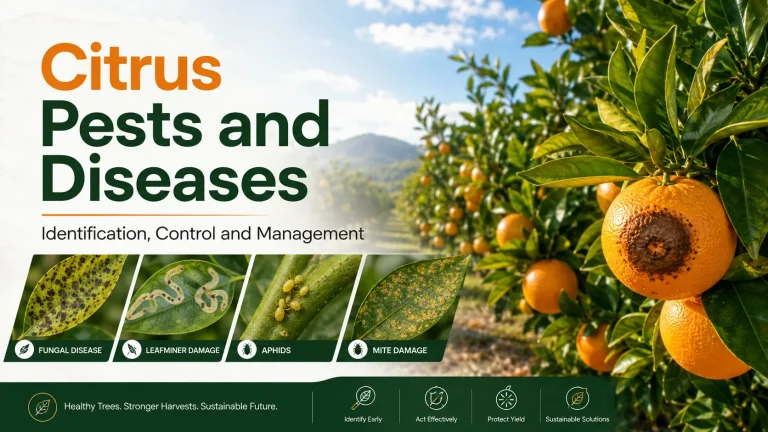
Citrus Pests and Diseases: Complete Guide to Identification, Prevention and Management
Frequently Asked Questions About Citrus Impietratura
What Are the First Symptoms of Impietratura?
The most characteristic early signs are round or irregular discolored spots or blister-like areas on the fruit rind. Gum pockets may develop directly beneath these lesions in the albedo.
Young leaves may also develop the oak-leaf pattern, although this symptom is not specific to Impietratura.
Can Impietratura Cause Fruit Drop?
Yes. The source identifies premature fruit drop as an important consequence of Impietratura infection. Affected fruits may also remain small, hard, and commercially unacceptable.
Can Impietratura Be Transmitted by Insects?
The source states that insect-vector transmission has not been confirmed for Citrus Impietratura.
The main documented route of spread is through infected citrus propagation material and grafting.
Can Pruning Tools Spread Impietratura?
Transmission by horticultural tools has not been confirmed in the source.
Therefore, the major management priority is the use of healthy budwood and nursery plants rather than treating pruning tools as the primary transmission route for this disease.
Can Impietratura Be Cured with Fungicides?
No fungicide cure is described for Impietratura.
The disease is graft-transmissible and its causal agent remains unknown, so management focuses on prevention, sanitation of propagation material, and use of certified nursery plants rather than fungicide treatment. …
How Can Growers Avoid Introducing Impietratura into New Orchards?
Growers can reduce the risk by using certified nursery plants, obtaining budwood from healthy mother trees, avoiding propagation from symptomatic trees, and purchasing plants only from reliable and licensed nurseries.
Movement of unverified budwood between orchards and regions should also be minimized.
Is Impietratura the Same as Boron Deficiency?
No. Impietratura and boron deficiency are different problems, although both can involve gum formation in citrus fruit.
The source explains that the pattern and location of gum deposits, the overall condition of the tree, and nutritional testing can help distinguish the two.
In Impietratura, gum pockets are typically associated with rind lesions and occur beneath the peel in the albedo, while boron deficiency produces a different pattern of internal gumming.
Conclusion: Protecting Citrus Orchards from Impietratura
Citrus Impietratura disease can reduce both citrus yield and fruit quality through rind lesions, internal gum formation, fruit hardening, reduced fruit size, and premature fruit drop. Because the disease is graft-transmissible and its causal agent remains unidentified, management depends mainly on prevention and clean propagation practices.
The most effective strategy is to establish orchards with certified healthy nursery plants, use budwood from verified mother trees, avoid propagation from symptomatic material, and carefully control the movement of citrus propagation material between orchards and regions. Certification programs, biological indexing, screenhouse maintenance of mother plants, thermotherapy, and shoot tip grafting all contribute to reducing the risk of introducing and spreading graft-transmissible citrus diseases.
For growers and nursery operators, the key message is simple: healthy planting material is the first line of defense against Citrus Impietratura.