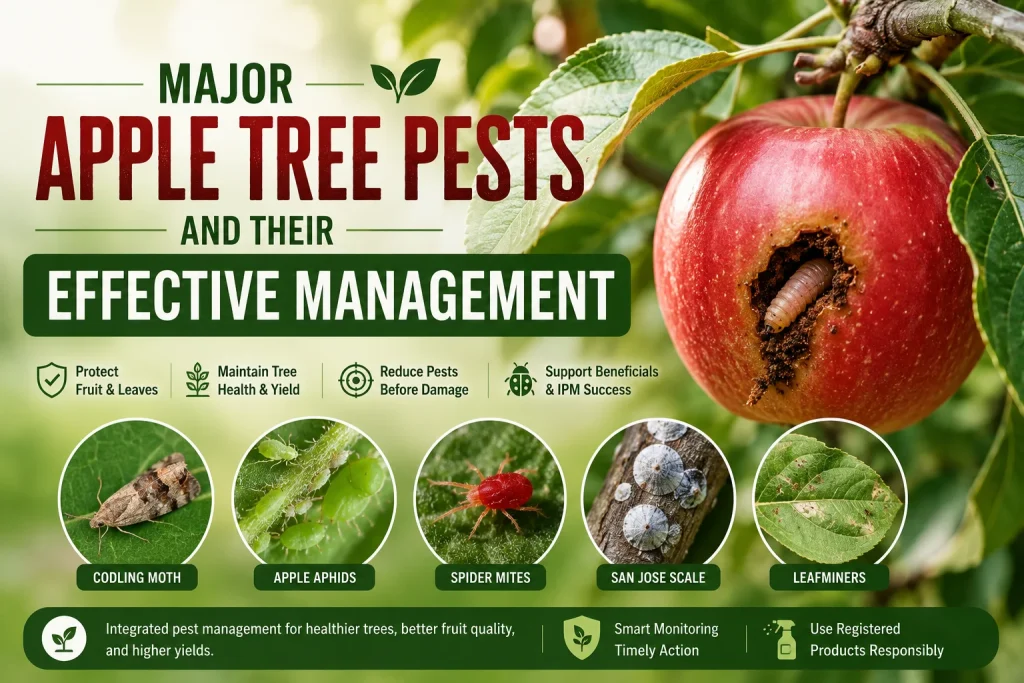
Introduction to Apple Tree Pest Management
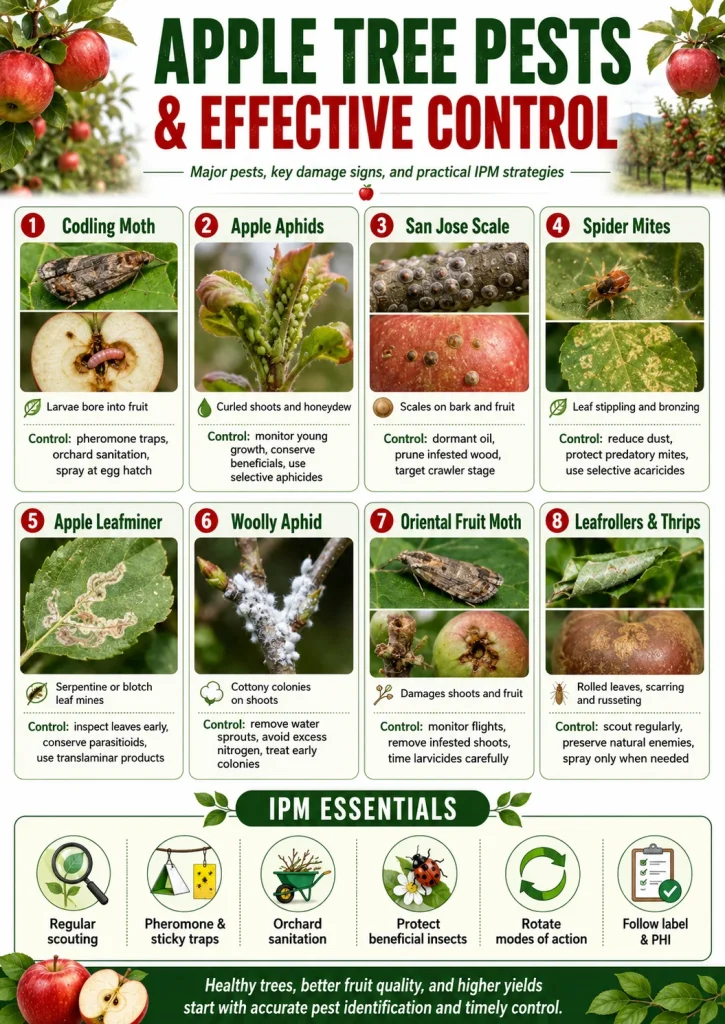
Apple trees are affected by a wide range of insects and mites that can damage leaves, shoots, branches, blossoms, and fruit. Effective apple tree pests management begins with correct identification, regular orchard monitoring, and timely intervention based on pest activity and crop growth stage.
A successful control program should not rely only on pesticide applications. Instead, growers should combine cultural practices, biological control, orchard sanitation, pest monitoring, and carefully selected insecticides or acaricides. This approach is known as integrated pest management in apple orchards, or apple orchard IPM.
The main objectives of apple pest control are to:
- Prevent direct fruit damage
- Protect leaves and young shoots
- Maintain tree health and yield
- Reduce pest populations before they reach damaging levels
- Preserve beneficial insects and natural enemies
- Delay insecticide and acaricide resistance
For chemical control, growers should select registered products according to the target pest, pest life stage, orchard conditions, and local label instructions. Behavaran Zarrin Mozhdeh offers a range of insecticides and acaricides that may be included in professional apple orchard pest-management programs where registration and label recommendations permit.
Why Pest Control Is Important in Apple Orchards
Pest control is essential because even relatively small pest populations can reduce the commercial value of apples. Some pests feed directly inside the fruit, while others weaken trees by removing plant sap or damaging foliage.
Uncontrolled apple insect pests may lead to:
- Worm-damaged or deformed fruit
- Premature fruit drop
- Reduced fruit size and color
- Leaf yellowing and defoliation
- Weak shoot growth
- Lower flower-bud formation
- Reduced yield in the current and following seasons
- Greater susceptibility to environmental stress
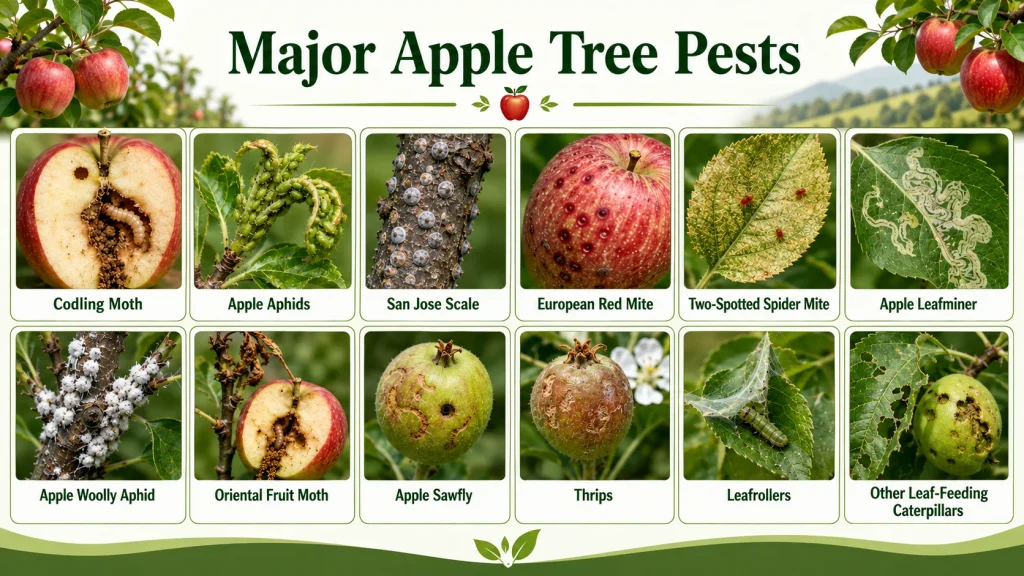
Certain pests, including codling moth and San Jose scale, may cause serious economic losses if they are not detected early. Mites and aphids can also become more severe when natural enemies are disrupted by repeated use of broad-spectrum pesticides.
Therefore, a professional apple orchard pest-management program should include frequent scouting, trap monitoring, inspection of leaves and fruit, and accurate spray timing. Preventive calendar spraying without monitoring may increase production costs, harm beneficial organisms, and accelerate pesticide resistance.
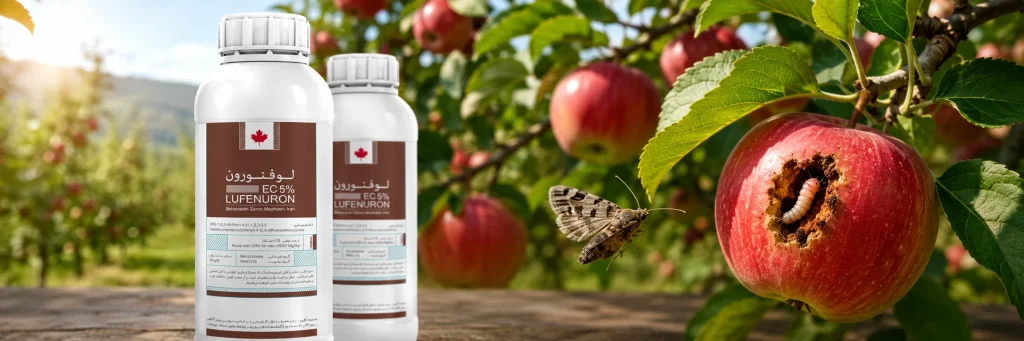
Codling Moth in Apple Trees
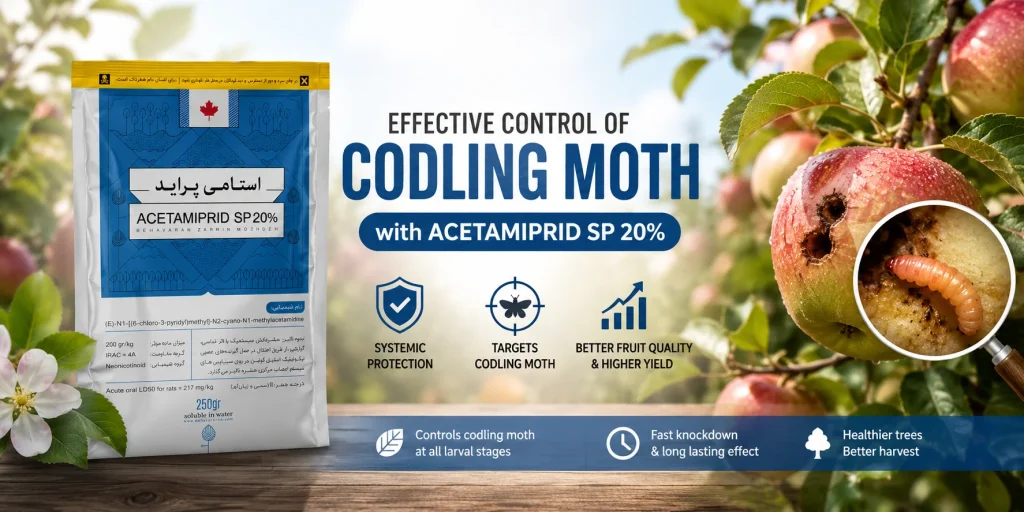
Codling moth is one of the most destructive pests of apple fruit. The larvae enter the apple and feed internally, making the fruit unsuitable for fresh markets and reducing storage quality.
Identification and Damage
Adult codling moths are small and usually active around dusk. After mating, females lay eggs on leaves, twigs, or developing fruit. Newly hatched larvae move to the fruit surface and enter through the calyx, stem end, or side of the apple.
Common signs of codling moth damage include:
- Small entry holes on the fruit
- Brown waste material around the entry point
- Internal feeding tunnels
- Damage around the seed cavity
- Premature fruit drop
Because the larvae become protected once they enter the fruit, codling moth control must target eggs and newly hatched larvae before penetration.
Monitoring and Management
Pheromone traps are commonly used to monitor adult activity and determine the beginning and intensity of moth flights. Orchard managers should also inspect fruit regularly for fresh entry holes.
Integrated management may include:
- Removing and destroying infested fallen fruit
- Cleaning bins and orchard equipment
- Using mating-disruption systems where suitable
- Protecting natural enemies
- Timing insecticide applications according to moth flight and egg hatch
- Rotating insecticides with different modes of action
Behavaran insecticides registered for lepidopteran larvae may be considered in a codling moth management program. Product selection and application timing should always follow the approved label and local agricultural recommendations.
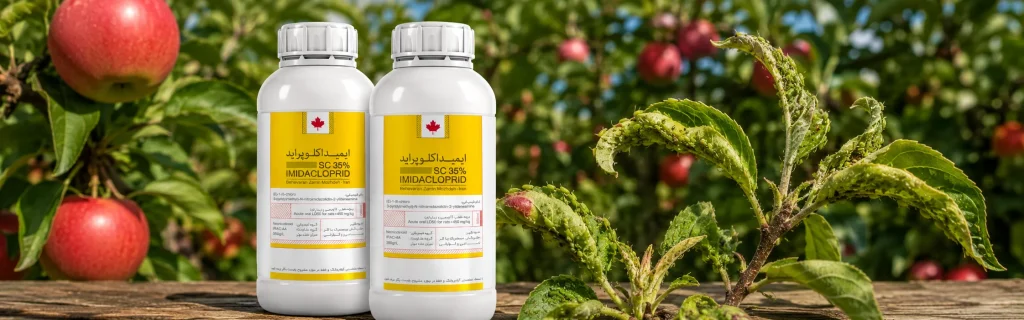
Apple Aphids and Their Damage
Several aphid species may infest apple trees. They usually colonize young leaves, tender shoots, and growing terminals, where they feed by removing plant sap.
Symptoms of Aphid Infestation
Typical symptoms include:
- Curled or distorted leaves
- Sticky honeydew on leaves and fruit
- Black sooty mold growing on honeydew
- Weak or shortened shoots
- Reduced growth in young trees
- Clusters of aphids on leaf undersides
Aphid feeding is especially damaging in nurseries and young orchards because it can interfere with tree establishment and canopy development.
Apple Aphid Control
Regular inspection of new shoots is important during spring and early summer. Aphids should be managed before leaves become tightly curled, because curled foliage can protect colonies from spray coverage.
Management options include:
- Controlling excessive nitrogen fertilization
- Removing heavily infested water sprouts
- Protecting lady beetles, lacewings, hoverflies, and parasitoids
- Avoiding unnecessary broad-spectrum insecticide applications
- Applying a suitable systemic or contact insecticide when populations exceed local thresholds
Behavaran insecticides containing active ingredients effective against sucking pests may be included in an apple aphid control program where registered. Growers should ensure complete canopy coverage and rotate chemical groups to reduce resistance risk.
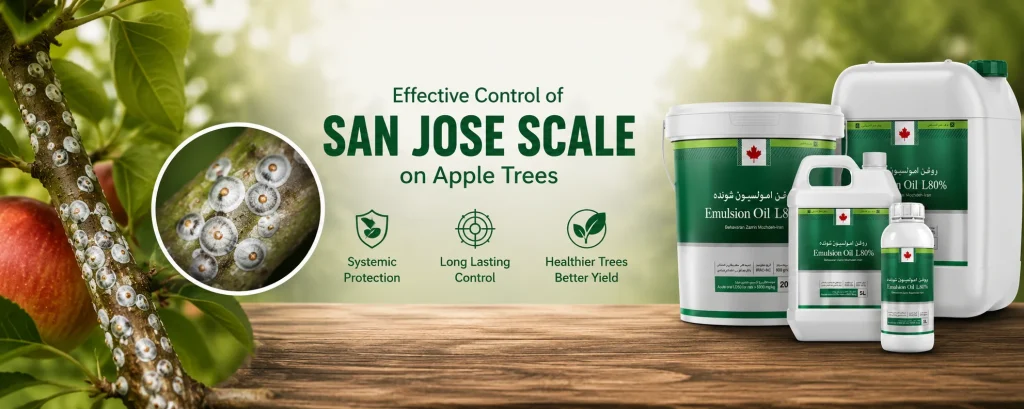
San Jose Scale on Apple Trees
San Jose scale is a serious armored-scale insect that attacks branches, shoots, leaves, and fruit. Heavy infestations may weaken trees and reduce both yield and market quality.
Identification and Damage
The insect is covered by a small, circular protective scale. It can be difficult to detect during early infestation because it blends with the bark.
Symptoms may include:
- Small gray or dark scales on branches
- Red or purple halos around feeding sites on fruit
- Reduced shoot growth
- Dieback of twigs and branches
- Weakening of heavily infested trees
Young mobile stages, called crawlers, are more vulnerable to insecticides than mature scales protected by their waxy covering.
San Jose Scale Management
Management should combine dormant-season and growing-season actions:
- Inspect pruning wood and scaffold branches
- Remove severely infested branches
- Apply horticultural or emulsion oil during the recommended dormant or delayed-dormant stage
- Monitor crawler emergence
- Use a registered insecticide when crawlers are active
- Ensure thorough coverage of bark and branches
Behavaran Emulsion Oil L80% may be considered as part of a dormant-season orchard sanitation and scale-management program where approved. Application concentration, timing, temperature limitations, and compatibility must follow the official label.
European Red Mite and Two-Spotted Spider Mite
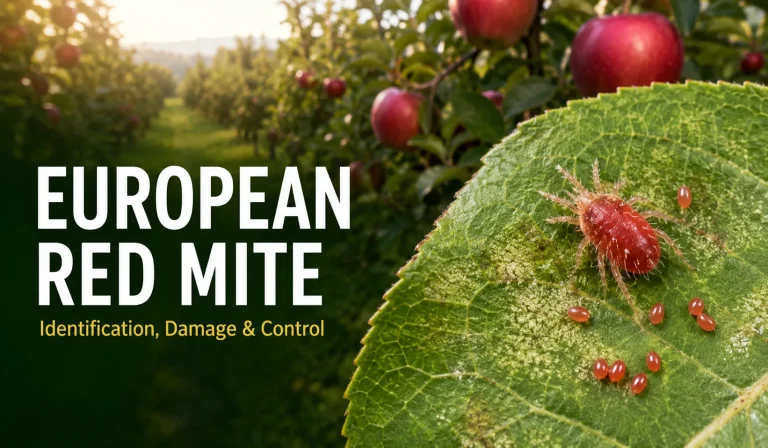
European red mite and two-spotted spider mite are important apple mite pests. They feed on leaf cells and reduce the photosynthetic capacity of the tree.
Symptoms and Damage
Mite injury commonly appears as:
- Fine yellow or bronze stippling on leaves
- General leaf bronzing
- Reduced photosynthesis
- Early leaf drop
- Poor fruit sizing and coloring
- Lower flower-bud development for the following season
Two-spotted spider mites often produce fine webbing when populations are high. European red mite eggs may overwinter on twigs and around buds.
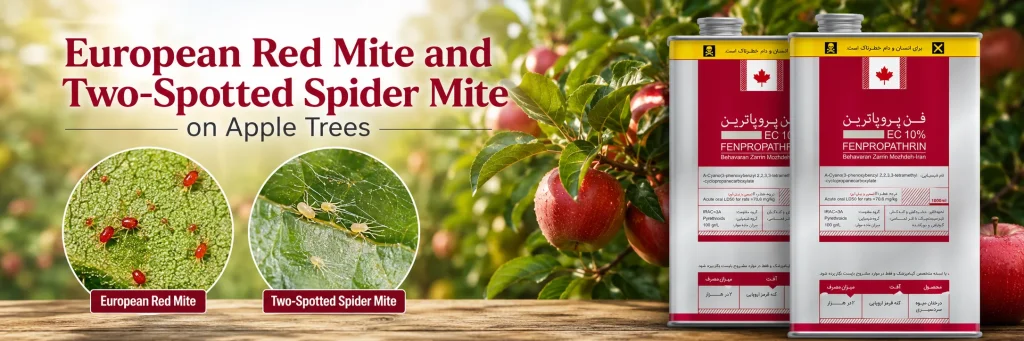
Apple Mite Control
Mite populations should be assessed by examining leaves from different parts of the orchard. Growers should also record the presence of predatory mites, because natural enemies can suppress pest populations.
Management practices include:
- Reducing dust in orchard roads
- Avoiding plant water stress
- Protecting predatory mites
- Avoiding repeated broad-spectrum insecticide applications
- Applying a selective acaricide at the correct mite life stage
- Rotating acaricides with different modes of action
Behavaran acaricides, including products based on active ingredients such as spirodiclofen where registered, may be used in professional apple mite control programs. The selected product should match the dominant mite species and developmental stage.
Apple Leafminer
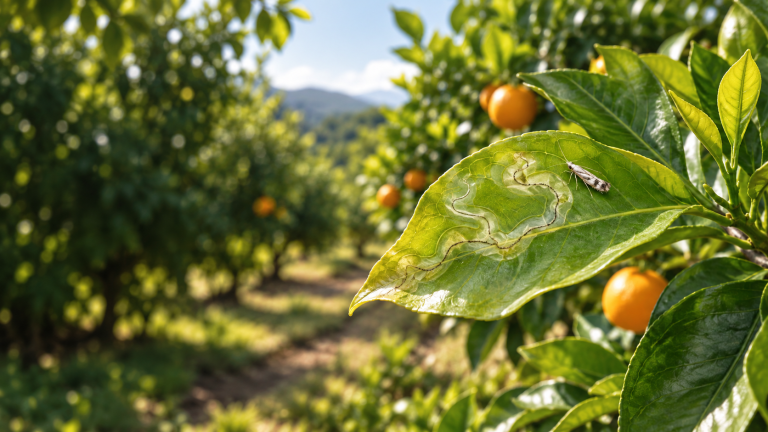
Apple leafminers are small insects whose larvae feed between the upper and lower surfaces of leaves. Their feeding creates visible mines that may reduce leaf efficiency.
Symptoms and Identification
Leafminer damage may appear as:
- Blotch-shaped or winding mines
- Brown areas within the leaf tissue
- Dry or dead patches
- Premature leaf drop under severe infestation
Because the larvae remain protected inside the leaf, early detection is important.
Leafminer Management
Effective management may include:
- Monitoring adult flights with suitable traps
- Inspecting leaves for eggs and young mines
- Conserving parasitoid wasps
- Removing heavily infested leaves in young trees where practical
- Applying a registered insecticide during egg hatch or early larval development
For chemical control, translaminar or systemic insecticides may provide better results than products that remain only on the leaf surface. Behavaran insecticides with appropriate activity against leaf-mining larvae may be included in the management program according to local registration.
Apple Woolly Aphid
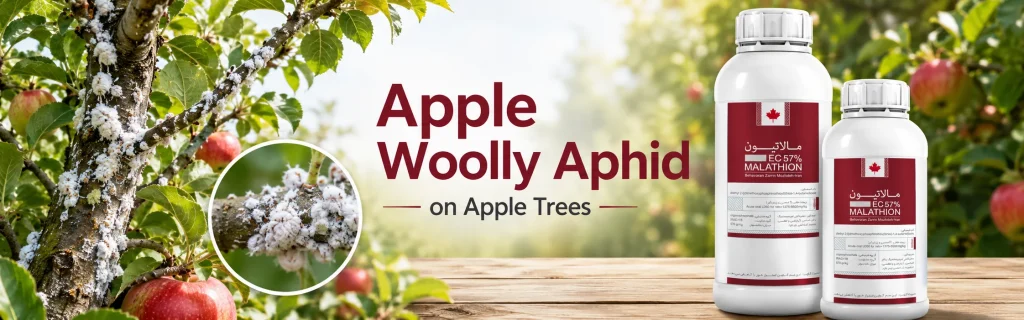
Apple woolly aphid is recognized by the white, cotton-like wax that covers its colonies. It may infest shoots, pruning wounds, branches, and roots.
Damage Caused by Woolly Aphid
Feeding can cause:
- Swollen galls on shoots and roots
- Cracked or weakened bark
- Reduced tree vigor
- Poor growth in young orchards
- Increased vulnerability of damaged tissues
Root colonies are particularly difficult to manage because they are protected below the soil surface.
Management Strategies
Apple woolly aphid management may involve:
- Using tolerant or resistant rootstocks
- Removing water sprouts and heavily infested shoots
- Avoiding excessive nitrogen
- Protecting parasitoids and predators
- Treating exposed colonies before populations spread
- Selecting systemic insecticides where registered
Chemical treatment is usually more effective when colonies are still small and accessible. Complete spray coverage is important because the waxy coating can reduce contact between the insect and the pesticide.
Oriental Fruit Moth
Oriental fruit moth is known mainly as a pest of stone fruits, but it may also attack apple orchards. Larvae can damage young shoots and fruit.
Symptoms and Damage
Typical signs include:
- Wilting or dying shoot tips
- Internal tunneling in young shoots
- Entry holes in fruit
- Feeding near the core
- Premature fruit drop
Damage may sometimes be confused with codling moth injury. Correct pest identification is important before choosing a control strategy.
Oriental Fruit Moth Control
Management may include:
- Monitoring adult moths with pheromone traps
- Removing infested shoots
- Destroying damaged fruit
- Applying mating disruption in suitable orchards
- Timing larvicides before larvae enter shoots or fruit
- Rotating insecticide groups
Behavaran products registered against fruit moth larvae may support an apple orchard IPM program, but treatment timing should be based on moth flight and egg hatch rather than a fixed calendar date.
Apple Sawfly
Apple sawfly larvae attack young fruit shortly after flowering. They may tunnel beneath the fruit skin or move directly toward the core.
Symptoms and Damage
Damage may include:
- Curved scars on the fruit surface
- Small entry holes
- Brown waste around feeding sites
- Internal fruit damage
- Early fruit drop
Because the damaging stage appears soon after flowering, monitoring around bloom and petal fall is important.
Apple Sawfly Management
Recommended practices may include:
- Monitoring adults with white sticky traps
- Inspecting young fruit after petal fall
- Removing infested fruitlets
- Protecting natural enemies
- Applying registered insecticides after pollinator activity has ended and only when necessary
Sprays during bloom should be avoided unless specifically permitted, because of the risk to bees and other pollinators. Any chemical treatment should follow the approved label, local pest thresholds, and pollinator-protection guidance.
Thrips in Apple Orchards
Thrips are tiny insects that may feed on blossoms, young leaves, and developing fruit. Damage is often more noticeable during dry and warm conditions.
Symptoms of Thrips Damage
Common symptoms include:
- Silvery or bronze feeding marks
- Distorted young leaves
- Flower injury
- Russeting or scarring on fruit
- Reduced market quality
Thrips may hide inside flowers and tight plant tissues, making spray timing and coverage especially important.
Thrips Management
Apple orchard managers should inspect blossoms and young fruit clusters during susceptible growth stages.
Management options include:
- Weed management around the orchard
- Avoiding excessive plant stress
- Preserving predatory insects
- Using sticky traps for monitoring
- Applying selective insecticides only when damaging populations are confirmed
Systemic or translaminar insecticides may be useful against hidden thrips populations where registered. Repeated use of the same insecticide group should be avoided because thrips can develop resistance quickly.
Leafrollers and Other Leaf-Feeding Caterpillars
Leafrollers include several moth species whose larvae fold or roll leaves together with silk. Some species also feed on blossoms and the surface of developing fruit.
Symptoms and Damage
Typical damage includes:
- Rolled or webbed leaves
- Chewed leaf margins
- Feeding scars on fruit
- Damage around fruit clusters
- Contamination of harvested fruit
Young larvae are generally easier to control than older caterpillars protected inside rolled leaves.
Management of Leaf-Feeding Caterpillars
Control measures may include:
- Inspecting flower clusters and shoot terminals
- Removing localized rolled leaves
- Conserving parasitoids and predatory insects
- Monitoring adult moths with traps
- Applying selective larvicides against young larvae
- Rotating insecticide modes of action
Behavaran insecticides with activity against lepidopteran larvae may be considered for leafroller control in apple trees where the product is officially registered. Applications should target early larval stages and provide good coverage of the inner canopy and fruit clusters.
Throughout the season, chemical control should remain one part of a broader apple pest-control strategy. Product choice, timing, dosage, pre-harvest interval, protective equipment, and resistance-management requirements must always follow the official pesticide label and local agricultural regulations.
Integrated Pest Management for Apple Orchards
Integrated pest management, or IPM, is the most reliable approach to controlling apple tree pests while reducing unnecessary pesticide use. An effective apple orchard IPM program combines pest identification, regular monitoring, cultural practices, biological control, and carefully timed chemical treatments.
The main purpose of IPM is not to eliminate every insect from the orchard. Instead, it aims to keep pest populations below levels that cause economic damage. This approach protects fruit quality, reduces production costs, preserves beneficial insects, and lowers the risk of pesticide resistance.
A practical IPM program for apple orchards should include:
- Regular inspection of leaves, shoots, blossoms, branches, and fruit
- Use of pheromone, sticky, or visual traps
- Recording pest activity throughout the season
- Identification of beneficial insects and predatory mites
- Removal of infested fruit and plant material
- Application of pesticides only when monitoring indicates a real need
- Selection of products according to the target pest and its life stage
- Rotation of different insecticide and acaricide groups
Monitoring is especially important for pests such as codling moth, Oriental fruit moth, apple sawfly, aphids, mites, leafminers, and San Jose scale. Treatment decisions should be based on pest pressure, orchard history, weather conditions, and local economic thresholds.
Cultural Control Methods for Apple Tree Pests
Cultural control methods make the orchard less suitable for pest development. These practices are an essential part of apple pest control because they can reduce pest populations before chemical treatment becomes necessary.
Orchard Sanitation
Damaged and infested fruit should be collected and removed from the orchard. Fallen apples may contain codling moth or other fruit-feeding larvae and can become a source of future infestation.
Pruned branches affected by scale insects, woolly aphids, or boring pests should also be removed and destroyed where appropriate.
Pruning and Canopy Management
Proper pruning improves light penetration and air movement inside the canopy. It also makes pest monitoring easier and improves spray coverage.
Dense canopies may protect aphids, mites, leafrollers, and scale insects from pesticide contact. Removing water sprouts and crowded branches can reduce these protected feeding sites.
Weed Management
Weeds may serve as alternative hosts for aphids, thrips, mites, and other pests. However, complete removal of all vegetation is not always desirable because flowering groundcover may support beneficial insects.
The best approach is balanced vegetation management that controls pest-host weeds while preserving selected plants that support natural enemies.
Balanced Fertilization
Excessive nitrogen can stimulate soft, succulent growth that attracts aphids and other sucking insects. A balanced fertilizer program helps maintain healthy tree growth without encouraging unnecessary pest development.
Irrigation and Tree Stress Management
Water-stressed trees may become more susceptible to spider mites and other pests. Proper irrigation helps trees tolerate feeding damage and supports healthy fruit development.
Removal of Alternative Hosts
Wild or neglected fruit trees near commercial orchards may harbor codling moth, aphids, scale insects, or fruit moths. Managing these nearby sources may reduce reinfestation.
Biological Control and Protection of Beneficial Insects
Biological control uses natural enemies to suppress apple insect pests and mites. Beneficial organisms can reduce the need for repeated pesticide applications when they are protected as part of an IPM program.
Important natural enemies in apple orchards include:
- Lady beetles that feed on aphids and scale insects
- Lacewing larvae that attack aphids, thrips, and small caterpillars
- Hoverfly larvae that consume aphid colonies
- Parasitoid wasps that attack aphids, leafminers, and caterpillars
- Predatory mites that feed on European red mite and spider mites
- Predatory bugs that attack small insects and mite eggs
- Birds and other predators that feed on caterpillars
To protect beneficial insects, growers should avoid unnecessary pesticide applications and select the most targeted product available. Broad-spectrum insecticides may rapidly reduce a pest population, but they can also eliminate natural enemies and create secondary outbreaks of mites or aphids.
Spraying should be avoided during periods of intense pollinator activity. When treatment is necessary, applications should normally be made after bee activity has decreased and only according to the official product label.
Flowering plants around orchards may provide nectar and pollen for adult parasitoids and predators. However, these plants should be managed carefully if they also host important pests.
Chemical Control of Major Apple Tree Pests
Chemical control remains an important part of professional apple orchard pest management, particularly when pest populations exceed economic thresholds or threaten fruit quality.
Successful chemical control depends on five main factors:
Correct Pest Identification
The product must be suitable for the actual pest. For example, an acaricide intended for mites should not be expected to control codling moth larvae, while a caterpillar insecticide may provide little control of scale insects or aphids.
Correct Pest Stage
Many pesticides are most effective against a particular life stage. Codling moth insecticides should generally target eggs or newly hatched larvae before they enter the fruit. Scale treatments are often most effective against crawlers, and some acaricides perform best against eggs or immature mites.
Correct Application Timing
Sprays should be timed according to monitoring information, pest development, tree growth stage, and weather conditions. Calendar-based applications without scouting may lead to poor results and unnecessary residues.
Good Spray Coverage
Leaves, fruit clusters, shoots, branches, and the inner canopy should receive adequate coverage. Coverage is particularly important when controlling scale insects, woolly aphids, leafrollers, mites, and other pests protected within the canopy.
Appropriate Mode of Action
The selected pesticide may act through contact, ingestion, systemic movement, or translaminar activity. The most appropriate type depends on where the pest is feeding and how well it is protected.
Growers must only use products that are registered for apple trees and the target pest in their country. Label dosage, application limits, protective equipment, compatibility, and pre-harvest interval must always be followed.
Recommended Behavaran Insecticides and Acaricides for Apple Orchards
Behavaran Zarrin Mozhdeh offers different insecticide and acaricide active ingredients that may support professional apple tree pest management programs, subject to local registration and label approval.
Potential product categories include:
| Major Apple Pest | Effective Insecticides or Acaricides |
|---|---|
| 1. Codling Moth | Lufenuron Behavaran-EC5%-1000ml |
| 2. Apple Aphids | Malathion-Imidacloprid Behavaran- 500 ml |
| 3. San Jose Scale | Malathion-EC57%-1000-500ml-OIL-L80% |
| 4. European Red Mite | Fenpropathrin Behavaran-EC10%-1000ml |
| 5. Two-Spotted Spider Mite | Fenpropathrin Behavaran-EC10%-1000ml |
| 6. Apple Leafminer | Cyromazine-WP75%-250ml |
| 7. Apple Woolly Aphid | Imidacloprid Behavaran |
| 8. Oriental Fruit Moth | Lufenuron and Acetamiprid Behavaran |
| 9. Apple Sawfly | |
| 10. Thrips | Malathion-Imidacloprid Behavaran- 500 ml |
| 11. Leafrollers | Malathion-Imidacloprid Behavaran- 500 ml |
| 12. Other Leaf-Feeding Caterpillars | Lufenuron and Acetamiprid Behavaran |
Behavaran Products for Aphids and Sucking Pests
Systemic or translaminar insecticides may be suitable for aphids, woolly aphids, leafhoppers, thrips, and certain other sucking pests.
Depending on local registration, Behavaran products based on active ingredients such as imidacloprid, dinotefuran, pymetrozine, or other sucking-pest insecticides may be considered.
These products should be selected according to:
- Pest species
- Infestation level
- Location of the colony
- Presence of flowers and pollinators
- Resistance history
- Permitted application period
Behavaran Products for Mites
Behavaran acaricides may include products based on active ingredients such as spirodiclofen, hexythiazox, etoxazole, propargite, bromopropylate, or other mite-control compounds.
Different acaricides may target:
- Mite eggs
- Larvae and nymphs
- Mobile adult stages
- Multiple developmental stages
Therefore, mite identification and population assessment should be completed before selecting a product.
Behavaran Products for Caterpillars and Fruit Moths
Products effective against lepidopteran larvae may be considered for codling moth, Oriental fruit moth, leafrollers, and other caterpillar pests where registered.
Chemical treatment should target young larvae before they enter fruit, shoots, or folded leaves.
Behavaran Products for Scale Insects
Dormant-season emulsion oil may help suppress overwintering scale insects, mite eggs, and certain other orchard pests. Behavaran Emulsion Oil L80% may be included in a dormant or delayed-dormant program where approved.
For growing-season scale management, treatments should generally target the crawler stage using an appropriate registered insecticide.
Product recommendations should never be based only on the active ingredient name. The formulation, concentration, approved crop, target pest, maximum number of applications, and local label instructions must also be checked.
Choosing the Right Behavaran Product for Each Apple Pest
The correct Behavaran product should be selected according to the target pest, pest life stage, orchard conditions, and treatment objective.
| Apple pest | Main treatment target | Suitable product category |
| Codling moth | Eggs and newly hatched larvae | Registered larvicide for fruit moths |
| Apple aphids | Colonies on young leaves and shoots | Systemic or translaminar aphicide |
| Woolly aphid | Young exposed colonies | Registered systemic insecticide |
| San Jose scale | Overwintering stages or crawlers | Emulsion oil or crawler insecticide |
| European red mite | Eggs, nymphs, or mobile mites | Stage-specific acaricide |
| Two-spotted spider mite | Developing and mobile stages | Registered acaricide |
| Apple leafminer | Eggs and early larvae | Translaminar or systemic insecticide |
| Oriental fruit moth | Newly hatched larvae | Registered moth larvicide |
| Apple sawfly | Young larvae after bloom | Registered insecticide timed after petal fall |
| Thrips | Adults and immature stages | Selective systemic or translaminar product |
| Leafrollers | Young exposed caterpillars | Registered larvicide |
Before recommending a Behavaran product, the orchard manager should ask:
- Which pest species is present?
- What life stage is currently active?
- Is the pest exposed or protected inside plant tissue?
- Are bees or other pollinators active?
- How close is the orchard to harvest?
- Which insecticide groups were used previously?
- Are predatory mites or other beneficial insects present?
- Is the product registered for apples and the target pest?
This decision-making process improves control and reduces unnecessary pesticide use.
Resistance Management and Rotation of Insecticides
Repeated use of the same insecticide or acaricide group can select resistant pest populations. Resistance may eventually cause poor control even when the product is applied correctly.
Resistance management is especially important for:
- Codling moth
- Aphids
- Thrips
- Spider mites
- European red mite
- Leafminers
- Leafrollers
Growers should rotate products according to their mode-of-action classification rather than simply changing brand names. Two products with different commercial names may still contain active ingredients from the same resistance group.
An effective rotation program should include:
- Avoiding repeated consecutive use of the same mode of action
- Limiting the number of applications per season
- Using the full registered dose
- Avoiding unnecessary low-dose treatments
- Treating pests at their most vulnerable stage
- Combining chemical control with sanitation and biological control
- Preserving natural enemies
- Keeping accurate spray records
Tank mixing two products does not automatically prevent resistance. Both products must be appropriate for the target pest, permitted by their labels, physically compatible, and used at effective rates.
Best Time to Spray Apple Trees for Pest Control
The best spraying time depends on the target pest and its life cycle. There is no single calendar date suitable for all apple tree pests.
Dormant and Delayed-Dormant Period
Dormant or delayed-dormant applications may help manage:
- Overwintering scale insects
- Mite eggs
- Certain aphid eggs
- Other pests present on bark and branches
Emulsion oil treatments must be applied under suitable weather conditions and according to label restrictions.
Green Tip to Pre-Bloom
This stage is useful for monitoring early aphid activity, mites, and scale insects. Chemical treatment should be applied only when necessary and with particular attention to upcoming bloom.
Bloom Period
Insecticide applications during bloom should generally be avoided because of risks to bees and other pollinators. Treatments should only be made when specifically permitted and when pollinator exposure can be prevented.
Petal Fall
Petal fall is an important timing period for several pests, including apple sawfly, early caterpillars, aphids, and certain fruit moths. Monitoring results should determine whether treatment is needed.
Fruit Development
During fruit development, growers should monitor codling moth flights, leafrollers, aphids, mites, leafminers, and scale crawlers. Sprays should be timed against the vulnerable stage rather than after severe damage becomes visible.
Pre-Harvest Period
Close to harvest, growers must carefully check the product’s pre-harvest interval. Only products permitted for late-season use should be applied.
Applications are usually most effective when:
- Wind speed is low
- Rain is not expected immediately after spraying
- Temperatures are within the label’s recommended range
- The tree is not under severe drought stress
- Spray coverage can be achieved
- Bees and other beneficial insects are not actively foraging
Safety, Pre-Harvest Interval and Responsible Pesticide Use
Responsible pesticide use protects growers, consumers, orchard workers, beneficial organisms, and the environment.
Follow the Official Label
The pesticide label is the primary legal and technical guide for application. Growers must follow instructions regarding:
- Approved crop and target pest
- Application rate
- Water volume
- Maximum number of treatments
- Application interval
- Required protective equipment
- Re-entry interval
- Pre-harvest interval
- Environmental restrictions
- Storage and disposal
Observe the Pre-Harvest Interval
The pre-harvest interval, or PHI, is the minimum time that must pass between the final pesticide application and harvest.
PHI requirements vary according to:
- Active ingredient
- Formulation
- Application rate
- Crop registration
- National regulations
A pesticide should never be applied closer to harvest than permitted by its label.
Use Personal Protective Equipment
Applicators should wear the protective equipment specified on the label, which may include gloves, protective clothing, boots, eye protection, and respiratory protection.
Prevent Spray Drift
Spraying should be stopped when wind conditions could carry droplets toward people, water sources, neighboring crops, livestock, or sensitive habitats.
Protect Water and Soil
Pesticides should not be mixed, washed, or disposed of near wells, streams, irrigation channels, or other water sources. Empty containers must be managed according to local regulations.
Store Products Safely
Pesticides should remain in their original containers with intact labels. They must be stored in a secure, dry, ventilated location away from food, animal feed, children, and unauthorized persons.
Keep Spray Records
Professional orchard managers should record:
- Date of application
- Orchard block
- Target pest
- Product and active ingredient
- Application rate
- Weather conditions
- Operator name
- Pre-harvest interval
- Observed treatment result
Accurate records support traceability, resistance management, food-safety programs, and future pest-control decisions.
Behavaran insecticides and acaricides should be used only according to their approved labels and under the guidance of qualified local agricultural specialists. A responsible apple orchard pest-management program combines effective pest control with protection of human health, beneficial insects, fruit quality, and the surrounding environment.