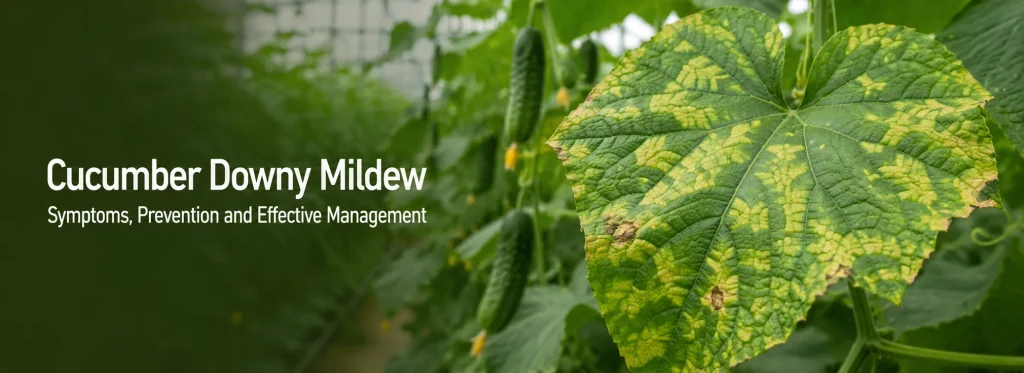
Cucumber downy mildew is one of the most damaging foliar diseases affecting field-grown and greenhouse cucumbers. The disease can develop rapidly under cool, humid conditions and cause extensive leaf damage, reduced photosynthesis and significant yield loss.
Recognizing the early symptoms, monitoring environmental conditions and combining preventive practices with an appropriate fungicide program are essential for effective cucumber downy mildew control. Copper-based products such as Behavaran Bordeaux SC20% and Behavaran Copper Oxychloride 35% WP may be incorporated into preventive disease-management programs where their use is permitted by the product label and local regulations.
What Is Cucumber Downy Mildew?
Cucumber downy mildew is a destructive disease of cucumbers and other plants belonging to the cucurbit family. It primarily affects leaves rather than fruits, stems or roots. However, severe leaf damage reduces the plant’s ability to perform photosynthesis, which can weaken the crop and negatively affect fruit development, quality and yield.
The disease occurs in both open fields and protected cultivation systems. It can be particularly problematic in greenhouses and plastic-covered production areas where high relative humidity and prolonged leaf wetness create favourable conditions for infection.
Although resistant cucumber varieties are available, many commercial cultivars do not provide complete protection. For this reason, effective management usually requires a combination of resistant varieties, regular crop monitoring, cultural practices and properly selected fungicides.
What Causes Downy Mildew in Cucumbers?
Cucumber downy mildew is caused by Pseudoperonospora cubensis. Although it is commonly discussed alongside fungal diseases, this pathogen is an oomycete, also known as a fungus-like organism.
Pseudoperonospora cubensis infects numerous members of the cucurbit family. Its major hosts include:
- Cucumber
- Melon
- Pumpkin
- Squash
- Cantaloupe
- Watermelon
The disease is generally more severe on cucumber and melon. The pathogen produces spores that can be carried by air currents from infected crops to healthy plants, sometimes over considerable distances.
Symptoms of Cucumber Downy Mildew
Correct identification is important because the symptoms of downy mildew may initially be confused with nutrient deficiencies, bacterial diseases or other cucumber leaf diseases.
Early Symptoms on Cucumber Leaves
The first visible signs usually appear as pale-green or yellow lesions on the upper surface of cucumber leaves. These lesions gradually develop a characteristic angular shape because their expansion is restricted by the leaf veins.
Typical early symptoms include:
- Pale-green or yellow areas on the upper leaf surface
- Angular lesions located between the veins
- Irregular yellowing that gradually becomes more noticeable
- Greyish or purplish growth on the underside of infected areas under humid conditions
Examining both sides of the leaf can help with diagnosis. During periods of high humidity, the lower leaf surface may display a grey to purple, downy growth directly beneath the yellow lesions.
Symptoms at Advanced Stages
As the infection progresses, the yellow lesions become brown and necrotic. Individual spots may merge, covering large portions of the leaf.
Advanced cucumber downy mildew symptoms include:
- Browning and drying of infected lesions
- Coalescence of multiple angular spots
- Extensive leaf blight
- Premature drying and loss of foliage
- Reduced plant vigour and photosynthetic capacity
- Lower fruit quality and crop productivity
Severely affected leaves may become completely dry and collapse. Rapid loss of foliage can also expose developing fruits to excessive sunlight and environmental stress.
Disease Cycle and How the Pathogen Spreads
Cucumber downy mildew is a polycyclic disease, meaning the pathogen can produce several infection cycles during a single growing season.
Primary infection begins when airborne spores reach susceptible cucumber leaves. Under favourable conditions, these spores germinate and enter the leaf tissue. The pathogen then grows within the plant and produces new spores on the underside of infected leaves.
These secondary spores are dispersed by air currents and can infect neighbouring plants, creating repeated disease cycles. As a result, a small number of infected plants can become the source of a rapidly expanding outbreak.
The pathogen may survive unfavourable periods in living host plants and, under certain conditions, through persistent structures. In many production regions, long-distance movement of airborne spores plays an important role in the introduction of the disease.
Environmental Conditions Favouring Disease Development
Moisture is one of the most important factors in the development of downy mildew in greenhouse cucumbers. The pathogen requires moisture on the leaf surface for successful spore germination and infection.
Disease development is favoured by:
- High relative humidity
- Prolonged leaf wetness
- Cool to moderate temperatures
- Poor air circulation
- Dense planting
- Excessive canopy growth
- Irrigation practices that keep foliage wet
- Condensation inside greenhouses
Infection can occur rapidly at temperatures close to 15°C when leaves remain wet for at least a few hours. Spores may also germinate over a wider temperature range, but longer periods of leaf wetness are usually required.
Greenhouses should therefore be monitored for condensation, poor ventilation and extended periods of high humidity, especially during the night and early morning.
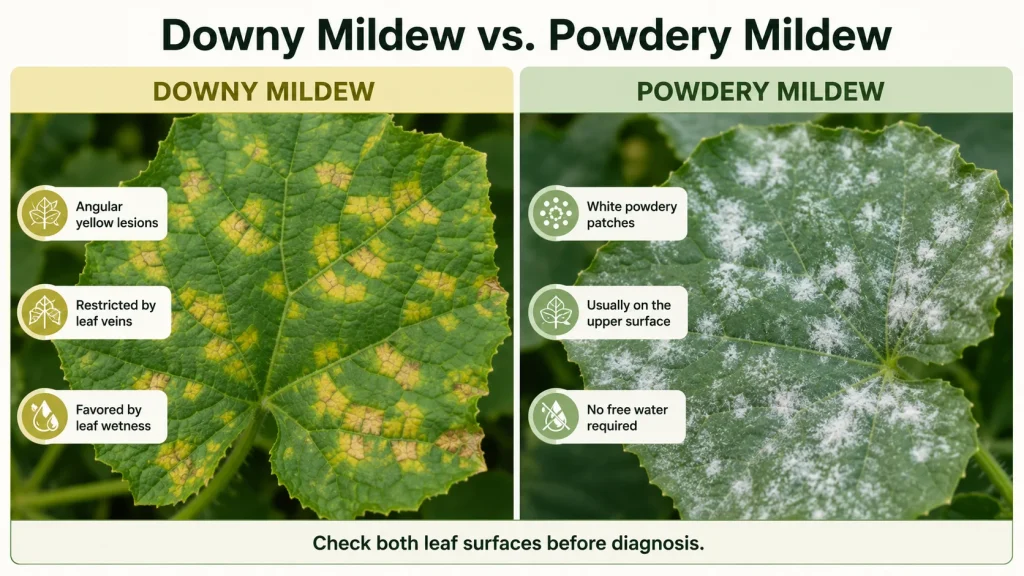
How to Distinguish Downy Mildew from Powdery Mildew
Downy mildew and powdery mildew are different diseases and require accurate diagnosis.
| Characteristic | Downy mildew | Powdery mildew |
|---|---|---|
| Upper leaf surface | Angular yellow lesions | White, powdery patches |
| Lower leaf surface | Grey or purple downy growth | White powder may appear on either side |
| Lesion shape | Usually restricted by leaf veins | Generally circular or irregular |
| Moisture requirement | Favoured by high humidity and leaf wetness | Can develop without free water |
| Main pathogen | Pseudoperonospora cubensis | Several true fungal pathogens |
The appearance of angular yellow lesions between the veins is one of the most useful characteristics for identifying cucumber downy mildew.
Integrated Management of Cucumber Downy Mildew
An effective cucumber disease management program should not depend on a single method. Integrated management combines preventive, cultural and chemical measures to reduce disease pressure and slow the development of fungicide resistance.
Cultural and Preventive Practices
Recommended preventive practices include:
- Selecting resistant or tolerant cucumber varieties when available
- Inspecting plants regularly for early symptoms
- Removing heavily infected plant material where appropriate
- Maintaining adequate spacing between plants and rows
- Avoiding excessive nitrogen fertilization
- Controlling volunteer cucurbit plants and alternative hosts
- Keeping production areas clean
- Monitoring disease forecasts and regional outbreak reports
Weekly crop inspection is especially important. During high-risk periods, plants may need to be examined more frequently so that the first angular lesions are detected before the disease spreads extensively.
Greenhouse Humidity and Irrigation Management
Proper greenhouse management can significantly reduce conditions favourable to infection.
Growers should:
- Provide adequate ventilation between and above crop rows
- Avoid excessive plant density
- Reduce prolonged condensation on leaves
- Irrigate at a time that allows foliage to dry
- Avoid late irrigation that leaves plants wet overnight
- Improve air circulation throughout the canopy
- Repair leaks and manage areas with persistent moisture
Irrigation scheduling should be based on crop requirements, greenhouse conditions and the selected production system. The main objective is to prevent unnecessary and prolonged leaf wetness.
Fungicides for Cucumber Downy Mildew Control
Fungicides may be necessary when environmental conditions favour disease development, particularly in areas with a history of severe outbreaks. However, product selection should be based on disease stage, crop conditions, registered uses and resistance-management principles.
Protectant fungicides are generally applied before infection or during the early stages of disease development. Products with curative or limited systemic activity may be considered after the first symptoms appear, provided they are registered for the crop and disease.
Preventive and Copper-Based Fungicides
Copper fungicides have long been used as protectant products in programs for managing cucurbit downy mildew. They act primarily on the plant surface and help reduce successful infection when applied preventively and with adequate coverage.
Copper-based products may be most useful when:
- Applied as part of a preventive program
- Used before severe disease development
- Combined with cultural and environmental management
- Rotated or integrated with other registered fungicide groups
- Applied strictly according to the approved label
Under conditions highly favourable to an epidemic, copper fungicides alone may not provide sufficient control. In such situations, an integrated program involving other registered fungicide groups may be required.
Fungicide Rotation and Resistance Management
Repeated use of fungicides with the same mode of action can select resistant pathogen populations. To reduce this risk:
- Rotate fungicides with different FRAC groups
- Avoid repeated applications of a single active ingredient
- Include multi-site protectant fungicides where appropriate
- Follow restrictions on the number of permitted applications
- Use the recommended application interval on the product label
- Combine chemical control with non-chemical practices
A resistance-management program should be planned before disease pressure becomes severe.
Behavaran Fungicides for Cucumber Downy Mildew
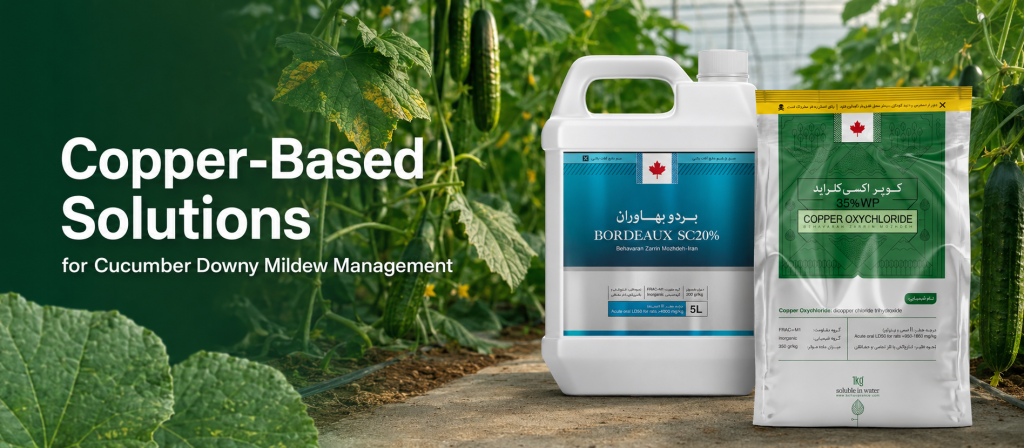
Behavaran Zarrin Mozhdeh supplies copper-based fungicides that may be considered within an integrated program for cucumber downy mildew management, subject to the registration status, approved label and local agricultural recommendations.
Behavaran Copper Oxychloride 35% WP
Behavaran Copper Oxychloride 35% WP is a copper-based, contact and protective fungicide. It belongs to the multi-site FRAC M1 group and is designed to remain on plant surfaces, helping protect healthy tissues from infection.
Its multi-site mode of action makes copper oxychloride a useful component of resistance-management programs. Unlike site-specific fungicides, copper compounds affect several biological processes in susceptible pathogens, which generally reduces the risk of resistance development.
Potential benefits within a disease-management program include:
- Protective contact activity
- Multi-site mode of action
- Suitability for preventive programs
- Compatibility with integrated disease-management strategies
- Support for fungicide resistance management
For the best preventive performance, uniform coverage of susceptible leaf surfaces is important. The product must only be used on crops and diseases listed on its approved label.
Behavaran Bordeaux SC20%
Behavaran Bordeaux SC20% is a copper-based protective fungicide formulated as a suspension concentrate. Bordeaux compounds have traditionally been used for the preventive management of several plant diseases, including downy mildews.
The product acts mainly as a contact protectant, creating a copper-based protective deposit on treated plant surfaces. It should therefore be considered primarily for disease prevention or early intervention rather than recovery of severely damaged leaves.
Important characteristics include:
- Copper-based protective activity
- Multi-site FRAC M1 classification
- Contact action on treated plant surfaces
- A role in preventive disease-management programs
- Potential integration with other cultural and chemical practices
Application timing, crop safety, compatibility and environmental conditions should always be evaluated according to the official product label and guidance from qualified local specialists.
Safe and Responsible Use of Copper Fungicides
Copper fungicides must be handled responsibly. Excessive or unnecessary applications may increase the risk of crop injury and copper accumulation in soil.
Before using any plant-protection product:
- Read and follow the complete product label
- Use suitable personal protective equipment
- Observe the approved application rate and interval
- Follow the stated pre-harvest interval
- Avoid drift to neighbouring crops and water sources
- Do not apply under unsuitable weather conditions
- Check compatibility before preparing tank mixtures
- Keep products in their original packaging and away from children
Registration status and approved uses may differ between countries. Always follow local regulations and professional agricultural recommendations.
Frequently Asked Questions About Cucumber Downy Mildew
Can cucumber plants recover from downy mildew?
Existing necrotic leaf tissue cannot recover. However, early detection and an effective management program may help protect healthy foliage and slow further disease development.
What are the first symptoms of cucumber downy mildew?
The earliest symptoms are usually pale-green or yellow angular lesions on the upper leaf surface. Under humid conditions, greyish or purple downy growth may appear beneath these lesions.
What conditions favour cucumber downy mildew?
High relative humidity, cool to moderate temperatures and prolonged leaf wetness favour infection and disease development. Poor greenhouse ventilation and condensation can significantly increase disease risk.
Can copper fungicides control cucumber downy mildew?
Copper fungicides can contribute to preventive management, particularly when disease pressure is low to moderate. They should be combined with crop monitoring, humidity management and other registered fungicides when required.
What is the best fungicide for cucumber downy mildew?
There is no single product suitable for every situation. The most effective program depends on disease severity, environmental conditions, local registrations and pathogen sensitivity. Alternating approved fungicides from different FRAC groups is generally more reliable than repeated use of one product.
Conclusion
Cucumber downy mildew can spread rapidly and cause serious foliage and yield losses when cool, humid conditions prevail. Early identification of angular yellow leaf lesions, regular crop monitoring and careful management of greenhouse humidity are essential for reducing disease development.
Copper-based fungicides such as Behavaran Copper Oxychloride 35% WP and Behavaran Bordeaux SC20% may contribute to preventive cucumber downy mildew control as part of an integrated management program. Product selection and application must always follow the approved label, local regulations and professional agricultural advice.