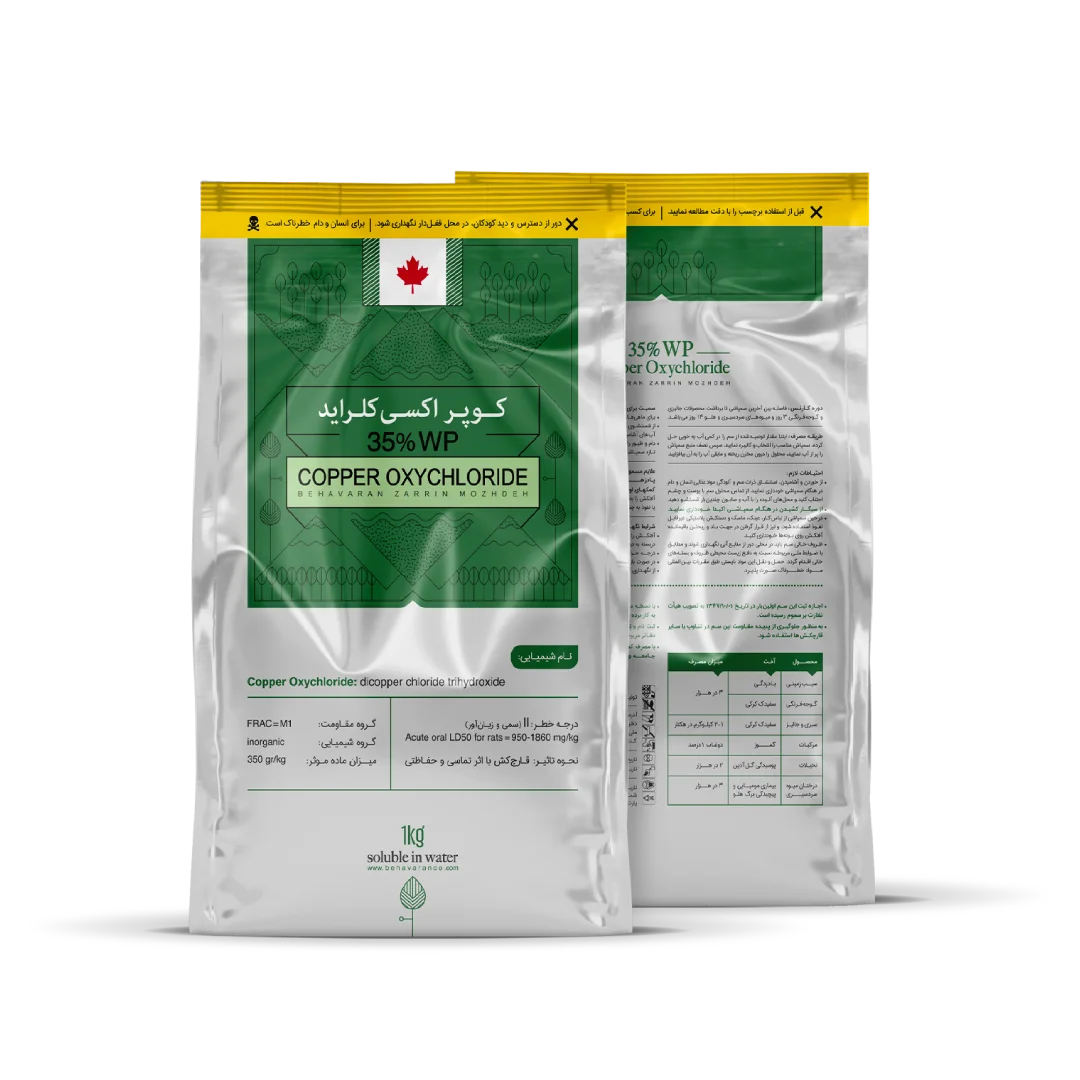
Copper Oxychloride fungicide by Behavaran is a broad-spectrum protective fungicide and bactericide for fruit trees, vegetables, citrus and other crops.
Copper Oxychloride Behavaran is a broad-spectrum protective fungicide and bactericide used for the management of a wide range of fungal and bacterial plant diseases.
It is particularly suitable for disease-management programs in fruit trees, citrus, vegetables, cucurbits, potatoes, tomatoes and other crops, depending on local registration and label recommendations.
Copper Oxychloride acts mainly as a contact protectant, remaining on treated plant surfaces and helping prevent infection before pathogens penetrate plant tissues.
1000 g
Copper Oxychloride is an inorganic copper fungicide and bactericide with multi-site activity.
After application, copper ions are gradually released on the plant surface. These copper ions interfere with several essential processes in fungal and bacterial cells, including:
Because Copper Oxychloride acts at multiple biochemical sites, it is widely used as a protective treatment in integrated disease-management programs.
Its primary activity is contact and preventive, rather than systemic.
Copper Oxychloride fungicide offers several advantages in crop protection:
Copper Oxychloride is widely used in fruit-tree disease management because of its protective activity against several fungal and bacterial pathogens.
Depending on registration, it may be used against diseases including:
Preventive application before periods of high disease pressure is generally more effective than waiting until severe infection develops.
Copper Oxychloride can be used in preventive programs against peach leaf curl and other diseases of stone fruit trees.
Dormant or early-season applications are commonly used as part of preventive management, depending on local recommendations and the crop growth stage.
Good spray coverage is important because Copper Oxychloride acts mainly on the plant surface.
The product may also be used in disease-management programs for citrus and pistachio gummosis, depending on local registration.
Copper-based fungicides are often included in preventive disease-management strategies where Phytophthora and other susceptible pathogens are a concern.
For root, crown or trunk diseases, application method and timing should follow crop-specific recommendations.
Copper Oxychloride can be used in disease-management programs for vegetables and cucurbits against diseases such as:
Because the product acts protectively, applications should generally be made before severe infection becomes established.
Copper Oxychloride may be used as part of a disease-management program against potato and tomato late blight where permitted by local registration.
Repeated applications may be required under favorable disease conditions, but application frequency and rate should always follow the approved product label.
According to the supplied product information, Copper Oxychloride may be included in a four-stage preventive spray program for fruit trees:
The exact timing should be adjusted according to crop, disease pressure, climate and local recommendations.
Before tank-mixing Copper Oxychloride with other pesticides or fertilizers, a compatibility test is recommended.
Do not mix with products known to be incompatible with copper compounds unless the label specifically permits the combination.
Water quality, pH and formulation type may also affect compatibility.
A specific pre-harvest interval (PHI) has not been provided in the available product information.
This should not be interpreted as meaning that no PHI is required.
Always follow the approved local label and registration requirements for each crop.
Copper Oxychloride has a multi-site mode of action, which generally gives it a lower resistance risk than many single-site fungicides.
However, good resistance-management practice still includes:
| Product | Diseases | Consumption rate |
|---|---|---|
| Fruit trees | canker and shot | 1-3 kg per 1000 L |
| Potato | late blight | 3 kg per 1000 L |
| Tomato | downy mildew | 3 kg per 1000 L |
| Palms | inflorescence rot | 3 kg per 1000 L |
| Packaging | 1000gr |
|---|---|
| Formulation | WP35% |
| Resistance group | FRAC=M1 |
| Chemical group | Inorganic |
| Amount of active ingredient | 350gr/Kg |