Weight

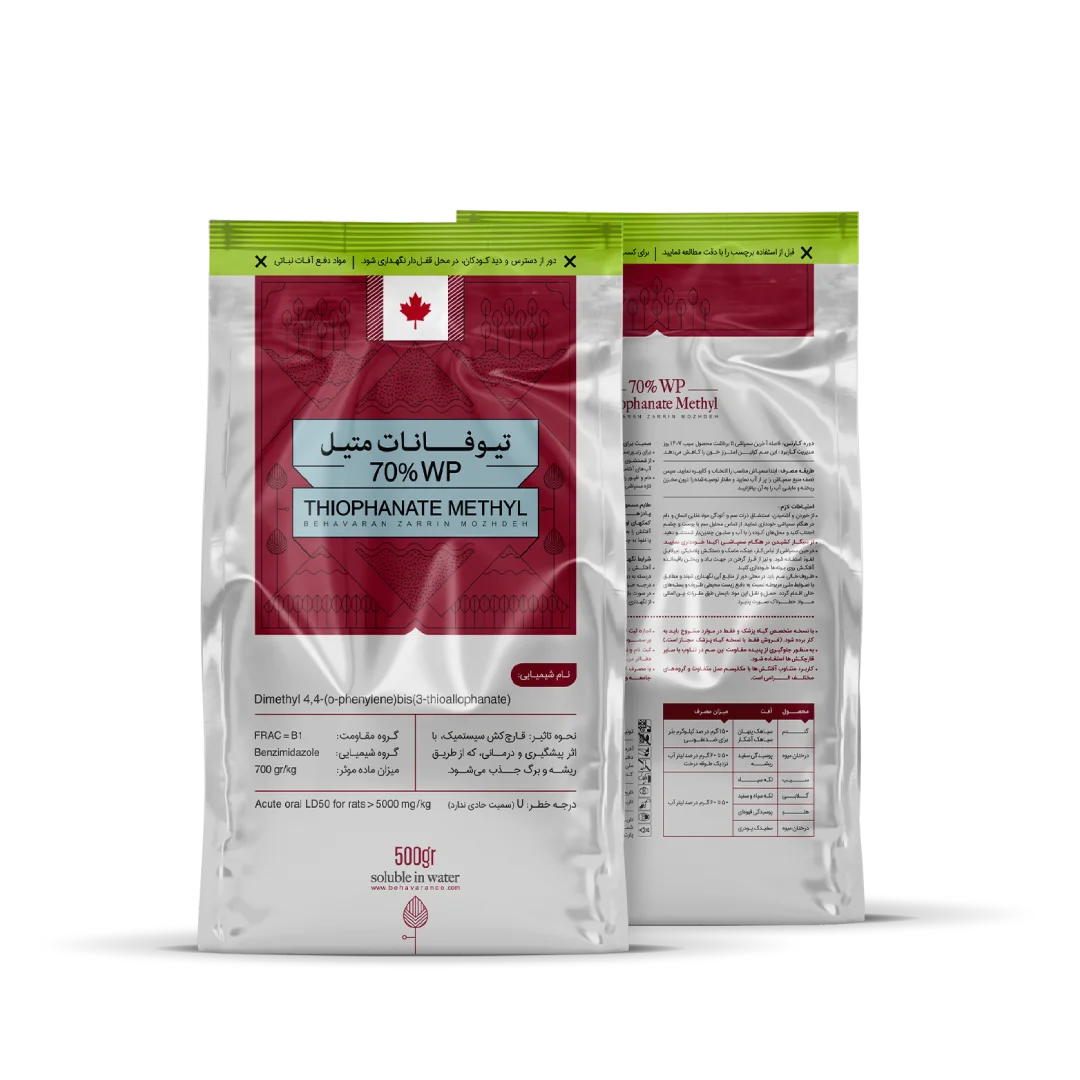
500gr

Behavaran

Resistance group: FRAC=B1
WP70%

Thiophanate Methyl

WP70%

Thiophanate Methyl

Thiophanate Methyl 70% WP (Topsin M) – systemic fungicide for wheat smut, fruit tree root rots, black spot on apple/pear. Protective & curative action. 1kg packaging.

500 gr package
  • Thiophanate Methyl (Topsin M) Behavaran
  • Systemic fungicide with protective and curative action, absorbed through roots and leaves. Effective against wheat smut, white root rot, Armillaria root rot in fruit trees, black spot on apple and pear, and powdery mildew on fruit trees.

Mode of Action

  • Systemic fungicide with protective and curative properties from the thiophanate family. Low toxicity to mammals but mutagenic and irritant. Inhibits β-tubulin biosynthesis, disrupting fungal mitosis and cell division.

Uses

  • Internationally used for eye spot, scab, powdery mildew, gray mold, leaf spots, rusts, brown spots, and root rots on fruit trees, cereals, cucurbits, soy, peanuts, walnuts, garlic, onions, almonds, strawberries, grapes, tomatoes, and eggplants. Pre-harvest interval (PHI) for apples is 7-14 days.

  • Wheat – common covered smut: 150 g per 100 kg seed
  • Wheat – loose smut: 150 g per 100 kg seed
  • Apple – black spot: 500-600 g per 1000 L water
  • Pear – black spot: 500-600 g per 1000 L water
  • Fruit trees – white root rot: 1-1.2 kg per 1000 L for tree irrigation
  • Septoria pyricola: 50 g near the trunk base.
Product Diseases Consumption rate
Wheat common covered smut 150 g per 100 kg seed
Wheat loose smut 150 g per 100 kg seed
Apple black spot 500-600 g per 1000 L water
Pear black spot 500-600 g per 1000 L water
Fruit trees white root rot 1-1.2 kg per 1000 L for tree irrigation
Pear Septoria pyricola 50 g near the trunk base

Additional information

Weight

500gr

Formulation

WP70%

Resistance group

FRAC=B1

Chemical group

Benzimidazole

Amount of active ingredient

700gr/Kg

  • Low mammalian toxicity but persistent in soil—limit applications to protect earthworms and soil microbes.
  • Toxic to aquatic life; avoid runoff into water bodies during root drench or foliar applications.
  • Safe for pollinators when dry; integrate into IPM to minimize non-target effects.
  • High resistance risk—use rotation and cultural practices for sustainable disease control.
  • Do not exceed recommended frequency of applications; repeated overuse may affect soil microorganisms and ecological balance in paddy fields.
  • Collect and dispose of empty containers and product residues according to local regulations; do not burn or bury containers in or near water sources.
  • Toxic to aquatic organisms; prevent contamination of ponds, streams, canals, and irrigation channels by avoiding cleaning of equipment or disposal of leftover spray near water bodies.
  • Avoid spraying under strong wind to reduce drift to non‑target plants, neighboring crops, and natural habitats.
  • Use in an integrated disease management (IDM) program and rotate with fungicides of different modes of action to slow down resistance development in the rice blast pathogen.
  • Used containers should be collected according to local regulations.

Related products