Introduction
Citrus leafminer is a common and economically important pest of citrus trees in tropical, subtropical and Mediterranean regions. The pest mainly attacks young and tender citrus leaves, producing distinctive winding tunnels beneath the leaf surface.
Although mature citrus trees can usually tolerate moderate infestations, severe or repeated attacks may weaken nursery plants, newly planted orchards and young trees. Effective citrus leafminer control therefore requires early identification, regular monitoring and an integrated pest management strategy.
Understanding the pest’s appearance, life cycle and preferred feeding sites helps growers make better management decisions while protecting beneficial insects and reducing unnecessary pesticide applications.
What Is Citrus Leafminer?
The citrus leafminer, scientifically known as Phyllocnistis citrella, is a tiny moth whose larvae feed within young citrus leaves. It is considered an important citrus pest in many citrus-producing regions around the world.
The pest can spread through infested nursery plants, young shoots and other citrus plant material. Adult moths can also move between nearby trees and orchards.
Citrus leafminer populations can increase rapidly because the insect has a short life cycle and may produce several overlapping generations during the growing season. Warm weather, suitable humidity and continuous production of fresh citrus foliage create favorable conditions for infestation.
Young leaves are particularly attractive to adult females. Once citrus leaves become mature and firm, they are generally less suitable for egg laying and larval development. For this reason, most citrus leaf miner damage is associated with periods of new vegetative growth.

How to Identify Citrus Leafminer
Correct identification is essential before starting a citrus leafminer treatment program. The pest passes through four main developmental stages: egg, larva, pupa and adult moth.
The most obvious sign of infestation is the presence of narrow, silvery and winding mines on tender citrus leaves. However, examining the different life stages can provide a more accurate diagnosis.
Eggs
Citrus leafminer eggs are extremely small, oval and difficult to detect without close inspection. Fresh eggs appear transparent or whitish and may resemble tiny drops of water. They gradually become pale yellow or greenish before hatching.
Adult females usually lay their eggs individually on tender citrus leaves. Most eggs are found on the lower surface of young leaves, particularly near the midrib or toward the base of the leaf.
Eggs may occasionally be deposited on green shoots or very young fruit, but mature and hardened leaves are generally unsuitable for successful larval development.
Larvae
After hatching, the larva immediately enters the leaf tissue and begins feeding beneath the epidermis. Citrus leafminer larvae are pale green, flattened and only a few millimeters long.
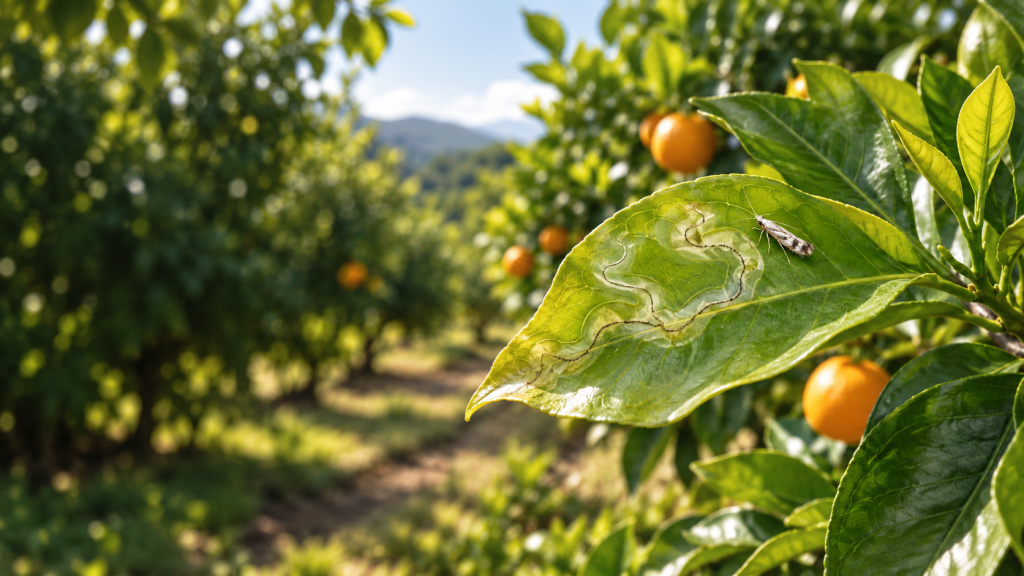
The feeding larva moves through the leaf and produces a characteristic serpentine tunnel. A thin, dark line of larval waste can usually be observed inside the mine. This dark central line helps distinguish citrus leafminer damage from certain diseases or physical injuries.
The first three larval stages are responsible for most of the feeding damage. During the final pre-pupal stage, feeding stops and the larva prepares a protected area for pupation.
Pupae
The mature larva usually moves toward the edge of the leaf and folds or curls the leaf margin to create a pupal chamber. Inside this protected area, it forms a delicate cocoon.
The pupa is initially yellowish-brown and becomes darker as development progresses. The curled edge of a mined citrus leaf is often a useful indication that the insect has reached the pupal stage.
Adults
Adult citrus leafminers are very small moths with narrow, silvery-white wings. Their forewings contain subtle dark markings and a small dark spot near the tip. The body and hindwings are pale and covered with fine scales.
Adult moths commonly hide within the citrus canopy during the day. They become more active around sunset, during the night and in the early morning.
Because the adults are tiny and easily overlooked, growers often notice citrus leafminer damage before seeing the moth itself.
Citrus Leafminer Life Cycle
The citrus leafminer life cycle consists of the egg, larval, pupal and adult stages. Development can be completed rapidly under warm and favorable conditions.
Eggs may hatch within several days, depending on temperature. Newly emerged larvae immediately enter the leaf and begin feeding. The larval feeding period generally lasts about one week, although environmental conditions can shorten or extend this period.
At the end of larval development, the insect forms a pupal chamber near the edge of the leaf. The adult moth later emerges and begins another generation.
Under highly favorable conditions, the complete life cycle may take approximately two weeks. In cooler or less suitable environments, development can take considerably longer.
Several generations may occur during one growing season. Different generations frequently overlap, which means that eggs, larvae, pupae and adult moths may be present in the orchard simultaneously.
Population development is closely connected to citrus flush growth. Whenever trees continuously produce tender new leaves, the pest has more opportunities to reproduce and increase its population.
Citrus Leafminer Damage Symptoms
The most recognizable citrus leafminer damage symptoms are narrow, irregular and winding mines on young citrus leaves. These tunnels often have a silvery or translucent appearance and contain a dark line of larval waste.
Additional symptoms may include:
- Curling, rolling or distortion of young leaves
- Reduced expansion of new foliage
- Yellowing around heavily damaged areas
- Dry or dead tissue in severe infestations
- Premature leaf drop
- Slower development of young citrus trees
- Reduced photosynthetic leaf area
One mine per leaf is common during light infestations. However, several larvae may attack the same leaf when pest pressure is high. Large leaves may consequently contain multiple overlapping tunnels.
Citrus leafminer larvae damage the photosynthetic tissues of the leaf. Severe infestations can reduce the ability of young trees to produce a strong and healthy canopy.
Leafminer injury may also increase the risk of citrus canker because damaged leaf tissue can provide entry points for the bacteria responsible for the disease. Citrus orchards with a history of canker should therefore be monitored particularly carefully.
Which Citrus Trees Are Most at Risk?
Nursery plants and young citrus trees are the most vulnerable to citrus leafminer. Trees between one and three years old frequently produce tender shoots and depend on healthy foliage for canopy establishment.
Other high-risk trees include:
- Newly planted citrus trees
- Young non-bearing orchards
- Top-worked or recently grafted trees
- Nursery plants producing continuous flushes
- Trees receiving excessive nitrogen fertilizer
- Trees exposed to frequent or unnecessary irrigation
- Citrus varieties with soft, broad and thin young leaves
Trees under five years old may experience significant growth reduction if successive flushes are heavily infested. Repeated damage can delay canopy development and weaken young plants.
Healthy, mature citrus trees generally tolerate leafminer injury more successfully. In many cases, damage on established bearing trees is mainly cosmetic and does not justify routine insecticide treatment.
Susceptibility may also vary among citrus species and cultivars. Soft and thin leaves usually provide more favorable conditions for larvae than thick leaves that harden rapidly.
Monitoring and Treatment Decisions
Regular monitoring should begin when citrus trees start producing a new flush. Inspect the youngest leaves for eggs, fresh mines, active larvae and curling around the leaf margins.
Old mines on hardened leaves do not necessarily indicate an active infestation requiring immediate treatment. By the time the damage is clearly visible, the larva may have completed feeding or entered the pupal stage.
Monitoring should focus on:
- The percentage of young leaves showing fresh mines
- The presence of eggs and active larvae
- The age and condition of the citrus trees
- The amount of tender new growth
- Pest activity in nursery plants and nearby orchards
- The presence of parasitoids and other beneficial insects
- Local weather and seasonal growth patterns
Pheromone traps can help detect adult moth activity and identify periods when populations are increasing. However, trap catches should be evaluated together with direct inspection of young foliage.
Treatment decisions should be based on tree age, infestation intensity, economic thresholds and local agricultural recommendations. Calendar-based spraying without field monitoring can increase production costs, disrupt beneficial insects and accelerate pesticide resistance.
Integrated Citrus Leafminer Control
An effective integrated management of citrus leafminer combines cultural practices, biological control, monitoring and carefully justified chemical intervention. No single method provides complete and permanent control.
Manage New Flush Carefully
Citrus leafminer depends on tender foliage for reproduction and larval development. Orchard practices that produce continuous and irregular flushes can therefore increase pest pressure.
Avoid excessive nitrogen fertilization and unnecessary irrigation during periods of high leafminer activity. These practices may stimulate repeated production of soft leaves that are highly attractive to adult moths.
Where appropriate, coordinate irrigation, fertilization and pruning so that new growth develops more uniformly and hardens within a shorter period.
Excessive pruning of mature citrus trees should also be avoided during high-risk periods because it can stimulate susceptible new growth.
Use Clean Planting Material
Infested nursery trees and leafy plant material can introduce citrus leafminer into new production areas. Carefully inspect nursery plants before transport, purchase or planting.
Young trees should be obtained from reliable nurseries that follow appropriate pest-management and plant-health practices. Local quarantine and plant movement regulations must also be observed.
Conserve Natural Enemies
Citrus orchards contain several beneficial organisms that attack leafminer larvae and pupae. Parasitoid wasps can make a significant contribution to natural population control.
Predatory spiders, ants, lacewing larvae and lady beetles may also feed on different citrus leafminer stages.
Repeated use of broad-spectrum insecticides can reduce these natural enemies and may cause outbreaks of other orchard pests. Conserving beneficial insects is especially important in mature orchards, where moderate leaf damage can often be tolerated.
Consider Pheromone-Based Monitoring
Pheromone traps attract male citrus leafminer moths and can help growers determine when adult activity begins. They are particularly useful for monitoring seasonal population changes and improving the timing of orchard inspections.
In some production systems, pheromone-based mating disruption may also support other control methods by reducing successful reproduction.
Trap placement, density and replacement intervals should follow the manufacturer’s instructions and current local recommendations.
Use Horticultural Mineral Oils Responsibly
Where approved, horticultural mineral oils may discourage adult females from laying eggs on treated citrus foliage. Oils can be most useful when applied during the early development of a new flush.
Effective coverage of young leaves is important. However, mineral oils may injure citrus trees when used during unsuitable weather or combined incorrectly with incompatible products.
Only locally registered products should be used, and all label restrictions concerning temperature, humidity, plant condition and compatibility must be followed.
Apply Insecticides Only When Justified
Chemical intervention may be necessary in citrus nurseries, young non-bearing orchards or severe infestations. However, insecticides should not replace monitoring, cultural practices or biological control.
Citrus leafminer larvae are protected inside the leaf, making poorly timed contact treatments less effective. Overlapping generations and repeated applications may also contribute to pesticide resistance.
Use only products officially registered for citrus leafminer and citrus crops in the country of application. Product selection and application must be handled according to the approved label and qualified local crop-protection guidance.
When chemical control is necessary, resistance-management principles should be followed by avoiding repeated reliance on products with the same mode of action. Pollinators, parasitoids and other non-target organisms must also be protected.

A Note on Behavaran Cyromazine and Leafminer Control
Behavaran Cyromazine is an insect growth regulator developed for the management of certain fly larvae, including dipteran leafminers affecting vegetable crops. It interferes with normal larval growth and development, helping reduce the population of susceptible leafminer species.
However, not all insects commonly described as “leafminers” belong to the same group. Vegetable leafminers targeted by cyromazine are generally flies from the order Diptera, whereas the citrus leafminer, Phyllocnistis citrella, is a moth belonging to the order Lepidoptera.
For this reason, Behavaran Cyromazine should not automatically be presented as a treatment for citrus leafminer unless its use against this specific pest and citrus crop is included on the locally approved product label. Correct pest identification is essential before selecting any leafminer control product.
For more information about its characteristics and approved applications, visit the Behavaran Cyromazine product page.
Common Management Mistakes
Several common mistakes can reduce the effectiveness of citrus leafminer control and increase unnecessary production costs:
- Treating mature trees when the damage is only cosmetic
- Spraying after young leaves have hardened
- Making decisions based only on old or inactive mines
- Using broad-spectrum insecticides repeatedly
- Ignoring parasitoids and other natural enemies
- Applying excessive nitrogen during high-risk periods
- Over-irrigating trees and stimulating continuous flush growth
- Pruning heavily when adult moths are active
- Failing to inspect nursery plants before planting
- Using the same insecticide mode of action repeatedly
- Applying pesticides without checking local registration and label directions
The presence of visible mines does not always mean that immediate pesticide treatment is required. Correct timing and accurate assessment are more important than routine spraying.
Conclusion
Successful citrus leafminer management begins with close observation of tender citrus leaves. Young trees, nursery plants and newly established orchards require the greatest protection because repeated infestations may delay canopy development and weaken plant growth.
Mature trees can usually tolerate moderate leaf mining without a significant reduction in yield. For this reason, treatment decisions should always consider tree age, flush stage, infestation level and the activity of natural enemies.
The most sustainable citrus leafminer control program combines regular monitoring, careful management of new flush, clean planting material, conservation of beneficial insects and responsible use of locally registered treatments when intervention is justified.
An integrated approach provides
Frequently Asked Questions About Citrus Leafminer
What is citrus leafminer?
Citrus leafminer, scientifically known as Phyllocnistis citrella, is a small moth whose larvae feed inside young citrus leaves and create winding, silvery mines.
What are the main symptoms of citrus leafminer damage?
Typical symptoms include serpentine mines, dark waste lines inside the tunnels, curled leaf edges, distorted young leaves and reduced development of new foliage.
Which citrus trees are most vulnerable?
Nursery plants, newly planted orchards, grafted trees and citrus trees under five years old are generally most vulnerable. Mature trees can usually tolerate moderate damage.
Does citrus leafminer damage citrus fruit?
The pest primarily attacks tender leaves and young shoots. Direct fruit damage is uncommon, but severe leaf infestations may weaken young trees and reduce healthy canopy development.
Can citrus leafminer increase the risk of citrus canker?
Yes. Mines and damaged leaf tissue may create additional entry points for the bacterium responsible for citrus canker, particularly in orchards where the disease is already present.
When should citrus trees be monitored for leafminer?
Monitoring should begin when a new flush develops. Growers should inspect the youngest leaves for eggs, fresh mines, active larvae and curling around the leaf margins.
How can citrus leafminer be controlled naturally?
Natural control can be supported by conserving parasitoid wasps, lacewings, spiders, ants and lady beetles. Avoiding unnecessary broad-spectrum insecticide applications helps protect these beneficial organisms.
Are pheromone traps useful for citrus leafminer control?
Pheromone traps can help detect adult moth activity and identify periods of increasing pest pressure. Trap results should be evaluated together with direct inspection of young citrus leaves.
Is chemical treatment always necessary?
No. Mature citrus trees often tolerate moderate infestations without significant yield loss. Chemical intervention is generally more relevant to nurseries, young trees or severe outbreaks and must follow local registration and label requirements.
Can Behavaran Cyromazine control citrus leafminer?
Behavaran Cyromazine is introduced for certain dipteran leafminers, particularly leaf-mining flies affecting vegetable crops. Citrus leafminer is a moth from the order Lepidoptera. Therefore, the product should not be presented or used for citrus leafminer unless this specific crop and pest are included on the locally approved label.
What is the best approach to citrus leafminer control?
The most reliable approach combines early monitoring, careful management of new flush, clean planting material, conservation of natural enemies and responsible use of locally registered treatments when intervention is justified.