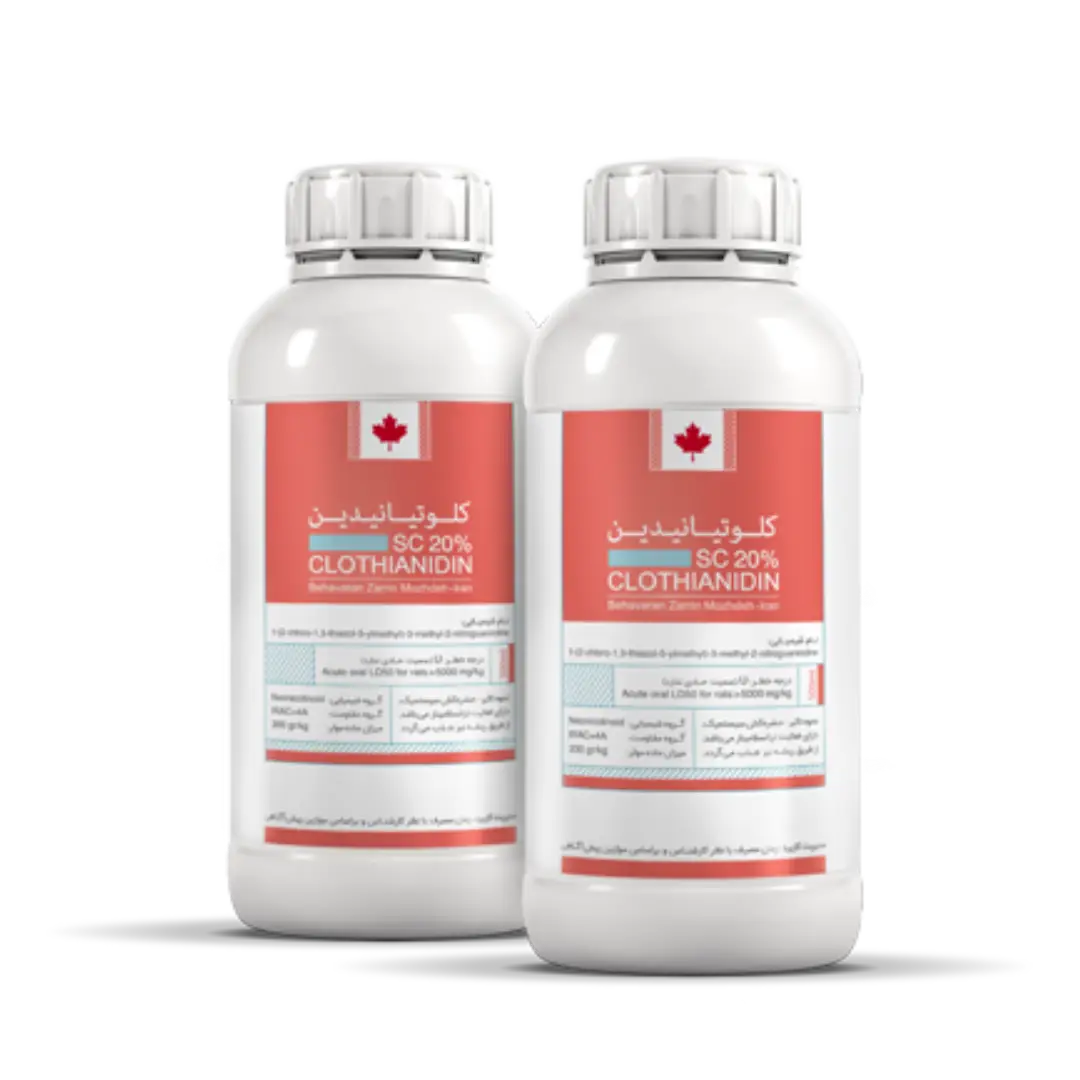
Clothianidin (Clodi) – Behavaran
500 mL packaging
Clothianidin is a systemic insecticide belonging to the neonicotinoids, which acts strongly on the nervous system of sucking and chewing pests, especially aphids, psyllids, whiteflies, thrips, and beetles, causing their rapid death.
Due to its high systemic properties and long persistence in plants, it is highly effective for pest control at different stages of plant growth. Compared to older insecticides, it has higher safety for mammals.
Mode of Action
A penetrating and systemic insecticide with stomach action that is absorbed through the roots. It belongs to the neonicotinoid group and has two isomers (Z and R).
This insecticide affects the nicotinic acetylcholine receptors in the insect nervous system.
An important feature of this product is that after absorption through roots or leaves, it is distributed throughout all plant tissues, so pests are eliminated even when feeding on newly grown parts of the plant.
Uses
In Iran, it is used to control pistachio psyllid. In other countries, it is effective for controlling aphids, thrips, wireworms, flea beetles, cutworms, on cabbage, rice, corn, potatoes, ornamental plants, and fruit trees.
Application Guidelines
-
Avoid spraying trees during the flowering stage.
-
Apply only once per year.
-
Spraying should be done when the likelihood of harm to natural enemies is minimal.
Note: For better absorption, spraying should be carried out at the early stages of pest appearance, so the plant can fully benefit from the systemic effect of the insecticide.