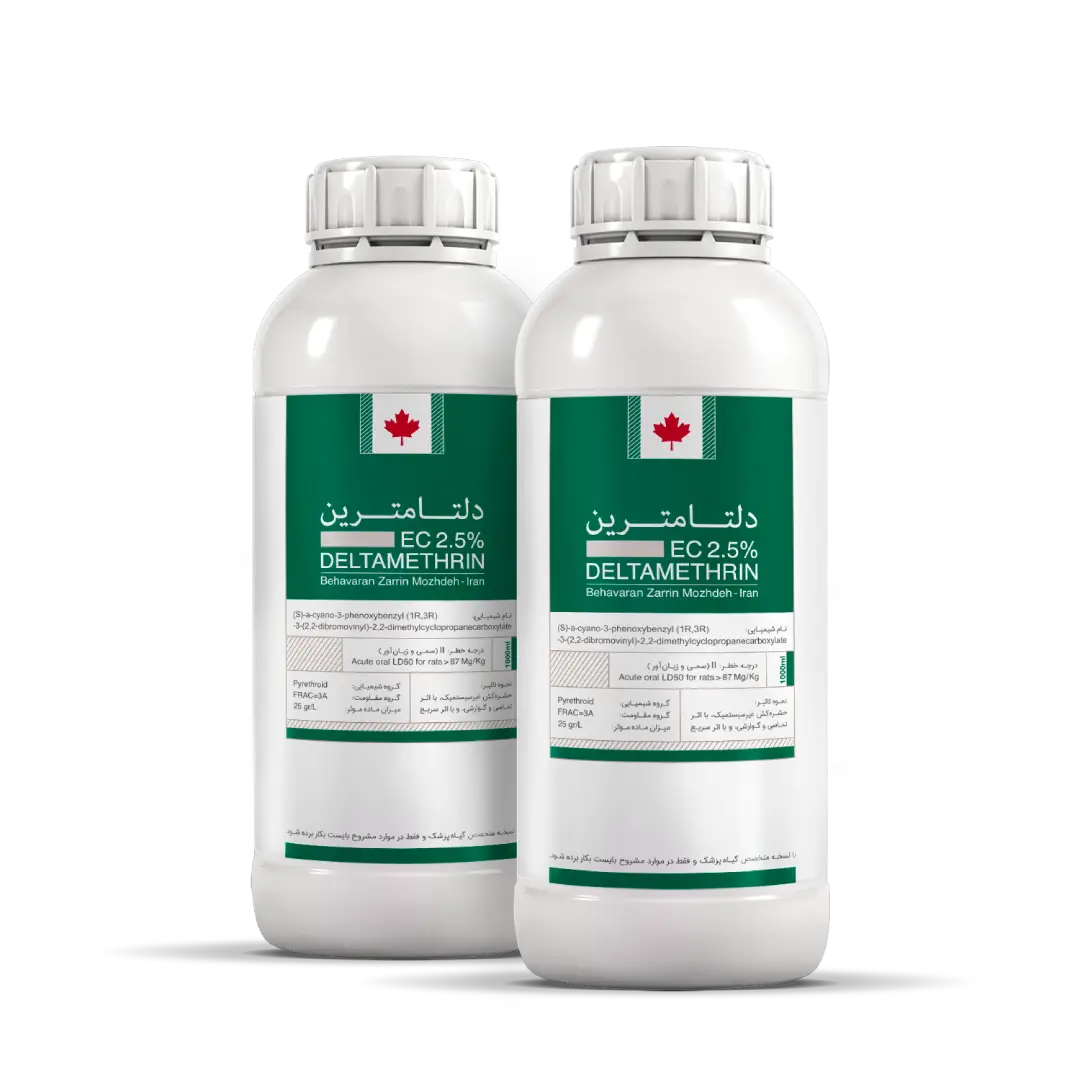
Deltamethrin EC 2.5% is a fast-acting pyrethroid insecticide for leafminers, thrips, wheat bugs, and other pests. Suitable for fruit trees, sugar beet, cotton, and greenhouse crops. Safety and environmental guidelines included.
Fast-Acting Non-Systemic Insecticide
Deltamethrin EC 2.5% is a non-systemic, contact and stomach insecticide with fast knockdown activity. It is highly effective against a wide range of pests including: Leafminers on fruit trees, Leafminer in vegetables and sugar beet (Prodnia), Wheat bugs in the nymph stage, Thrips on onions, Leafminers and whiteflies in greenhouse and open-field crops and Colorado potato beetle, psyllids, and mealybugs
Deltamethrin is a pyrethroid insecticide with high stability and rapid action.
Contains a mixture of 8 stereoisomers, with the S-isomer providing the highest activity.
Disrupts sodium channels in the axonal membrane of insect nerve cells, causing paralysis and death.
Effective as a contact and stomach poison with long residual activity.
Uses
International Uses
Vegetable and ornamental crops, open field and greenhouse leafminers
Sucking pests on apple, wheat, and barley
Colorado potato beetle, psyllids, fruit tree leafminers, mealybugs, thrips, and greenhouse whiteflies
Pre-Harvest Interval (PHI): 3 days
| Product | Pest | Consumption rate |
|---|---|---|
| Cotton & Sugar Beet | Prodnia Leafminer | 1 L/ha |
| Wheat | Wheat Bugs | 300 ml/ha |
| Fruit Trees | Leafminer | 500 ml per 1000 L spray solution |
| Onions | Thrips | 300 ml/ha |
| Cucurbits & Melons | Melon & Field Flies | 300 ml/ha |
| Packaging | 1000ml |
|---|---|
| Formulation | EC2.5% |
| Resistance group | IRAC=3A |
| Chemical group | pyrethroid |
| Amount of active ingredient | 25gr/L |