
The Mediterranean fruit fly (Ceratitis capitata), commonly known as the Medfly, is one of the most economically important fruit pests in many fruit-growing regions of the world. Its importance comes from its exceptionally wide host range, rapid reproduction under favorable conditions, ability to attack fruit close to harvest, and the difficulty of controlling larvae once they are developing inside the fruit.
Mediterranean fruit fly can attack many commercial crops, including citrus fruits, apples, pears, peaches, apricots, nectarines, figs, persimmons, grapes and several tropical and subtropical fruits. Some fruiting vegetables may also be affected. International references describe Medfly as a major quarantine pest with well over 100 recorded hosts.
Unlike many pests that damage only leaves or shoots, Medfly directly affects the harvested product. Females lay eggs beneath the fruit skin, and the developing larvae feed within the fruit. As a result, fruit may soften, rot, become unsuitable for marketing or drop prematurely.
For growers, successful Mediterranean fruit fly control therefore depends on early detection, orchard sanitation, monitoring, trapping and coordinated management, rather than relying on a single control measure.
What Is the Mediterranean Fruit Fly?
The Mediterranean fruit fly belongs to the family Tephritidae, a group containing many economically important fruit flies.
Its scientific name is:
Ceratitis capitata (Wiedemann)
Despite its common name, the species did not originate in the Mediterranean region. Its origin is generally associated with Africa, after which it spread to numerous fruit-growing regions worldwide. Today, it is regarded as an important pest in parts of Africa, the Mediterranean Basin, Asia, Central and South America, Australia and other suitable regions.
Its international importance is also related to quarantine regulations. Countries and regions free from Mediterranean fruit fly may impose strict phytosanitary requirements on imported fruit because the establishment of the pest can create serious commercial and agricultural problems.
Why Is Mediterranean Fruit Fly So Destructive?
Several biological characteristics make Medfly particularly difficult to manage.
The pest has a broad host range, meaning that populations can move between different fruit crops as they ripen throughout the season. It can also complete multiple generations when temperatures and host availability are favorable.
Most importantly, the damaging larval stage develops inside the fruit, where it is protected from many external control measures.
Mediterranean fruit fly management therefore needs to begin before severe fruit infestation becomes visible.
Mediterranean Fruit Fly Identification
Correct identification is an important first step because several fruit fly species may occur in orchards.
Adult Mediterranean Fruit Fly
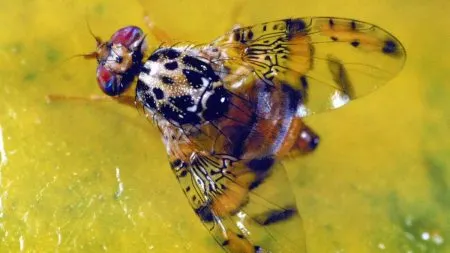
The adult Mediterranean fruit fly is relatively small, generally around 4–5 mm long.
Typical characteristics include:
- yellowish to brown or dark body coloration;
- prominent compound eyes;
- patterned thorax;
- transparent wings with characteristic bands and markings;
- relatively compact body compared with some other fruit fly species.
Correct field identification is best supported by trap catches examined by a plant-protection specialist, particularly in regions where multiple fruit fly species occur.
Mediterranean Fruit Fly Eggs
The eggs are:
- small;
- elongated;
- whitish;
- often compared in appearance with very small grains of rice.
Females insert eggs beneath the surface of suitable fruit rather than leaving them exposed.
Because the eggs are hidden inside fruit tissue, they are rarely noticed during routine orchard inspection.
Mediterranean Fruit Fly Larvae
After hatching, larvae begin feeding on the fruit pulp.
The larvae are generally:
- creamy white;
- legless;
- elongated;
- tapered toward one end.
Larvae are the stage responsible for most of the direct internal fruit damage.
Mediterranean Fruit Fly Pupae
When mature, larvae leave the damaged fruit and enter the soil, where pupation occurs.
The pupal stage is typically:
- oval or barrel-shaped;
- brown;
- located in soil around host trees or beneath infested fruit.
This behavior explains why orchard-floor sanitation and removal of infested fruit are important components of management.
IAEA references describe mature larvae leaving fruit, entering the soil and pupating before adults emerge and restart the cycle.
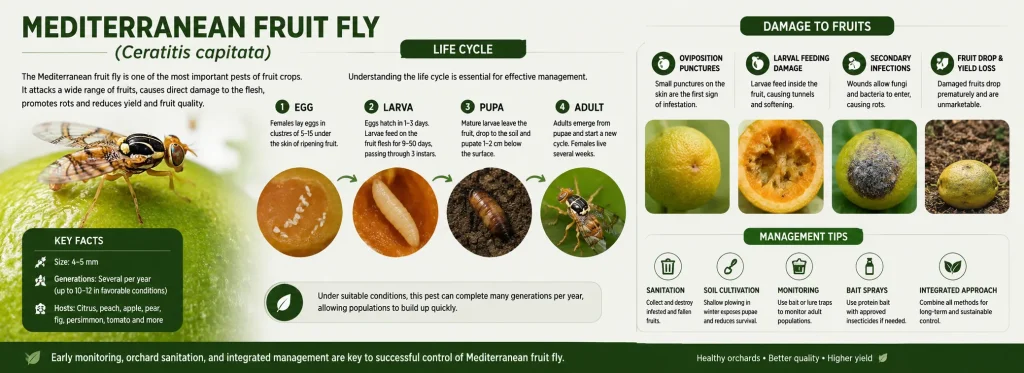
Mediterranean Fruit Fly Life Cycle
Understanding the Mediterranean fruit fly life cycle is essential because each developmental stage requires a different management approach.
The general life cycle includes:
Egg → Larva → Pupa → Adult
Egg-Laying in Fruit
Adult females search for suitable host fruit and insert eggs beneath the fruit skin.
The oviposition site may initially be difficult to notice. With time, the area around the puncture may become discolored or sunken depending on the fruit species and stage of maturity.
Several eggs may be deposited at one site.
Larval Development Inside the Fruit
After the eggs hatch, larvae feed within the fruit pulp.
This internal feeding:
- damages healthy tissue;
- accelerates fruit deterioration;
- creates soft areas;
- reduces quality;
- may contribute to premature fruit drop.
Secondary microorganisms may also colonize damaged fruit tissue, accelerating decay.
Pupation in the Soil
Once larvae complete development, they leave the fruit and move into the soil for pupation.
This stage is particularly important in orchard management because fruit left beneath trees can continuously supply mature larvae to the soil.
Removing infested and fallen fruit can therefore interrupt the pest’s life cycle.
Adult Emergence
Adults emerge from pupae and seek food, mates and suitable fruit for egg-laying.
Development time is strongly influenced by temperature. UC IPM notes that Mediterranean fruit fly development is temperature-dependent, which means the timing of generations can vary considerably between regions and seasons.
Consequently, fixed statements such as “the pest always produces a specific number of generations each year” should be interpreted carefully. Warm areas with continuous host availability can support more generations than cooler regions.
Mediterranean Fruit Fly Host Plants
The wide host range of Medfly is one of the main reasons it is difficult to manage.
Important hosts may include:
- oranges and mandarins;
- peaches and nectarines;
- apricots;
- apples;
- pears;
- persimmons;
- figs;
- grapes;
- plums;
- several tropical fruits.
IAEA sources describe citrus, stone fruits, pome fruits, figs, grapes and numerous tropical fruits among Medfly hosts.
This means management should not focus only on a single commercial crop. Nearby host trees, abandoned orchards and unmanaged fruit can also influence local pest populations.
Mediterranean Fruit Fly Damage
What Does Mediterranean Fruit Fly Damage Look Like?
Damage usually begins when females puncture fruit for egg-laying.
At first, the puncture may be small and difficult to distinguish. Later, signs may include:
- localized discoloration;
- softening around the puncture;
- internal breakdown of fruit tissue;
- premature fruit drop;
- decay;
- presence of larvae inside damaged fruit.
Once larvae are feeding inside the fruit, commercial quality can decline rapidly.
Direct Damage to Fruit
The most important direct damage comes from larval feeding.
Larvae consume the fruit pulp and disrupt healthy tissue. The affected fruit may become soft, watery or internally damaged even before severe symptoms are visible externally.
Fruit intended for fresh markets may become unmarketable.
Secondary Fruit Rot
Egg-laying punctures and larval feeding damage the integrity of the fruit.
These injuries can facilitate invasion by microorganisms responsible for fruit decay, increasing postharvest losses.
Premature Fruit Drop
Severely damaged fruit frequently drops from trees before harvest.
Unfortunately, fruit that falls to the orchard floor can still contain larvae. If these larvae reach maturity and enter the soil, another generation may develop.
For this reason, fallen infested fruit should not simply be left beneath trees.
How to Detect Mediterranean Fruit Fly Early
Early detection is much more effective than waiting until large numbers of damaged fruits appear.
Inspect Ripening Fruit
Growers should regularly inspect susceptible fruit as it approaches maturity.
Look for:
- suspicious punctures;
- localized softening;
- unusual discoloration;
- premature fruit drop;
- internal larvae in damaged fruit.
Fruit fly activity often becomes more important as suitable host fruits approach ripening.
Use Monitoring Traps
Traps are widely used for surveillance and monitoring of fruit fly populations.
Their purpose is not simply to capture insects. Trap information can help growers determine:
- whether the pest is present;
- when adult activity begins;
- whether populations are increasing;
- when management should be intensified.
Electronic and conventional trapping systems are important tools for fruit-fly monitoring programs.
Traps for Mediterranean Fruit Fly Monitoring
Different traps and attractants may target males, females or both.
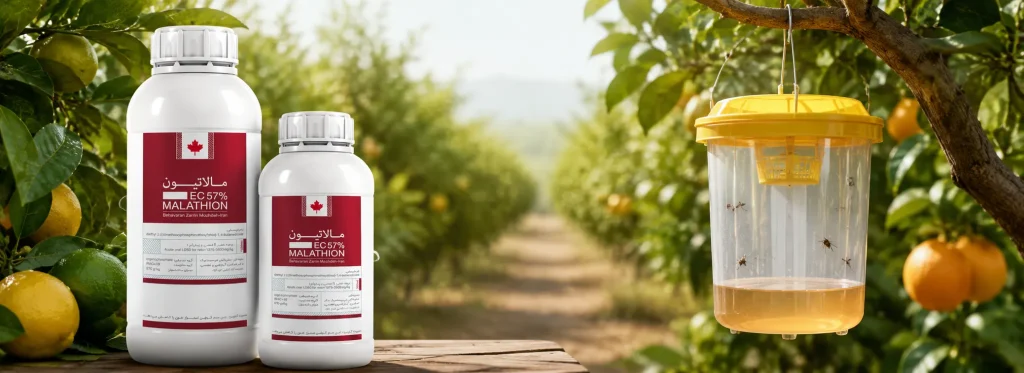
McPhail-Type Traps
McPhail traps have historically been associated with food-based attractants.
Protein and other food-based attractants can be useful because adult fruit flies, particularly females preparing to produce eggs, require nutrients.
FAO/IAEA trapping references describe the McPhail trap as an early trap design used with protein baits for capturing female fruit flies.
Trimedlure Traps
Trimedlure (TML) is a well-known attractant for male Mediterranean fruit flies.
Male-targeting traps can be useful for detection and population monitoring, although trap interpretation should be incorporated into a broader monitoring program.
FAO/IAEA trapping guidance identifies trimedlure as an effective attractant for Mediterranean fruit fly.
Yellow Traps
Visual attraction can also be incorporated into fruit fly monitoring systems.
Yellow surfaces are attractive to several fruit fly species and can support population surveillance when used appropriately. Research on electronic traps has also used yellow coloration as part of monitoring systems for fruit flies.
Integrated Management of Mediterranean Fruit Fly
There is no single “best method” that will reliably manage Medfly under all conditions.
The most effective approach is Integrated Pest Management (IPM), combining monitoring, sanitation, cultural practices, trapping and, where legally registered and justified, targeted chemical or area-wide control.
Orchard Sanitation
Orchard sanitation is one of the most important components of Mediterranean fruit fly management.
Growers should prevent infested fruit from remaining in the orchard where larvae can complete development.
Management may include:
- frequently collecting fallen fruit;
- removing visibly infested fruit from trees;
- preventing waste fruit from accumulating near packing or storage areas;
- managing abandoned host fruit near commercial orchards.
Cultural control through removal of host fruits and fruit on the ground can help interrupt Medfly infestations.
Manage Harvested and Overripe Fruit
Fruit that remains on trees after commercial harvest can act as a reservoir for Mediterranean fruit flies.
A clean orchard after harvest therefore provides fewer opportunities for the pest to reproduce.
This becomes especially important where several host crops ripen sequentially in nearby orchards.
Soil Management and the Pupal Stage
Because mature larvae leave fruit and pupate in soil, orchard-floor management can contribute to an IPM program.
However, soil cultivation alone should not be treated as a complete solution.
It is much more valuable when combined with:
fruit sanitation + monitoring + trapping + timely control measures.
The objective is to interrupt several points in the pest’s life cycle rather than relying on one operation.
Bait-Based Control of Mediterranean Fruit Fly
Adult fruit flies require nutrients and can be attracted to food-based baits.
For this reason, protein-based bait systems have historically been used for Mediterranean fruit fly management.
Research and international control programs describe bait sprays combining a food attractant with an approved insecticidal component as an established Medfly suppression strategy.
However, available active ingredients, registrations, application restrictions and permitted uses differ by country and crop.
For commercial orchard use, growers should follow:
the locally registered product label, pre-harvest interval, maximum application limits and recommendations of qualified plant-protection professionals.
Is Malathion Used for Mediterranean Fruit Fly?
Historically, malahttps://en.behavaranco.com/product/malathion/thion Behavaran combined with protein bait has been widely used in Mediterranean fruit fly programs, and older and international references document this approach.
However, pesticide registrations and residue requirements change over time and differ significantly between countries.
Therefore, instead of treating malathion as a universal recommendation, commercial growers should first confirm whether the active ingredient is currently registered for Medfly on the specific crop in their country.
This point is especially important for fruit intended for export.
When Should Mediterranean Fruit Fly Control Begin?
One of the biggest mistakes is starting management only after damaged fruit becomes common.
By that stage, larvae may already be developing inside large numbers of fruits.
Monitoring should begin before susceptible fruit reaches the high-risk ripening stage and continue throughout periods when suitable host fruit is available.
Trap catches, fruit maturity, temperature, previous infestation history and nearby host plants can all help determine the level of risk.
Why Mediterranean Fruit Fly Control Sometimes Fails
Control programs often fail because only one part of the pest’s life cycle is targeted.
For example, capturing some adults while leaving hundreds of infested fruits beneath the trees allows larvae to continue entering the soil.
Similarly, orchard sanitation alone may not prevent adults arriving from nearby untreated host plants.
The pest can move among neighboring orchards and host crops, which is why coordinated management can be more effective than isolated action on one tree or one orchard.
Area-Wide Management of Mediterranean Fruit Fly
Medfly is particularly suited to area-wide pest management because populations move beyond individual orchard boundaries.
Large-scale programs may integrate:
- surveillance;
- mass trapping;
- bait-based suppression;
- sanitation;
- quarantine;
- biological approaches;
- sterile insect technique.
The IAEA has supported area-wide programs using the Sterile Insect Technique (SIT), in which large numbers of sterile male flies are released so that mating with wild females does not produce offspring.
SIT is generally implemented through organized regional pest-management programs rather than by individual growers.
Mediterranean Fruit Fly and Export Fruit
The importance of Medfly goes beyond direct crop loss.
Because it is an internationally important quarantine pest, detection in a production region may affect:
- market access;
- phytosanitary certification;
- packinghouse requirements;
- monitoring programs;
- export protocols.
For exporters, Mediterranean fruit fly management should therefore form part of the orchard’s broader phytosanitary and traceability program.
Common Mistakes in Mediterranean Fruit Fly Management
Waiting for severe fruit damage
Management should start based on monitoring and risk, not only after damaged fruit is obvious.
Leaving fallen fruit beneath trees
Infested fruit may contain larvae capable of continuing the life cycle.
Monitoring only one crop
Nearby hosts can maintain populations even after the primary crop has been harvested.
Using only traps
Monitoring traps provide valuable information, but trapping alone may not control high populations unless it forms part of a properly designed mass-trapping system.
Depending only on chemical control
Medfly has several life stages in different environments, so integrated management usually performs better than reliance on a single tactic.
Frequently Asked Questions About Mediterranean Fruit Fly
What is the scientific name of Mediterranean fruit fly?
The scientific name is Ceratitis capitata.
Which fruits are attacked by Mediterranean fruit fly?
Important hosts include citrus, peaches, nectarines, apricots, apples, pears, figs, persimmons, grapes and many other fruits. The pest has a very broad host range.
What stage of Mediterranean fruit fly damages fruit?
The larval stage causes most direct damage because larvae feed inside the fruit pulp.
Where does Mediterranean fruit fly pupate?
After completing larval development, mature larvae leave the fruit and generally pupate in the soil.
How can growers identify Mediterranean fruit fly infestations?
Common indicators include adult flies in monitoring traps, egg-laying punctures, softening fruit, larvae inside fruit, premature fruit drop and increasing trap catches near ripening host crops.
What is the best way to control Mediterranean fruit fly?
There is no single method suitable for every orchard.
An effective program usually combines:
monitoring + orchard sanitation + removal of infested fruit + trapping + appropriate registered control measures.
Are McPhail traps useful for Mediterranean fruit fly?
Yes. McPhail-type traps have long been used with food-based attractants in fruit fly monitoring programs.
What is Trimedlure?
Trimedlure is an attractant widely used for attracting male Mediterranean fruit flies in detection and monitoring programs.
Conclusion: Successful Mediterranean Fruit Fly Control Requires an Integrated Approach
The Mediterranean fruit fly (Ceratitis capitata) is a serious pest because it combines a broad host range with internal fruit feeding, rapid reproduction under suitable conditions and the ability to move between different fruit crops throughout the season.
The most effective management strategy begins with early monitoring.
Once Medfly is detected, growers should combine orchard sanitation, removal of infested and fallen fruit, appropriate trapping systems and other locally approved management techniques. Where chemical intervention is necessary, it should be based on pest monitoring and carried out only with products registered for the crop and pest.
Most importantly, Mediterranean fruit fly management should not be viewed as a single treatment.
Breaking the pest’s life cycle at several stages is the foundation of successful long-term control.
For orchards producing fruit for commercial markets or export, regular monitoring and coordinated management across neighboring orchards can become even more important.