Weight

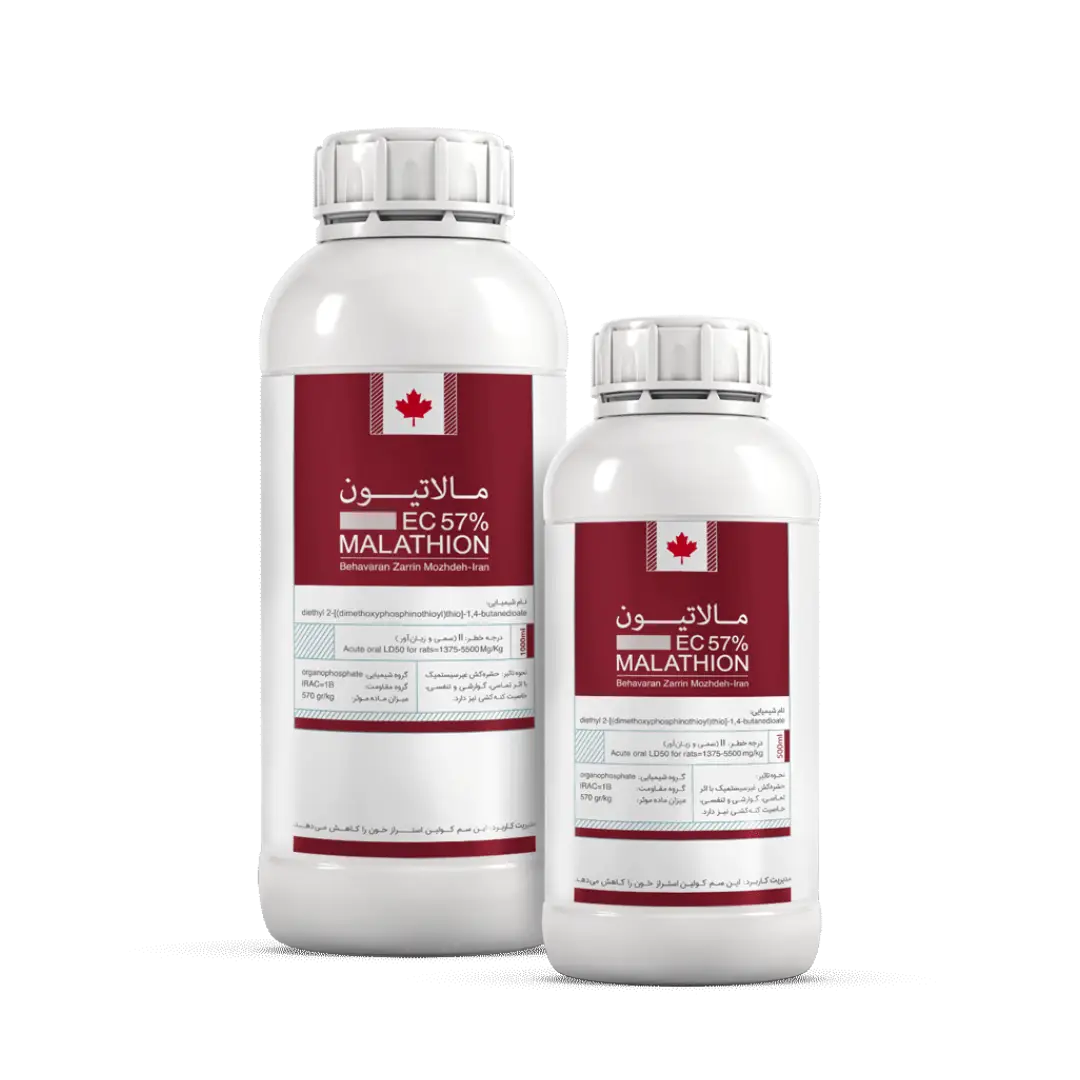
1000ml, 500ml

Behavaran

Resistance group: IRAC=1B
EC57%

Malathion

EC57%

Behavaran Zarrin Mozhdeh

Malathion is an effective organophosphate insecticide with contact and stomach action, used to control agricultural pests, storage pests, and disease-carrying insects, while offering high efficacy and relatively low risk to humans and the environment.
Tags:

Malathion Insecticide – Behavaran

| 500 – 1000 ml Packaging

  • Malathion is an effective organophosphate insecticide with contact and stomach action, used to control plant pests, storage pests, and disease-carrying insects. Despite its high efficacy, it poses relatively low risk to humans and the environment.
Product Description

  • Malathion is a non-systemic insecticide with contact, stomach, and slight inhalation effects, also showing acaricidal activity. It is effective against a wide range of pests, including:
  • Temperate fruit tree pests
  • Mealybugs and leafhoppers
  • Date and cherry fruit worms
  • Sugar beet flies
  • Melon and cucurbit pests
  • Citrus mealybugs and aphids
  • Olive psyllids
  • Alfalfa pests
  • Asian sugarcane locusts
  • Rose aphids
Mode of Action
  • Malathion belongs to the organophosphate group and contains two isomers. Its primary mechanism is acetylcholinesterase (AChE) inhibition in the insect nervous system. AChE normally breaks down acetylcholine; inhibition leads to acetylcholine accumulation at nerve junctions, causing neural paralysis and death.
  • Contact action: Absorbed through direct contact with the insect body.

  • Stomach action: Enters the insect through feeding on treated leaves or fruits, causing poisoning.

  • Fumigant action: At high temperatures and in enclosed spaces, effective vapors can form.

Due to its low mammalian toxicity and broad-spectrum efficacy, Malathion is still widely used as a relatively safer alternative to older organophosphates such as diazinon and fenitrothion.

Applications:


Malathion is used to control a wide range of sucking and chewing pests on:

  • Field crops: Rice, wheat, barley, cotton, vegetables

  • Fruit crops: Temperate fruit trees, citrus, grapes, dates, cherries

  • Ornamentals & greenhouse plants: Aphid control

  • Public health: Mosquito and fly control

  • Livestock: Tick and lice control

  • Storage: Grain pest management

Additionally, Malathion can be applied in bait or trap formulations (e.g., 0.3% Malathion + 3% hydrolyzed protein) for controlling Mediterranean fruit fly, cherry fly, and olive fruit fly. No pre-harvest interval has been recorded for these applications.

Product Pests Consumption rate
Vegetables & Cucurbits Thrips 1 liter per hectare
Alfalfa Weevil 2 liters per hectare
Cherry Cherry fruit fly 2 liters per 1000 liters of water
Citrus Various aphids and scale insects 2–2.5 liters per 1000 liters of water

Additional information

Weight

1000ml, 500ml

Formulation

EC57%

Resistance group

IRAC=1B

Chemical group

Organophosphate

  • Oral LD50 in rats: 1000–1500 mg/kg
  • Use protective equipment (mask, goggles, and safety clothing) during spraying
  • Avoid direct skin contact and inhalation of vapors
  • Properly dispose of leftover solutions and empty containers
  • Avoid spraying in very hot weather to prevent excessive evaporation
  • Short half-life in soil (3–10 days); rapidly degraded by sunlight and microorganisms
  • Highly toxic to honeybees-Moderately toxic to birds
  • Toxic to fish and crustaceans at low concentrations
  • Low risk of long-term accumulation in soil

Related products