Weight

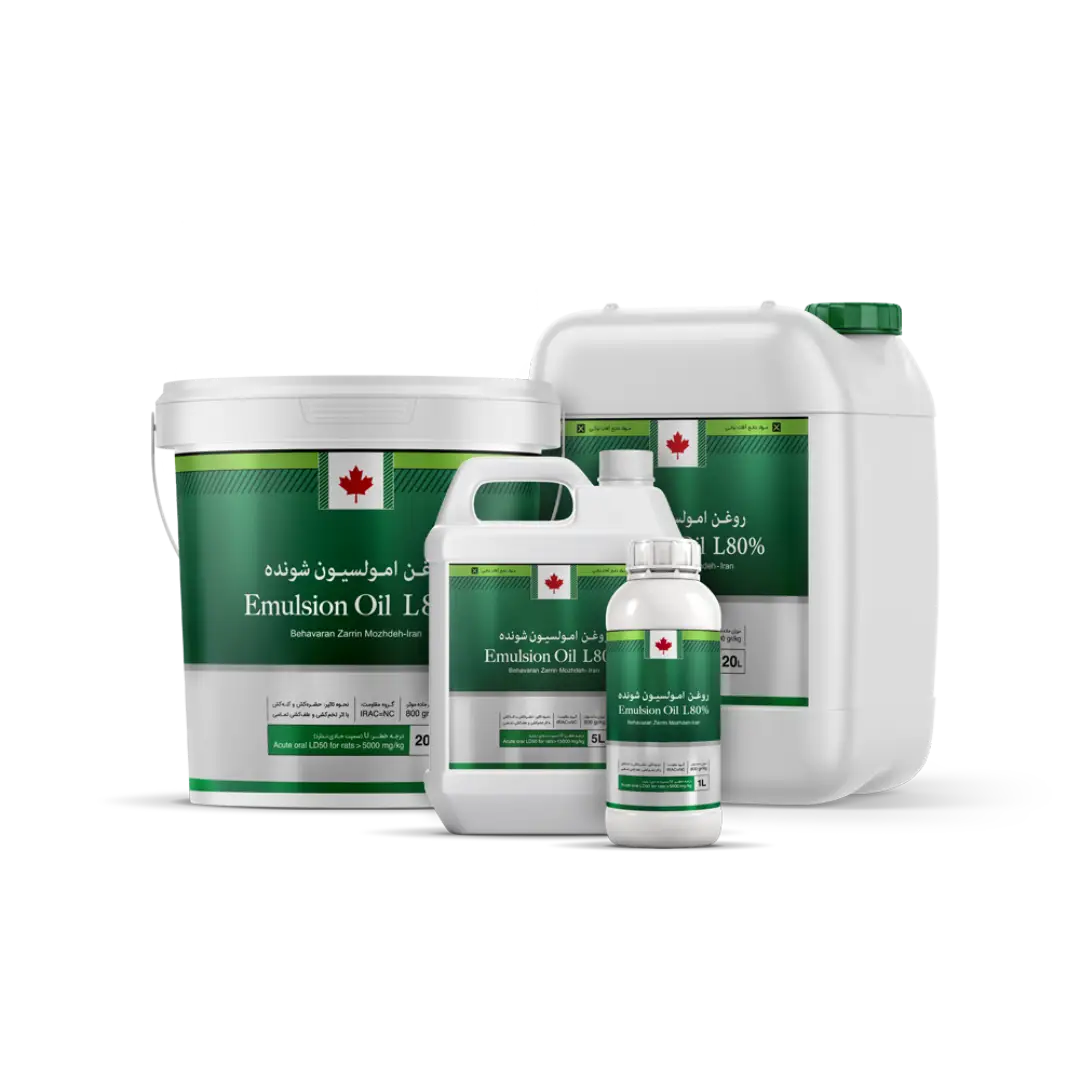
1000ml, 20 L, 5 L

Behavaran

Resistance group: IRAC=NC
L80%

Emulsion Oil-80%

L80%

Emulsion Oil-80%

petroleum-based contact insecticide and acaricide with ovicidal effect. Controls aphids, scales, mites, and eggs on fruit trees and crops. Suitable for dormant and summer sprays.

Emulsion Oil-80% L – Available in 1, 5, and 20 liters
  • A contact insecticide, acaricide, and herbicide with ovicidal (egg-killing) effect.

Mode of Action
  • Petroleum-based emulsifiable oils (summer oils) are used to control aphids, scales, mites, and their eggs, as well as some diseases on fruit trees. This pesticide works by covering the respiratory and vital openings on the body surface of insects and eggs, suffocating them and causing death.

  • The purity of emulsifiable oils is expressed by the sulfonation degree—for example, a sulfonation degree of 100 indicates pure saturated hydrocarbons, while lower degrees mean more unsaturated hydrocarbons. These oils are made from paraffin and come in various sulfonation levels. High sulfonation oils (85-95) are used for summer spraying, and lower sulfonation oils (65-80) are for winter spraying.

Uses

  • Effective against woolly aphids, pistachio trunk scale, date palm transparent scale, mealybugs, red tea mite, black scale, purple olive scale, scales on cold climate fruit trees, white mulberry scale on non-fruit-bearing trees and ornamentals, eastern yellow mite, soft scales, red mites, armored scales, and citrus waxy scales.
  • The optimal time for use is about one week before bud break at average temperatures to control mites, scales, aphids, and other pests on fruit trees. Dilute the Emulsifiable oil with water before applying it as a foliar spray, ensuring thorough coverage of all plant parts.
  • Emulsion oil enhances the effect of insecticides and fungicides and is compatible with most of them. Adding this oil increases the adhesion of pesticides to plant surfaces, reducing wash-off by rain. Another use is combined application with plant oils like soybean oil to delay premature bud break and help prevent late-winter or early-spring frost damage.
  • Recommended concentration for pest control is 1–1.5%. Using more than 3% combined with potassium nitrate sprays in February increases potassium ion concentration in pistachio flower buds, improving flowering and fruit quality.
  • In years where chilling hours (0–7°C) are insufficient in pistachio growing regions, mid to late February applications assist in meeting chilling requirements and developing flower and vegetative buds. Use only if 66% of the chilling requirement has naturally occurred, determined via weather models such as Utah Model. The concentration for pistachio chilling requirement fulfillment is 40% for Akbari variety and 30% for Ahmad Aghaei and Kaleh Ghoochi varieties.
  • For pistachio cultivation in areas with fresh soil and water, recommended emulsifiable oil rates are 40‰ (Akbari) and 30‰ (other varieties). In saline soil and water, 50‰ (Akbari) and 40‰ (others) are recommended. High-purity oils (above 90% sulfonation) suit these applications best.
  • The interval between the last oil spray and harvest is 3-4 weeks. Never apply oil undiluted. The interval between spraying sulfur-based pesticides and emulsifiable oils should be at least one month.
  • Winter spray dose for fruit trees against scales and mites is 15 liters per 1000 liters (1.5%).
Product Pest Consumption rate
fruit trees scales and mites 15 liters per 1000 liters (1.5%) in Winter spray

Additional information

Weight

1000ml, 20 L, 5 L

Formulation

L80%

Resistance group

IRAC=NC

  • Always dilute emulsifiable oil with water; do not apply undiluted.
  • Avoid spraying during flowering to protect beneficial insects like bees.
  • Maintain at least 30 days between sulfur pesticide and oil application to prevent phytotoxicity.
  • Use protective gear to avoid skin and eye irritation during application.
  • Use the recommended concentrations strictly; higher concentrations may cause plant damage.
  • Not suitable for application on very hot days to prevent leaf burn.
  • Observe a 3-4 week pre-harvest interval after the last oil spray.
  • Ensure thorough coverage during spraying for maximum efficacy.
  • Petroleum oils have low environmental persistence but can affect beneficial arthropods; avoid spraying when pollinators are active.
  • Enhance pesticide efficacy while reducing runoff, thus minimizing environmental contamination.
  • Proper application timing and concentration reduce risk of phytotoxicity and resistance.
  • Use protective gear to avoid skin and eye irritation during application.
  • Supports sustainable pest management by improving compatibility with other pesticides and plant oils.
  • Follow integrated pest management practices and local regulations to optimize environmental safety.

Related products