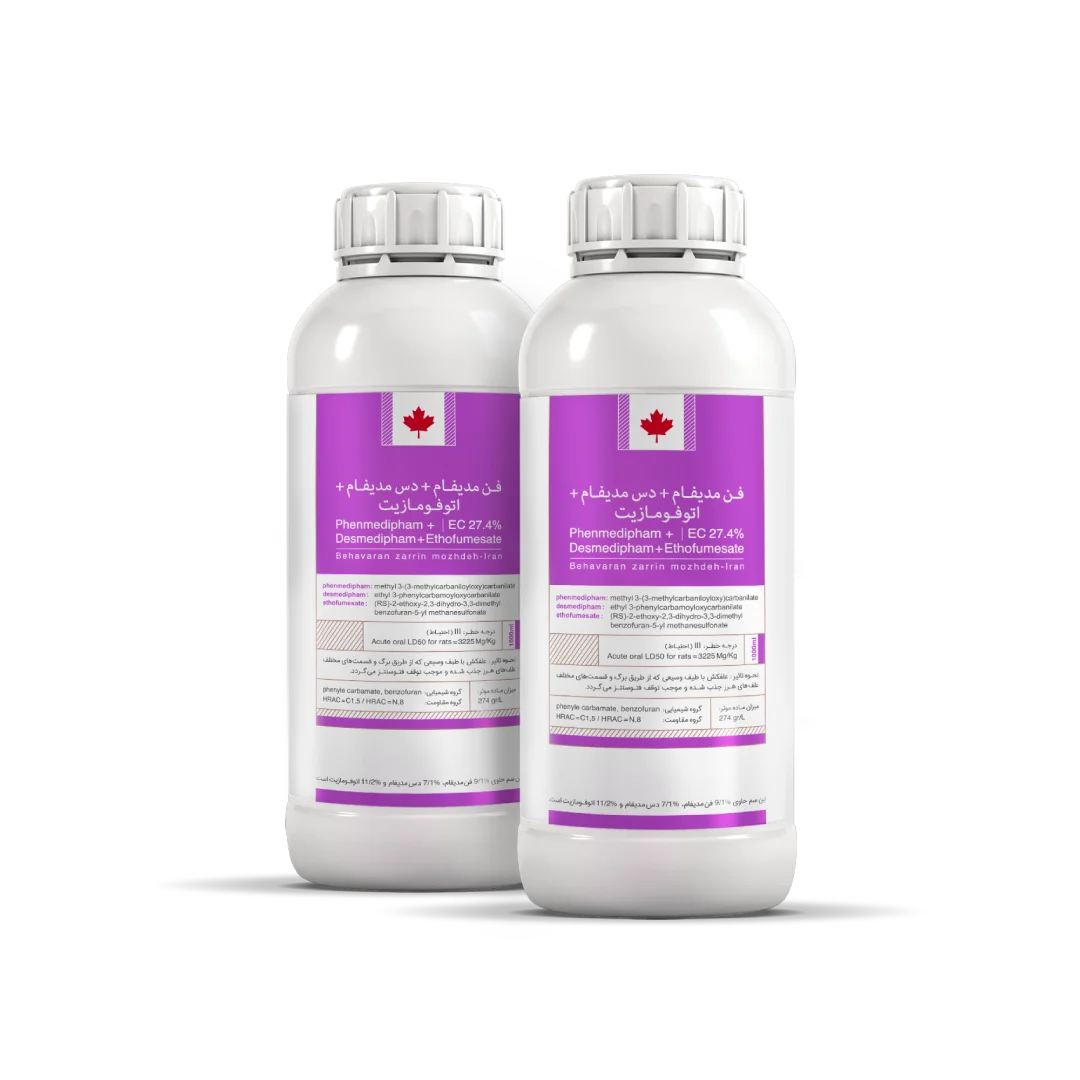
Weight

1000ml

Behavaran

Resistance group: HRAC=C1,5, HRAC=N,B
EC27.4%

phenmedipham+ Desmedipham+ Ethofumesate

EC27.4%

Behavaran Zarrin Mozhdeh

Combined herbicide Fenmedipham + Desmedipham + Autophomizite, produced by Behavaran Company with a complete post-emergence formulation for controlling sugar beet broadleaf weeds; has a rapid contact effect and long residual effect, suitable for phased application and professional weed management.
Phenmedipham + Desmedipham + Autophomezite (Bethanal Progress) Behavaran One liter package
  • The triple combination of Phenmedipham + Desmedipham + Autophomezite is one of the most complete and common selective herbicides in sugar beet and fodder beet, which is used post-emergence to control a wide range of broadleaf and some narrowleaf weeds. This formulation provides both a rapid contact effect (by Phenmedipham and Desmedipham) and a long-term systemic-soil effect (by Autophomezite), and is therefore considered a standard tool in professional beet weed management.
How it works
  • A contact herbicide from the mixed herbicides belonging to the group of biscarbamates and photosynthesis inhibitors. Fenmedipham and desmedipham are absorbed by the leaves and autophomosite by the stems and roots.
  • 1. Fenmedipham + desmedipham (contact – photosystem II inhibition) Inhibition of electron transport in photosystem II – causing a stop in energy production – necrosis and burning of young weed tissues – rapid and visible effect in 2-3 days
  • 2. Autophomicide (systemic-soil) Inhibition of cell division in the root and stem meristem – prevention of regrowth and emergence of subsequent waves – creation of a residual effect in the soil The combination of these three substances simultaneously produces a shock + lasting effect, which is one of the important features of this herbicide. Uses This combination is particularly effective in controlling annual broadleaf weeds in sugar beet, in other countries it is used to control annual broadleaf weeds in sugar beet and annual broadleaf weeds in fodder beet, sugar beet and also strawberries.
  • Betanal Prograss AM is applied as a single spray at the 2-4 leaf stage of sugar beet or in two sprays at a rate of 2 kg/ha at the cotyledon stage and one week later.
  • It is applied at the 4-leaf stage of sugar beet or in two sprays at a rate of 1.5 liters/ha at the 2-4 leaf stage of weeds.
  • Although its effect is contact, its residues in the soil will also be effective unless the soil organic matter content is more than 5%, in which case some herbicide may remain in the soil.
  • Spraying at the cotyledon stage of weeds will yield the best results. It is possible that not all sensitive weeds will be controlled with the first spray, so repeated spraying based on a specific schedule is necessary.


Product Weeds Dosage Rate
Sugar beet fields Broadleaf weeds 4 liters per hectare

Additional information

Weight

1000ml

Formulation

EC27.4%

Resistance group

HRAC=C1,5, HRAC=N,B

Chemical group

Benzofuran, Phenyle Carbamate

Amount of active ingredient

274gr/L

  • The persistence of this herbicide in the soil: Fenmedipham 26 days, Desmedipham 34 days and Autofumozit 20 to 30 days.
  • The intensity of the effect of the poison increases with increasing temperature and humidity, which is why the use of this
  • herbicide is recommended at temperatures above 21 degrees Celsius and it is better to spray in the afternoon.
  • The beet should be at the 2-4 leaf stage; using it earlier will cause burns. The temperature should not exceed 28 degrees.
  • Excessive use and more than the recommended dose will cause the solution to crystallize, in addition, the prepared solution must be used within two hours.
  • This herbicide is not recommended for use on plants under conditions of wind stress, pest attack and diseases, in addition, it is not recommended for use in conditions where light intensity is high.
  • In conditions of frost occurring 7 days after spraying, it may cause damage and failure to repair crops. Dry soil with high organic matter reduces the effectiveness of this herbicide.
  • This herbicide has little or no effect on weeds such as chickenweed, cottongrass, foxtail, rattail, anthemis, sedge, hen’s claw, matricaria and cowslip.

  • The triple combination is low risk to bees. May be moderately to moderately toxic to aquatic organisms;
  • avoid entry into waterways.
  • The half-life of the compounds in soil is moderate and biodegradation occurs.
  • After three washes, the poison containers should be safely buried or taken to a recycling center.
  • Drift can damage sensitive plants around the field.

Related products