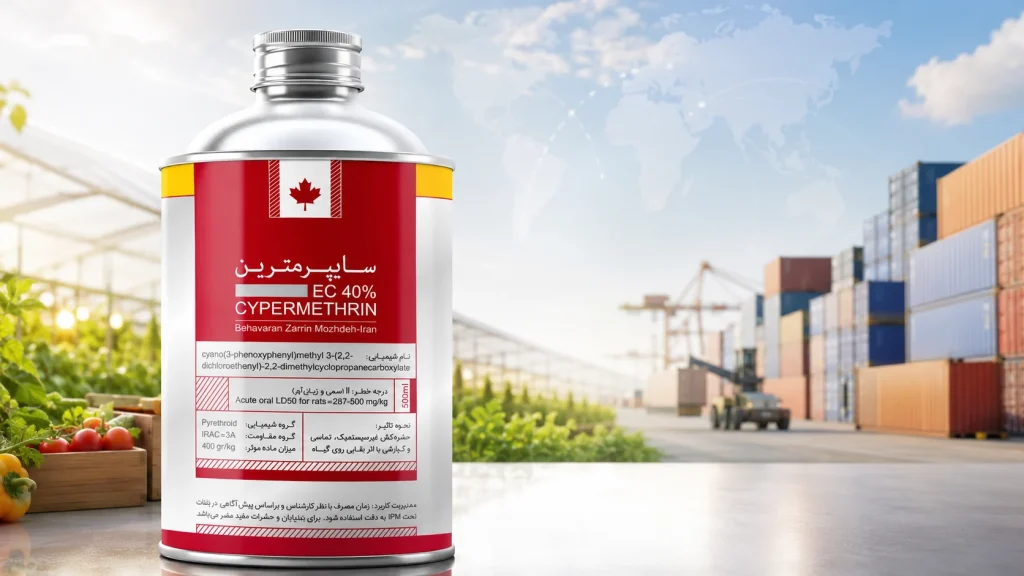
What Is Cypermethrin EC 40% Insecticide?
Cypermethrin EC 40% is a concentrated agricultural insecticide formulated for professional crop-protection programs. Its active ingredient, cypermethrin, belongs to the synthetic pyrethroid family and is widely recognized for its rapid action against susceptible insect pests. The product is supplied as an emulsifiable concentrate (EC), allowing it to form a uniform spray mixture when diluted according to the approved product label and the regulations of the destination country.
For agricultural importers, distributors and agrochemical companies, Cypermethrin EC 40% can be a valuable addition to a commercial insecticide portfolio because the active ingredient is established in many crop-protection markets. Cypermethrin is classified by the Insecticide Resistance Action Committee as a Group 3A pyrethroid insecticide and a sodium-channel modulator.
Behavaran Zarrin Mozhdeh offers Cypermethrin EC 40% for international buyers seeking bulk agricultural insecticide supply, export-oriented packaging and potential OEM or private-label cooperation. Product registration, approved crops, target pests, application conditions and label claims must always comply with the legal requirements of the importing country.
Cypermethrin 40% EC Active Ingredient and Emulsifiable Concentrate Formulation
Cypermethrin 40% EC contains cypermethrin as the active insecticidal ingredient in an emulsifiable concentrate formulation. The term EC refers to a liquid formulation designed to produce a stable emulsion after it is mixed with water under the conditions specified on the registered label.
This formulation format is commonly used in professional agriculture because it supports convenient handling, controlled mixing and uniform distribution through compatible agricultural spraying equipment. However, the exact dilution rate, application volume, crop use and treatment interval must be determined only by the approved label and local agricultural authorities.
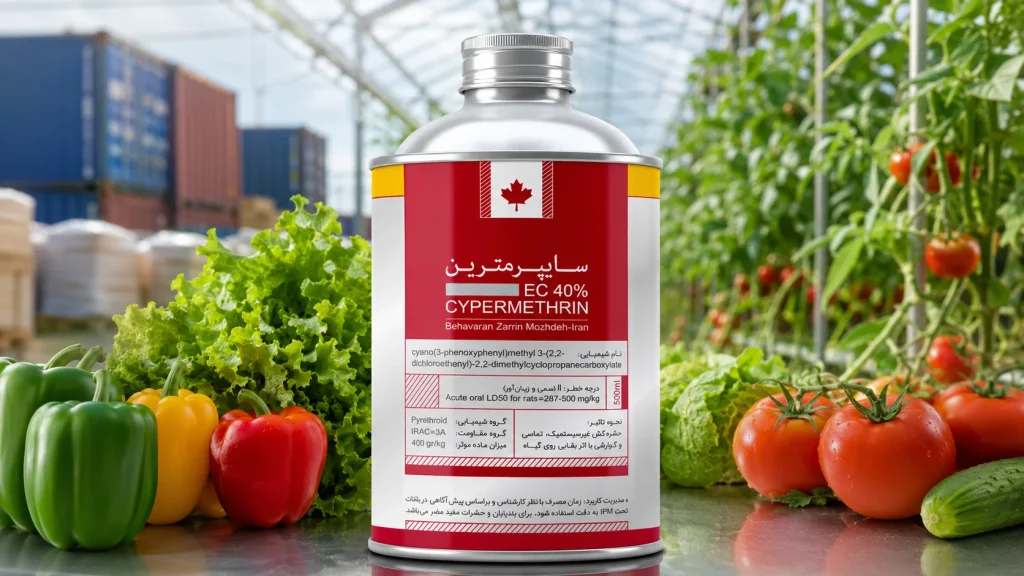
How Does Cypermethrin EC 40% Insecticide Control Agricultural Pests?
Cypermethrin EC 40% controls susceptible agricultural pests by disrupting the normal operation of their nervous system. Cypermethrin is a synthetic pyrethroid classified by the Insecticide Resistance Action Committee as an IRAC Group 3A sodium channel modulator. It interferes with sodium channels involved in transmitting nerve signals, resulting in prolonged nerve stimulation, loss of normal movement and rapid control of susceptible insects.
The product is generally described as a non-systemic insecticide with contact and stomach activity. This means it does not move throughout the plant like a systemic insecticide. Effective performance therefore depends on proper spray coverage, application timing, pest susceptibility and compliance with the registered product label.
Cypermethrin 40% EC can be incorporated into crop-protection programs where cypermethrin is approved for the relevant crop and target pest. Actual results may vary according to pest species, growth stage, local resistance levels, weather conditions and application quality. Importers and distributors should ensure that all crop claims, application rates and safety instructions comply with the registration requirements of their destination market.
Contact and Stomach Action of Cypermethrin Insecticide
The contact action of cypermethrin begins when susceptible insects come into direct contact with treated plant surfaces or spray droplets. Once exposed, the active ingredient affects sodium-channel function within the insect nervous system, interfering with normal nerve-signal transmission.
Its stomach action occurs when a susceptible pest feeds on treated plant material and ingests the insecticide. The combination of contact and ingestion activity makes agricultural cypermethrin insecticide relevant to the management of various exposed chewing and feeding pests, where such uses are approved locally.
Because Cypermethrin EC 40% is non-systemic, uniform application is an important factor in performance. Dense foliage, hidden pest locations, unsuitable spray volume or incomplete coverage may reduce exposure. For this reason, application equipment, water volume and spraying technique should always follow the registered label and professional agricultural recommendations.
Product performance should not be described as universal. Sensitivity can differ between insect populations, particularly where pyrethroid insecticides have been used repeatedly. Cypermethrin should therefore be included in a broader integrated pest-management and resistance-management strategy rather than relied upon as the only method of control.
Fast Knockdown Effect of Cypermethrin 40% EC
One of the main commercial characteristics associated with Cypermethrin 40% EC is its fast knockdown effect on susceptible insects. As a Group 3A pyrethroid, cypermethrin keeps insect sodium channels open for longer than normal, causing nervous-system hyperexcitation and, in some cases, nerve blockage.
This rapid activity can help reduce active pest movement and feeding soon after effective exposure. However, fast knockdown should not be interpreted as guaranteed control under every field condition. Results depend on several factors, including:
- The susceptibility and life stage of the target pest
- Spray timing and coverage
- Environmental conditions during and after application
- The condition and calibration of spraying equipment
- The presence of pyrethroid-resistant pest populations
- Compliance with the approved dose and application interval
Repeated use of Cypermethrin EC 40% or other Group 3A insecticides can increase resistance-selection pressure. Crop-protection programs should therefore rotate products with different IRAC mode-of-action groups, where approved, and combine chemical control with monitoring and other suitable integrated pest-management practices.
Residual Crop Protection with Agricultural Cypermethrin Insecticide
After application, cypermethrin residues may remain on treated plant surfaces for a period of time, potentially exposing susceptible pests that contact or consume the treated area after spraying. This surface activity is commonly referred to as residual crop protection.
The duration and reliability of residual activity are not fixed. They may be influenced by sunlight, temperature, rainfall, irrigation, plant growth, crop surface characteristics, spray coverage and local environmental conditions. New plant growth may also remain untreated because Cypermethrin EC 40% is not a systemic insecticide.
Cypermethrin has a strong tendency to bind to soil and other surfaces. Regulatory assessments also note that residues entering water through drift or runoff can present risks to aquatic organisms. Application must therefore follow local requirements concerning buffer zones, water protection, runoff prevention and spray-drift reduction.
For international buyers, the residual-performance claim should always reflect the approved registration dossier and label in the destination country. Behavaran Zarrin Mozhdeh can provide available product specifications and technical documentation to support commercial evaluation, while the importer remains responsible for confirming permitted claims, crops, pests and application instructions in its local market.
Target Pests Controlled by Cypermethrin EC 40% Insecticide
Cypermethrin EC 40% is a broad-spectrum synthetic pyrethroid insecticide intended for the control of susceptible insect pests in agricultural production. It belongs to IRAC Group 3A and acts as a sodium-channel modulator in the insect nervous system. Its contact and stomach activity can make it suitable for managing several groups of chewing and sucking pests, provided that the intended crop-and-pest combination is approved in the destination country.
Potential target groups may include caterpillars, leaf-feeding larvae, beetles, weevils, borers, aphids, thrips and other susceptible insects. However, cypermethrin products are not registered for exactly the same crops and pests in every market. Importers should therefore avoid transferring claims from one country’s label to another. Every target-pest claim must be supported by the local registration dossier, approved label and relevant residue requirements.
For international buyers, this distinction is important. A technically accurate product page should describe Cypermethrin EC 40% as a versatile agricultural insecticide while clearly stating that approved uses depend on national regulations. Behavaran Zarrin Mozhdeh can provide available technical and commercial documentation for evaluation by importers, distributors and registration specialists.
Cypermethrin Insecticide for Caterpillars and Leaf-Feeding Pests
Caterpillars and other leaf-feeding larvae can cause significant damage by consuming foliage, flowers, growing points and developing produce. Depending on the species and infestation level, this feeding may reduce photosynthetic capacity, weaken crop development and lower the commercial quality of harvested products.
Where registered, cypermethrin insecticide may be used against susceptible lepidopteran larvae and other exposed leaf-feeding pests. Its contact activity affects insects that encounter treated surfaces, while its stomach action affects susceptible larvae that consume treated plant material.
The fast activity associated with pyrethroid insecticides may help reduce pest movement and feeding after sufficient exposure. However, performance depends on factors such as pest species, larval stage, spray coverage, crop canopy and local resistance status. Older larvae or insects hidden inside folded leaves, fruits or plant tissue may be more difficult to reach with a non-systemic insecticide.
Resistance management is especially important for caterpillar populations. IRAC advises that repeated generations of a pest should not be treated continuously with insecticides from the same mode-of-action group. Group 3A products should instead be included in a locally approved rotation with insecticides from different IRAC groups and combined with pest monitoring and other integrated pest-management measures.
Cypermethrin 40% EC for Beetles, Weevils and Borers
Beetles and weevils include a diverse range of agricultural pests that may feed on foliage, roots, stems, flowers, seeds or stored plant material. Certain borer larvae can also tunnel into stems, shoots or fruits, making them less accessible once they enter protected plant tissue.
Cypermethrin 40% EC may provide control of susceptible beetles, adult weevils and exposed borer stages where these uses are legally approved. Historical regulatory records have included agricultural crop uses for cypermethrin, while forestry applications have also involved cypermethrin-based protection against large pine weevil damage.
Timing and pest exposure are particularly relevant for borers. Because cypermethrin is generally considered a non-systemic insecticide, it is more likely to affect exposed adults, eggs or newly emerged larvae than larvae already protected deep inside plant tissue. For this reason, claims such as “complete borer control” should not be used unless they are specifically supported by local efficacy trials and registration approval.
International distributors should specify the exact beetle, weevil or borer species they wish to include on the product label. The manufacturer and importer can then determine whether the proposed claims are supported by available data and permitted under the destination country’s pesticide-registration system.
Agricultural Cypermethrin Insecticide for Aphids, Thrips and Sucking Pests
Aphids, thrips and other sucking pests damage crops by feeding on plant fluids or surface tissues. Depending on the species, they may cause leaf distortion, discoloration, reduced plant vigour and cosmetic damage to marketable produce. Some sucking pests can also contribute to the transmission of plant diseases.
Cypermethrin formulations have been associated with control claims for certain aphids, thrips, whiteflies, scale insects and mealybugs in some markets. These examples demonstrate the broad insecticidal profile of the active ingredient, but they should not be interpreted as universal registrations for every Cypermethrin EC 40% product.
Coverage can be particularly important when targeting sucking pests because many remain on leaf undersides, growing points or other sheltered areas. In addition, some aphid, thrips and whitefly populations may have reduced sensitivity to pyrethroid insecticides after repeated exposure.
For this reason, agricultural cypermethrin insecticide should be positioned as one component of a wider pest-management strategy rather than as the only solution. Monitoring, biological control, cultural practices and rotation among different insecticide modes of action can help support more sustainable crop protection.
Pyrethroid products can also affect beneficial insects and aquatic organisms. Regulatory authorities therefore require environmental precautions designed to reduce spray drift, runoff and unintended exposure. Product claims and promotional materials should communicate responsible use and compliance with the approved local label.
Cypermethrin Insecticide for Field Crops, Vegetables and Orchards
Cypermethrin has been used in crop-protection programs involving field crops, vegetables and orchard systems, although the approved uses differ among countries and individual products. Regulatory assessments have historically considered agricultural uses involving crops such as cotton, lettuce and pecans, while other registered or previously registered labels have included additional food and feed crops.
For field-crop markets, Cypermethrin EC 40% may be evaluated for susceptible pests affecting crops such as cotton, cereals or other broad-acre crops where approved. For vegetable production, potential registrations may involve selected leaf-feeding and sucking insects. Orchard uses may focus on exposed pests affecting foliage, flowers or fruit surfaces.
International buyers should assess each intended market according to:
- Approved crops and target-pest species
- Maximum residue limits in the destination market
- Pre-harvest and re-entry requirements
- Environmental and pollinator restrictions
- Resistance-management requirements
- Label language and local registration standards
Cypermethrin EC 40% should never be promoted with a universal crop list. The final commercial label must reflect the registration granted by the importing country.
Behavaran Zarrin Mozhdeh supplies Cypermethrin EC 40% for export-oriented commercial evaluation. Importers and distributors can request available specifications, packaging information and technical documents while confirming that all proposed crops, pests and claims meet the legal requirements of their local market.
Benefits of Cypermethrin EC 40% for Importers and Distributors
Cypermethrin EC 40% can be an attractive product for agricultural importers, wholesalers and distributors seeking a well-known synthetic pyrethroid insecticide for their crop-protection portfolios. Its established active ingredient, concentrated EC formulation and broad commercial positioning make it suitable for markets where cypermethrin is legally registered for relevant crops and target pests.
For international buyers, the commercial value of Cypermethrin 40% EC goes beyond its insecticidal properties. Importers also evaluate formulation quality, packaging flexibility, technical documentation, private-label options, order volume, delivery conditions and the reliability of the supplier. A dependable export partner should therefore provide clear product specifications and respond to the regulatory and commercial requirements of each destination market.
Behavaran Zarrin Mozhdeh supplies Cypermethrin EC 40% for qualified international buyers and can discuss bulk supply, export packaging, OEM production and private-label cooperation. Final product claims, labels and applications must comply with the pesticide-registration requirements of the importing country.
Strong Market Demand for Cypermethrin Insecticide
Cypermethrin is a familiar insecticidal active ingredient in many agricultural markets. Importers and distributors often prefer products based on recognized active ingredients because farmers, retailers and crop-protection professionals may already understand their general role in pest-management programs.
Demand for cypermethrin insecticide may be supported by several commercial factors:
- Its recognition as a synthetic pyrethroid insecticide
- Its rapid activity against susceptible insect pests
- Its potential use across different agricultural sectors where registered
- Its suitability for professional crop-protection portfolios
- Availability in concentrated formulations such as Cypermethrin 40% EC
- Opportunities for wholesale, OEM and private-label supply
However, market demand varies according to local crop patterns, pest pressure, registration status, competition, resistance levels and national pesticide policies. Importers should assess the commercial potential of Cypermethrin EC 40% in their own territory rather than relying only on general international demand.
A useful market assessment may include reviewing the main crops grown in the destination country, commonly reported insect pests, current registered competitors, available package sizes, dealer margins and local farmer preferences. This information can help the distributor determine the most suitable positioning, label claims and sales strategy.
Cypermethrin 40% EC for Agrochemical Distributor Portfolios
Cypermethrin 40% EC may complement the product range of agricultural distributors that already supply herbicides, fungicides, insecticides, acaricides and plant-nutrition products. Adding a recognizable pyrethroid insecticide can help distributors create a more complete crop-protection portfolio for agricultural retailers and professional growers.
The product may be positioned within a distributor portfolio as:
- A concentrated pyrethroid insecticide
- A contact and stomach-action crop-protection product
- An option for susceptible chewing and sucking pests where registered
- A product for field crops, vegetables or orchards under approved labels
- A wholesale insecticide for agricultural dealer networks
- A private-label product for regional agrochemical brands
Commercial positioning should remain technically accurate. Cypermethrin EC 40% should not be promoted as suitable for every pest or every crop. Each use must be supported by the approved registration and label in the destination market.
For distributors managing several insecticide products, mode-of-action planning is also important. Cypermethrin belongs to IRAC Group 3A, so it should be presented as part of a wider resistance-management program. A balanced portfolio may include insecticides from different mode-of-action groups, allowing professional users to rotate products according to local recommendations.
Commercial Packaging Options from a Cypermethrin Supplier
Packaging is an important purchasing factor for Cypermethrin EC 40% importers. The ideal package size may differ between large commercial farms, agricultural retailers, smallholder markets and government or institutional tenders.
Depending on manufacturing capability and commercial agreement, a Cypermethrin supplier may offer packaging options designed for different market segments. These may include small retail containers, medium-volume agricultural packs and larger commercial packaging for professional users. The final available sizes should always be confirmed before publication or quotation.
International buyers may also request customization in areas such as:
- Container size and material
- Label language
- Brand name and logo
- Product colour scheme
- Carton design
- Number of units per carton
- Barcode and batch-number placement
- Safety symbols and precautionary statements
- Pallet configuration
- Export marks and shipping information
For private-label orders, the label must be reviewed carefully to ensure that technical claims, hazard statements, application instructions and mandatory legal information comply with the regulations of the destination country.
Behavaran Zarrin Mozhdeh can discuss available packaging and branding options with importers based on requested quantity, market requirements and production feasibility. Buyers should provide their preferred package sizes and label specifications at the quotation stage.
Competitive Bulk Supply from a Cypermethrin Exporter
Bulk purchasing can help importers and distributors improve supply continuity and reduce the unit cost associated with packaging, production and international logistics. A competitive Cypermethrin exporter should offer more than a low price; buyers also need consistent formulation quality, dependable documentation, secure packaging and clear delivery terms.
Factors that may influence a bulk Cypermethrin 40% EC quotation include:
- Total order quantity
- Packaging size
- Standard brand or private label
- Label and carton customization
- Destination country
- Registration-document requirements
- Palletization and container loading
- Shipping method
- Payment terms
- Production schedule
- Raw-material and packaging costs
Importers should compare quotations based on total commercial value rather than price alone. An unusually low quotation may not include label customization, technical documents, export cartons, pallets, insurance or freight. Buyers should therefore request a detailed proforma invoice that clearly states the product specification, quantity, packaging, Incoterm, production time and documentation included.
Behavaran Zarrin Mozhdeh can provide export-oriented quotations for Cypermethrin EC 40% based on the buyer’s destination, required quantity and packaging preferences. To receive an accurate offer, international buyers should specify whether they require the Behavaran brand, OEM production or a private-label product.
Cypermethrin OEM Manufacturer and Private Label Services
Working with a reliable Cypermethrin OEM manufacturer can help international distributors introduce Cypermethrin EC 40% under their own brand while maintaining control over packaging, market positioning and local sales strategy. OEM and private-label cooperation is especially valuable for agrochemical companies that already have an established dealer network but prefer to outsource formulation, filling and packaging to an experienced producer.
Behavaran Zarrin Mozhdeh can discuss OEM and private-label supply arrangements with qualified importers, distributors and agricultural-input companies. Depending on the order requirements and production feasibility, cooperation may include customized branding, multilingual labels, suitable container sizes, export cartons and technical documentation.
The final product design and label must comply with the pesticide laws of the destination country. The importer is normally responsible for obtaining local registration, import permits and label approval, while the manufacturer may provide available product documents and technical information needed for the evaluation process.
Private Label Cypermethrin Insecticide for International Buyers
Private-label Cypermethrin insecticide allows an importer or distributor to sell the product under its own commercial brand rather than the manufacturer’s standard brand. This model can help buyers build brand recognition, strengthen relationships with local dealers and create a product portfolio that matches the needs of their target market.
A private-label Cypermethrin EC 40% project may include customization of:
- Brand name and logo
- Label colours and visual identity
- Local language or multilingual content
- Container and cap selection
- Packaging volume
- Outer carton design
- Barcode and product code
- Batch and production information
- Shipping marks
- Mandatory hazard and safety information
Before production begins, the buyer should provide the approved label text, packaging specifications and legal requirements of the destination country. Technical claims must remain consistent with the registered formulation and local pesticide approval.
Private-label production is not only a design service. It requires coordination between the buyer, manufacturer, packaging supplier and regulatory team. Clear approval of artwork, specifications and legal statements helps reduce delays and ensures that the finished product is suitable for commercial import.
OEM Cypermethrin 40% EC Production for Distributors
OEM Cypermethrin 40% EC production can be suitable for distributors that want a ready-to-market insecticide manufactured according to an agreed product specification. Under an OEM arrangement, the manufacturer may handle formulation, quality control, filling, sealing, coding and export packaging, while the distributor manages registration, importation and sales in the destination market.
An OEM order normally begins with confirmation of several commercial and technical details:
- Required formulation and concentration
- Total order quantity
- Preferred packaging size
- Container and carton specifications
- Private-label or manufacturer-brand requirements
- Destination country
- Required certificates and documents
- Expected delivery schedule
- Shipping and Incoterm preferences
Consistency is an important concern for international distributors. Buyers should therefore request confirmation of active-ingredient content, formulation properties, batch testing procedures and packaging quality before finalizing an order.
Behavaran Zarrin Mozhdeh can evaluate OEM Cypermethrin EC 40% inquiries based on production capacity, requested packaging and destination requirements. Final terms depend on the technical specification, order volume and level of customization.
Custom Label and Packaging from a Cypermethrin OEM Manufacturer
Custom packaging can make Cypermethrin EC 40% more suitable for different agricultural markets. A distributor serving commercial farms may prefer larger containers, while a retail-focused importer may require smaller packs that are easier to sell through local agricultural shops.
Potential packaging customization may include:
- Different container volumes
- Metal or other approved pesticide-compatible containers
- Tamper-evident caps or seals
- Multilingual product labels
- Customized cartons
- Dealer or retailer packaging formats
- Pallet configuration
- Batch coding and manufacturing details
- Export handling marks
The packaging material must be chemically compatible with the formulation and suitable for storage and transportation. It should also protect the product against leakage, contamination and damage during international shipment.
Label customization must be handled carefully. The product name, active ingredient, formulation, hazard symbols, precautionary statements, approved uses and manufacturer details should be accurate and legally compliant. Promotional claims that are not supported by the registration should not be added simply for marketing purposes.
International buyers should send their artwork and label requirements early in the negotiation process. This allows the Cypermethrin OEM manufacturer to review printing feasibility, container dimensions and mandatory technical information before production.
Flexible Order Quantities for Private Label Cypermethrin Insecticide
Order quantity is one of the main factors in private-label Cypermethrin insecticide production. The minimum order quantity may vary according to container size, label type, carton printing, formulation batch size and destination requirements.
Standard packaging usually requires less preparation than fully customized packaging. A buyer using the manufacturer’s existing container and carton format may therefore have more flexibility than a buyer requesting a unique bottle, custom cap, special label material and exclusive printed cartons.
Factors influencing the minimum order quantity may include:
- Production-batch size
- Packaging volume
- Number of label languages
- Custom carton-printing requirements
- Container availability
- Number of product variants
- Pallet and container-loading efficiency
- Documentation and registration needs
For new markets, some distributors may prefer an initial commercial order before moving to full-container purchases. Whether this is possible depends on manufacturing economics, packaging availability and export arrangements.
To receive an accurate quotation, the buyer should state the required volume, number of units, preferred packaging and whether the order will use the Behavaran brand or a private label. Behavaran Zarrin Mozhdeh can then review the request and confirm the feasible order quantity.
Registration Support for OEM Cypermethrin Insecticide
Pesticide registration is a critical part of importing and marketing OEM Cypermethrin insecticide. Each country may have different requirements for formulation data, toxicology, efficacy, residues, environmental assessment, label approval and product samples.
Depending on availability and the nature of the commercial agreement, registration-related documents may include:
- Product specification
- Safety Data Sheet
- Certificate of Analysis
- Composition statement
- Manufacturing information
- Technical Data Sheet
- Certificate of origin
- Free-sale or related commercial documents
- Product samples
- Packaging and label information
The exact registration package should be confirmed before the buyer begins the application. Some authorities may require studies or documents beyond those normally included with a commercial export order.
The importer or local registration holder is generally responsible for submitting the dossier, communicating with the national authority and obtaining approval. The manufacturer may support the process by providing available technical documents, signed certificates and product information.
Behavaran Zarrin Mozhdeh can review document requests from international buyers before confirming an OEM order. Buyers should provide a detailed checklist from their local authority so that document availability, format, legalization and translation requirements can be assessed in advance.
Cypermethrin Insecticide for Export and International Supply
Cypermethrin EC 40% is available for international buyers seeking a concentrated agricultural insecticide for wholesale distribution, commercial import and private-label development. For importers, purchasing an agrochemical product involves more than confirming the active ingredient and price. Product consistency, export packaging, documentation, regulatory compliance, shipment planning and supplier communication are all important parts of a successful order.
Behavaran Zarrin Mozhdeh supplies Cypermethrin EC 40% for export-oriented cooperation with agricultural importers, distributors, wholesalers and crop-protection companies. Orders may be supplied under the Behavaran brand or developed through an OEM and private-label arrangement, subject to order volume, packaging availability and destination-country requirements.
Before production and shipment, the buyer should confirm the required quantity, package size, label language, destination port, registration status and required technical documents. Because pesticide import and transport rules vary between countries, every order must be reviewed according to the regulations of the destination market.
Cypermethrin EC 40% Product Specifications and Commercial Comparison
The following Cypermethrin EC 40% comparison table summarizes the product’s technical characteristics, commercial options and export requirements. It helps agricultural importers and distributors quickly evaluate the formulation, mode of action, packaging flexibility, documentation and wholesale supply conditions before requesting a quotation from Behavaran Zarrin Mozhdeh.
Cypermethrin EC 40% Comparison Table for International Buyers
| Comparison Factor | Cypermethrin EC 40% | What It Means for Importers and Distributors |
|---|---|---|
| Active Ingredient | Cypermethrin | A widely recognized synthetic pyrethroid insecticide used in agricultural crop-protection programs |
| Formulation Type | EC – Emulsifiable Concentrate | A concentrated liquid formulation designed to form an emulsion when mixed with water according to the approved label |
| Concentration | 40% EC | A high-concentration commercial formulation suitable for professional agricultural markets where registered |
| Insecticide Group | Synthetic pyrethroid | Belongs to a familiar insecticide class commonly included in distributor portfolios |
| IRAC Classification | Group 3A | Helps buyers and growers place the product correctly in resistance-management programs |
| Mode of Action | Sodium-channel modulator | Disrupts normal nerve-signal transmission in susceptible insects |
| Type of Activity | Contact and stomach action | Controls susceptible pests through direct contact and ingestion of treated plant material |
| Systemic Activity | Non-systemic | Good spray coverage is important because the product does not move throughout the plant |
| Speed of Action | Fast knockdown | May reduce pest activity and feeding rapidly after sufficient exposure |
| Residual Activity | Surface residual protection | Can remain active on treated surfaces for a period influenced by weather, sunlight and crop conditions |
| Potential Target Pest Groups | Caterpillars, leaf-feeding pests, beetles, weevils, borers, aphids, thrips and other susceptible insects | Exact pest claims must be approved under the destination country’s registration |
| Potential Crop Segments | Field crops, vegetables and orchards | Final crop uses depend on national registration, residue limits and local label approval |
| Main Buyer Types | Importers, distributors, wholesalers, agrochemical companies and private-label brands | Suitable for business-to-business agricultural supply |
| Branding Options | Behavaran brand, OEM and private label | Buyers may select a ready brand or develop their own market identity |
| Packaging Options | Standard or customized commercial packaging | Package size, label language and carton design can be adjusted subject to production feasibility |
| Order Format | Wholesale, bulk and export orders | Suitable for dealer networks, regional distribution and container-based supply |
| Pricing Factors | Quantity, package size, branding, documents and Incoterm | Buyers should request a customized quotation rather than rely on a fixed price |
| Technical Documents | Product specification, SDS, COA and other available documents | Supports commercial evaluation, shipping and potential registration procedures |
| Export Preparation | Sealed containers, export cartons, palletization and shipping marks | Helps protect the product during storage and international transportation |
| Shipping Methods | Sea, land or approved multimodal transport | Transport method depends on destination, order volume and regulatory classification |
| Regulatory Requirement | Destination-country approval required | The importer must confirm registration, import permissions, approved crops and target pests |
| Main Commercial Advantage | Recognized active ingredient with flexible export and branding options | Can help distributors expand their insecticide portfolio with a market-oriented product |
Bulk Cypermethrin Supplier for Importers and Distributors
Working with a reliable bulk Cypermethrin supplier can help importers maintain product availability, support agricultural dealer networks and plan seasonal sales more effectively. Bulk purchasing may also improve production efficiency and reduce the unit cost of packaging and international transportation.
Behavaran Zarrin Mozhdeh can evaluate bulk Cypermethrin EC 40% inquiries from:
- National and regional pesticide importers
- Agricultural-input distributors
- Agrochemical wholesalers
- Crop-protection brands
- Private-label companies
- Agricultural retail networks
- Tender and institutional suppliers
A bulk quotation is normally prepared according to the total volume of the order, selected packaging, destination country, branding requirements and applicable delivery term. Buyers should clarify whether they require finished retail packages, customized private-label products or another commercially agreed supply format.
For accurate planning, importers are encouraged to provide an expected annual demand or initial order estimate. This information helps the manufacturer assess raw-material requirements, packaging availability, production scheduling and container-loading efficiency.
A dependable Cypermethrin supplier should also provide clear information about the formulation specification, packaging configuration, batch identification, production lead time and documents included with the shipment. These factors help the importer compare offers based on overall commercial value rather than product price alone.

Cypermethrin 40% EC Wholesale Supply for International Markets
Cypermethrin 40% EC wholesale supply is designed for buyers purchasing products for resale through agricultural dealers, regional distributors or professional crop-protection networks. The concentrated emulsifiable concentrate formulation can be positioned within international markets where the product is registered and approved for the proposed crops and target pests.
Wholesale buyers may choose between the manufacturer’s existing brand and a customized private-label presentation. The most suitable option depends on the buyer’s market strategy.
The Behavaran-branded product may be appropriate for distributors seeking an established manufacturer identity and a ready commercial presentation. Private-label supply may be more suitable for companies that already have a recognized local brand or want greater control over pricing, packaging and dealer promotion.
Factors that should be discussed before confirming a wholesale Cypermethrin order include:
- Target sales country or region
- Required number of units
- Preferred container volume
- Units per export carton
- Label language and legal content
- Standard brand or private label
- Registration-document requirements
- Preferred shipping method
- Delivery schedule
- Agreed Incoterm and payment conditions
International trade responsibilities should be clearly allocated through the agreed sales contract and Incoterm. Incoterms define important responsibilities between seller and buyer, but they do not replace the sales contract, product-registration requirements or transport regulations.
Behavaran Zarrin Mozhdeh can prepare wholesale offers based on the buyer’s commercial requirements and available production capacity. Buyers should request a detailed proforma invoice showing the product description, quantity, packaging, unit price, total value, delivery term and estimated production period.
Export Packaging and Palletization by a Cypermethrin Exporter
Export packaging must protect Cypermethrin EC 40% throughout filling, storage, loading and international transportation. Containers should be chemically compatible with the formulation, securely closed and marked according to applicable product and transport requirements.
Depending on the confirmed packaging plan, export preparation may involve:
- Properly sealed primary containers
- Tamper-evident closures where applicable
- Printed or approved multilingual labels
- Protective export cartons
- Dividers or inserts to reduce movement
- Batch and production coding
- Carton identification marks
- Stretch-wrapped pallets
- Suitable pallet securing
- Container-loading arrangements
Palletization can help improve handling efficiency and reduce the risk of carton movement during loading and unloading. The pallet pattern should be selected according to container dimensions, carton strength, package weight and buyer requirements.
The final number of bottles per carton, cartons per pallet and pallets per shipping container depends on the chosen packaging size and confirmed loading plan. These details should be calculated before production so that the buyer can estimate freight cost, warehouse space and distribution quantities.
Where a shipment is classified as dangerous goods, packaging, marking, documentation, container handling, segregation and stowage must follow the applicable transport rules. For sea transport, the International Maritime Dangerous Goods Code provides requirements for packaged dangerous goods, including packaging, container traffic and stowage.
Behavaran Zarrin Mozhdeh can coordinate export packaging specifications with the buyer before order approval. Special pallet dimensions, shipping marks or carton requirements should be submitted during the quotation and artwork-review stages.
International Shipping of Cypermethrin Insecticide
Cypermethrin insecticide may be shipped internationally by sea, land or an approved multimodal transport arrangement, depending on the destination, shipment volume and transport classification of the finished formulation.
Sea freight is commonly considered for large wholesale and container-based orders because it can accommodate substantial commercial volumes. Land transportation may be practical for accessible regional markets. Air freight is generally more restricted and must meet airline and dangerous-goods requirements when the product is classified for regulated transport.
The final transport classification should be confirmed from the product’s current Safety Data Sheet and applicable shipping regulations. Buyers and sellers should not assume that every cypermethrin formulation has identical transport requirements, because solvent composition, concentration, package size and physical properties can affect classification.
For maritime shipments, the carrier or freight forwarder may require information such as:
- Proper shipping name
- UN number, when applicable
- Hazard class and packing group
- Marine-pollutant status
- Flash point, where relevant
- Package type and quantity
- Safety Data Sheet
- Dangerous-goods declaration
- Emergency contact information
The IMDG Code is the international framework for the safe maritime transport of dangerous goods in packaged form. Air shipments must follow the applicable aviation requirements; IATA describes its Dangerous Goods Regulations as the global reference used by airlines for dangerous-goods transport.
Shipment arrangements should be handled by freight forwarders and carriers experienced in agricultural chemicals. The buyer should confirm that the destination port, customs broker and local warehouse are authorized to receive and handle the shipment.
Shipping costs depend on order size, route, container type, port charges, dangerous-goods surcharges, insurance, documentation and the agreed Incoterm. These charges should be clarified before the commercial contract is finalized.
Export Documents Required for Cypermethrin Import
The documents required to import Cypermethrin EC 40% vary by destination country, customs authority, pesticide regulator, payment method and shipping route. Importers should provide an official document checklist before confirming the order.
Common commercial and shipping documents may include:
- Commercial invoice
- Packing list
- Certificate of origin
- Bill of lading or other transport document
- Export customs declaration
- Insurance certificate, when applicable
- Sales contract or proforma invoice
- Safety Data Sheet
- Certificate of Analysis
- Product specification
- Batch or production information
- Dangerous-goods documentation, when applicable
International customs procedures commonly require documents such as an export invoice, packing list, transport document and evidence or certification of origin, although exact requirements differ by country and transaction.
For pesticide registration or regulatory clearance, the importer may also request:
- Technical Data Sheet
- Composition statement
- Manufacturing declaration
- Product label and packaging artwork
- Free-sale certificate, where available and required
- Manufacturer authorization letter
- Product samples
- Stability or quality information
- Other documents requested by the national authority
Document availability should be confirmed before the buyer submits a registration application or promises a delivery date to customers. Some certificates may require translation, notarization, legalization or authentication, which can increase preparation time and cost.
Behavaran Zarrin Mozhdeh can review the importer’s document checklist and confirm which commercial and technical documents can be supplied. To receive an export quotation, buyers should provide the destination country, order quantity, required packaging, branding preference, requested Incoterm and complete documentation requirements.
Why Choose a Reliable Cypermethrin Supplier from Iran?
Choosing a reliable Cypermethrin supplier from Iran can provide international buyers with access to competitive production costs, flexible packaging options and export-oriented cooperation. Importers should evaluate product quality, technical documentation, communication, delivery planning and compliance with destination-country regulations before placing an order.
Experienced Cypermethrin Manufacturer in Iran
An experienced Cypermethrin manufacturer should maintain consistent formulation, controlled production and batch-level quality checks. Buyers should confirm the product specification, concentration, packaging and available technical documents before purchase.
Competitive Cypermethrin 40% EC Wholesale Supply
Cypermethrin 40% EC wholesale pricing depends on order quantity, packaging size, branding, documentation and shipping terms. Bulk purchasing can help distributors improve supply planning and reduce unit costs.
Export-Focused Services from a Cypermethrin Supplier from Iran
An export-focused supplier should support buyers with quotations, packaging details, production scheduling, shipping coordination and available commercial documents. Requirements should be confirmed based on the destination country.
OEM and Private Label Cypermethrin Insecticide Options
OEM and private-label services allow distributors to sell Cypermethrin EC 40% under their own brand. Label language, artwork, packaging size and carton design may be customized subject to production feasibility and local regulations.
Reliable Technical and Commercial Support for Cypermethrin Importers
Reliable support includes clear product information, timely communication and assistance with available specifications, SDS, certificates of analysis and export documentation. The importer remains responsible for local registration and legal approval.
Why Buy Cypermethrin from Behavaran Zarrin Mozhdeh?
Behavaran Zarrin Mozhdeh offers Cypermethrin EC 40% for agricultural importers, distributors and wholesale buyers. The company can discuss branded supply, bulk orders, packaging customization and private-label cooperation according to the buyer’s market requirements.
Behavaran Zarrin Mozhdeh as a Cypermethrin Manufacturer
Behavaran Zarrin Mozhdeh supplies Cypermethrin EC 40% as part of its agricultural crop-protection product range. Product specifications and order conditions can be provided for commercial evaluation.
Behavaran Cypermethrin EC 40% for Agricultural Export
Behavaran Cypermethrin EC 40% is available for export to markets where the product can be legally registered and imported. Buyers should confirm approved crops, pests and application claims in their country.
Bulk Cypermethrin Supply for International Distributors
International distributors can request bulk quotations based on required quantity, packaging format, destination and shipping terms. Larger orders may provide better production and logistics efficiency.
Behavaran Cypermethrin OEM and Private Label Services
Behavaran Zarrin Mozhdeh can review OEM and private-label requests, including custom branding, multilingual labels, packaging selection and export cartons. Final customization depends on order volume and regulatory requirements.
Export Support from Behavaran Zarrin Mozhdeh
The company can provide available product information, packaging details and commercial documents required for order evaluation and shipment planning. Buyers should submit their destination, quantity and documentation checklist when requesting a quotation.
Cypermethrin Insecticide Price and Wholesale Order Factors
The price of Cypermethrin EC 40% is not fixed because it depends on several technical, commercial and logistical factors. International buyers should request a customized quotation based on the required quantity, packaging size, branding, destination country and shipping terms.
For importers and distributors, comparing only the unit price may not provide a complete picture. Product specification, packaging quality, export documents, production lead time and transportation costs should also be considered when evaluating a Cypermethrin supplier.
Factors Affecting Cypermethrin 40% EC Wholesale Price
The wholesale price of Cypermethrin 40% EC may be influenced by:
- Total order volume
- Active ingredient and formulation costs
- Packaging size and container material
- Standard brand or private label
- Label and carton customization
- Required technical and export documents
- Destination country
- Payment terms
- Delivery terms and Incoterms
- Production and shipping schedule
Larger orders may offer better production efficiency, while small customized orders may have a higher unit cost. Buyers should provide complete order details to receive an accurate Cypermethrin EC 40% wholesale quotation.
Packaging and Quantity Effects on Cypermethrin Bulk Price
Packaging has a direct effect on the Cypermethrin bulk price. Smaller retail packs generally require more containers, caps, labels and cartons per litre of product, which may increase the unit cost. Larger commercial packs may reduce packaging costs but may not be suitable for every market.
The final price also depends on the number of units, bottles per carton, cartons per pallet and total container-loading plan. Importers should select packaging according to their dealer network, target customers and local regulations.
Behavaran Zarrin Mozhdeh can evaluate different packaging options based on production feasibility and order quantity.
OEM and Private Label Costs for Cypermethrin Insecticide
OEM and private-label Cypermethrin insecticide orders may include additional costs for artwork preparation, custom label printing, carton design, multilingual content and special packaging.
The final OEM cost may depend on:
- Number of packaging sizes
- Custom bottle or container requirements
- Label material and printing method
- Number of label languages
- Custom carton printing
- Barcode and batch-coding requirements
- Registration-related documents
- Initial order quantity
Using standard containers and existing packaging formats may help reduce setup costs. Buyers requesting fully customized packaging should provide their artwork and technical requirements early in the quotation process.
Shipping Costs for Cypermethrin Insecticide Export
Shipping costs vary according to order volume, destination, transport method, container type and applicable dangerous-goods requirements. Sea freight is often more suitable for large wholesale orders, while land transport may be practical for regional markets.
Freight costs may include:
- Inland transportation
- Port handling
- Freight charges
- Documentation fees
- Palletization
- Dangerous-goods surcharges, when applicable
- Insurance
- Customs and destination charges
The selected Incoterm determines which costs and responsibilities are assigned to the buyer and seller. Buyers should confirm whether the quotation is based on EXW, FOB, CFR, CIF or another agreed delivery term.
Request a Quotation from a Cypermethrin Manufacturer and Exporter
International buyers can request a customized quotation for Cypermethrin EC 40% based on their market, required quantity and packaging preferences. Providing complete information helps the manufacturer prepare a more accurate price, production schedule and export plan.
Behavaran Zarrin Mozhdeh works with agricultural importers, distributors, wholesalers and private-label companies interested in Cypermethrin insecticide for commercial supply.
Information Required for a Cypermethrin Bulk Supply Quotation
To receive a Cypermethrin bulk supply quotation, buyers should provide:
- Destination country
- Required order quantity
- Preferred packaging size
- Standard brand or private label
- Label language
- Required documents
- Destination port or delivery location
- Preferred Incoterm
- Expected order date
- Registration status in the destination market
This information allows the supplier to calculate packaging, production, documentation and shipping requirements more accurately.
Request Cypermethrin 40% EC Price and Packaging Details
Buyers requesting Cypermethrin 40% EC price information should specify whether they require retail packaging, wholesale packaging or a custom private-label format.
The quotation may include:
- Product specification
- Available package sizes
- Units per carton
- Minimum order quantity
- Production lead time
- Unit and total price
- Payment terms
- Shipping terms
- Available documents
A detailed commercial offer helps importers compare suppliers based on quality, packaging and total landed cost rather than price alone.
Contact Behavaran Zarrin Mozhdeh for Cypermethrin Export
Importers and distributors can contact Behavaran Zarrin Mozhdeh to request product specifications, packaging information, export conditions and a customized quotation for Cypermethrin EC 40%.
When sending an inquiry, buyers should include their company name, country, required quantity, preferred packaging and whether OEM or private-label production is needed.
Buy Cypermethrin Insecticide for Wholesale and Distribution
Cypermethrin EC 40% is available for wholesale buyers seeking supply for agricultural dealers, distributors and crop-protection networks. Orders may be prepared under the Behavaran brand or through a private-label agreement, subject to production and regulatory requirements.
Before purchasing, buyers should confirm local registration, import permissions, approved label claims and documentation requirements in their country.
Start an OEM or Private Label Cypermethrin Insecticide Order
To begin an OEM or private-label Cypermethrin insecticide project, the buyer should submit:
- Brand name and logo
- Preferred packaging size
- Label language
- Destination-country requirements
- Artwork or design instructions
- Order quantity
- Required documents
- Expected delivery schedule
Behavaran Zarrin Mozhdeh can review the request and confirm packaging availability, minimum order quantity, customization options and estimated production time.
For the best response, buyers should send a complete inquiry with technical, commercial and shipping details.
Frequently Asked Questions About Cypermethrin EC 40%
The following answers cover common questions from agricultural importers, distributors and wholesale buyers interested in Cypermethrin EC 40%. Order conditions, packaging options and document availability may vary depending on the destination country, order volume and local pesticide regulations.
What Is the Minimum Order Quantity from a Cypermethrin Supplier?
The minimum order quantity for Cypermethrin EC 40% depends on the selected packaging size, branding requirements, label language and level of customization. Standard Behavaran packaging may allow greater flexibility, while OEM and private-label orders usually require a higher quantity because of custom label and carton production.
International buyers should provide the required quantity, destination country and preferred packaging format to receive an accurate MOQ and quotation.
Is Private Label Cypermethrin Insecticide Available?
Yes, private-label Cypermethrin insecticide may be available for qualified importers and distributors. Buyers can request production under their own brand, subject to order quantity, packaging availability and regulatory requirements.
Private-label options may include customized branding, multilingual labels, carton design, barcode placement and selected packaging sizes. All label claims and safety information must comply with the regulations of the destination market.
Can a Cypermethrin OEM Manufacturer Provide Custom Packaging?
A Cypermethrin OEM manufacturer may provide custom packaging based on production feasibility and order volume. Customization can include container size, label design, brand identity, outer cartons and pallet configuration.
Buyers should submit their preferred packaging specifications before requesting a final quotation. The selected container must be compatible with the Cypermethrin EC 40% formulation and suitable for international transport and storage.
What Documents Are Available for Cypermethrin Import Registration?
Available technical and commercial documents may include:
- Certificate of Analysis
- Safety Data Sheet
- Technical Data Sheet
- Product specification
- Composition statement
- Certificate of origin
- Manufacturing information
- Product label and packaging details
- Commercial invoice and packing list
The exact documentation package depends on availability and the requirements of the importing country. Importers should send the official registration checklist issued by their local pesticide authority so Behavaran Zarrin Mozhdeh can confirm which documents can be provided.
Can Buyers Request Cypermethrin 40% EC Product Samples?
International buyers may request Cypermethrin 40% EC samples for product evaluation or registration purposes. Sample availability, quantity, packaging and shipping conditions must be confirmed individually.
Because agricultural chemicals may be subject to transport and customs restrictions, the buyer should first provide the destination country, intended purpose and required sample quantity. Shipping costs and import permissions may be the buyer’s responsibility.
How Can Importers Get a Cypermethrin Insecticide Price?
To receive an accurate Cypermethrin insecticide price, importers should submit a detailed inquiry containing:
- Destination country
- Required quantity
- Preferred packaging size
- Behavaran brand or private label
- Label language
- Required technical documents
- Destination port
- Preferred Incoterm
Behavaran Zarrin Mozhdeh can then prepare a customized quotation covering the product specification, packaging configuration, minimum order quantity, production lead time and available export terms.
Contact Behavaran Zarrin Mozhdeh
For Cypermethrin EC 40% prices, bulk orders, OEM production, private-label packaging, technical documents and export inquiries, please contact our sales team.
Email:
info@behavaranco.com
behavaran.agrochemical@gmail.com
Export WhatsApp:
+98 912 285 3630