
Diseases of Walnut Trees
Walnut anthracnose disease
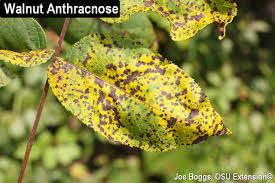
One of the important fungal diseases (gnomonia leptostyla) that is widespread due to increased humidity and causes slow growth of trees and general weakness within a few years. Symptoms of this disease are the formation of brown spots under the leaves and yellowing of the leaves and browning of the leaf margins. The pathogen spreads at appropriate temperatures and humidity and attacks not only the leaves but also the petioles and fruit, causing fruit drop and the formation of black, wrinkled spots and hollow fruits.
Strategies for controlling and treating walnut anthracnose disease
It is recommended to use resistant varieties, collect and burn infected organs such as leaves and fruits from the ground, perform two sprayings, the first in mid-autumn and the second before the buds swell, using copper pesticides such as Bordeaux and copper oxychloride, and spray in the spring when the fruit becomes hazelnut-like and after the shoots fall, and spray after the fruit is harvested. In addition, feeding with resistant fertilizers such as potassium fertilizers, calcium fertilizers, and phosphorus-potassium fertilizers has a great effect on controlling diseases.
Walnut blight disease or walnut kernel rot
The causative agent of walnut blight disease is a type of bacteria (xanthomonas arboricola), which is also the most important cause of blackening of walnut kernels and walnut kernel rot. It is the most serious of the leaf and fruit diseases and is very common in temperate regions with rainy spring.
Symptoms of walnut blight appear on leaves, fruits, branches and buds as small spots on the leaves that gradually expand and turn black.
Symptoms of the disease appear as black spots on the florets when the fruit is the size of a pea, which gradually expand, sink, and crack, gradually turning the entire skin and flesh of the fruit black and wrinkled. The causative agent of the disease is a type of bacteria that spends the winter on leaves and fallen fruit on the soil and is transmitted to other plants through rain and insects, causing great damage in walnut orchards.
Walnut blight control and treatment strategy
The best way is to use disease-resistant fertilizers such as amino-potassium and phosphorus-potassium fertilizers during the tree’s growth stages in spring and to spray twice using Bordeaux and copper oxychloride fungicides. The best time to use fungicide on walnuts is before the buds open in late March and the next stage is in the fall after the leaves fall. It is better to spray again after flowering and the buds fall.
Walnut Borer
Walnut borer is one of the most important pests of fruit trees, which is especially important in walnut trees. The borer (zeozera pirina) is a wood-eating pest of fruit trees that is very common in areas with water shortage and drought. This pest has many hosts, including fruiting and non-fruiting trees, but is most commonly seen on walnut, apple, pear, and plum trees. Biologically, the sawfly is a moth with white wings and black spots on it, which has different life stages, including egg, larva, pupa, and adult insect. The insect larva is almost white with black spots and dots. The destructive phase of this pest is the wood-eating larvae that hatch from eggs over a long period of time from late May to September and enter the branches from one-year-old branches and begin to feed on the wood tissue and veins of the tree. Gradually, they enter larger branches and Tree trunks become In many areas, one generation of this pest may take two years.
Symptoms of walnut borer damage
Following the loss of vascular tissues, symptoms such as drying of branch tips, dry green state and the presence of excrement next to buds and holes on the trunk and thick branches and the presence of sawdust are seen.

Methods of combating and controlling the borer pest
The best way to control this pest is to reduce the
likelihood of the pest attacking the trees, which is done through regular and sufficient irrigation, strengthening the trees using organic fertilizers and nitrogen and potassium fertilizers.
Pruning infected branches and burning them in gardens, inserting wire into the pest’s entry holes to kill the larvae, using poisoned baits such as zeozoran paste, or placing cotton soaked in dorsabane poison into the holes and injecting poison into the holes are some of the methods for controlling the borer pest.
What is the best pesticide to kill borer?
Given that most of the life stages of this pest are spent inside the tree trunks, it is not recommended to spray this pest separately. It is better to spray this pest at the same time as spraying other pests such as apple borer with pesticides such as Dursban or Fozalon. The best way to combat borer is to install Delta traps containing pheromone that attracts male insects to track and control the insect. The number of borer traps per hectare is 5 to 10, which should be installed at a height of 1.5 meters.
Walnut Gall Mite Pest
The walnut gall mite and the felt mite are very similar, and in many cases, farmers and experts consider these two pests to be the same. The gall mite (Eriophyes tristriatus) damages the leaves and fruit, and the felt mite (Eriophyes erineus) damages the leaves of walnut trees. The first symptoms of gall mites are gall-like bumps on walnut leaves, which turn green as the average temperature increases from May and are seen more on the edges of the veins and less on the surface of the leaves. As the weather warms from June to August, the galls become more numerous and the population of gall mites inside the galls increases sharply. This pest is mostly seen in the middle part of walnut trees that are more than 15 years old and also causes galls on the fruit. The presence of galls on the leaves of the trees causes reduced food production, yellowing, small leaves and fruits, and the leaves shrink and the fruits fall.
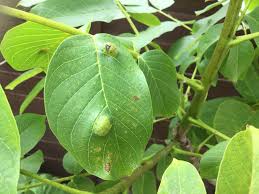
Strategies for combating and controlling gall mites in walnuts
Given the presence of beneficial insects in spring and summer, the best time to use effective acaricides is autumn and winter. When the gall mite population leaves the galls from the second half of October onwards, the best time to use herbal acaricides such as Biomite or low-risk organic acaricides such as Nisuron or Kenemite is once or twice at 15-day intervals.
In addition to spraying, collecting and burying fallen infected leaves in winter and using organic acaricides such as Behavaran bromopropylate and Behavaran propargite at a concentration of one in a thousand to control both gall mites and felt mites in winter, in combination with horticultural oil (Behavaran Volk) in late winter, is recommended.
Conclusion
This article introduces important and destructive walnut pests, including walnut gall mites and walnut felt mites, walnut borer pests, walnut blight and walnut anthracnose, and the best methods for controlling and treating various walnut tree pests and diseases.