
Citrus pests
Citrus thrips
Citrus thrips have two sexes, male and female, both winged, yellow with dark spots and banded tentacles. Distribution and damage: By feeding on plant sap, it creates ring wounds around the fruit tail joint, creates a leathery and deformed state, and becomes twisted and creates silver stripes on the branches and young leaves, and creates a broom-like state on the branches. Citrus thrips are most commonly seen in orchards in the south and some northern regions of the country. Citrus thrips overwinter as eggs inside plant tissues on young branches and inside fruits. Nymphs live inside leaves and among dry grass to become adult insects, and create a generation every two to three weeks.

Management and control of thrips pests in citrus
Spring spraying in late April, one stage, and repeating it in September with pesticides such as spirotetramat or monto, thiaclobrid + deltamethrin (Proteus), profenphos or coracron, and abamectin along with volk oil.
Types of citrus aphid pests
Citrus green aphid
Many genera and species of aphids damage citrus. Green citrus aphid, black and brown citrus aphid, green peach aphid, and scaly aphid… This pest is between 1.8 and 2 mm in size and yellowish green. Aphid damage in citrus is in the form of twisting of young branches and newly grown leaves. Most of the aphids accumulate under the leaves, and infected branches are twisted and shorter than healthy branches, and their growth stops. Due to the activity and feeding of aphids, honeydew is produced from the plant sap on the surface of leaves and fruits, as a result of which fumagin fungi accumulate on leaves, fruits, and branches. Also, the loss of flowers and small fruits due to the weakness of the plant is another damage caused by aphids. Aphid pests usually overwinter in the form of seeds of ornamental shrubs, and they begin to be active and reproduce with the onset of spring.

Management and control of citrus aphids
The best way to control citrus aphids is to spray with a pesticide such as malathion in the early morning or evening to avoid harming pollinators and other beneficial insects.
Citrus whitefly
Citrus whitefly, by feeding on plant sap and secreting honeydew, weakens the plant and produces fumagin fungus and reduces the level of photosynthesis in trees. This pest is seen in many gardens in the northern regions of the country, and its damage is greater in nurseries. Whitefly causes more damage in gardens where proper gardening principles are not followed, and its wintering is seen as late-instar nymphs or pupae under the surface of leaves or weeds. When spring arrives and the weather becomes favorable, they begin to grow and lay eggs. A complete generation of the pest lasts 50 days in the summer, and citrus whitefly usually has three generations per year.

Management and control of citrus whitefly
Using yellow cards in gardens is effective for catching insects.
Superfoods
Citrus brown shield
Females are pear-shaped and yellow, with brown shields measuring 1.8 to 2 mm in diameter, and have scales that are 1.5 to 1.3 mm in diameter and are lighter than males. Males have a pair of wings in the last instar and are able to fly and mate with females.
The question may arise: what is the damage caused by citrus brown scale?
This pest has entered the country from southern China and the Far East and has been observed in the provinces of Zanjan, Gilan, Mazandaran and Tehran. In addition to citrus trees, it infects ornamental trees such as tea, boxwood and palm. Among citrus trees, it is more interested in oranges and tangerines than other trees. Trees are weakened by this pest’s attack and have less resistance to the cold of winter. This pest overwinters as adult female insects or first and second instar nymphs. Their eggs are laid in May and after 48 hours the insect hatches and is dispersed by the wind or other insects. This pest feeds on the sap of trees. It has many natural enemies.
Super red fruits
Roundworms are round, flat female insects with a diameter of 1.8 that are scattered throughout the region and attack all aerial parts of the plant and usually gather on the underside of the leaves. As a result of the activity of this pest, the leaves turn pale and yellow and fall off. The life span of this pest is 65 to 75 days.
Super rich yellow compounds
The female shield is one and a half to two millimeters in diameter and brown in color. The shield is covered with waxy secretions. The female body is yellow and round, and the male is smaller. In many tropical and subtropical regions, it feeds on plant sap and causes yellowing of leaves, fruit drop, and weakness of trees. They overwinter as second-instar nymphs and adult females.
Superdar Yellow Oriental Mixtures
The female pest is round to oval kidney-shaped, without tentacles and flat, yellow and brown, and the male insect is elongated oval with yellow skin on the edge of the shield, which begins to feed on the host plant after penetration of the mouthparts. The pest is polyphagous and is widespread in tropical and subtropical citrus-growing regions.
The damage caused by the pest is through feeding on leaves, branches and fruit, causing malformation, poor quality, fruit fall, fruit shrinkage, and fruit dehydration. This pest thrives in humid, subtropical climates and has five generations per year.
Management and control of citrus scab types
Taking measures such as creating ventilation in the garden by doing proper pruning, observing proper planting distance between seedlings, reducing garden humidity, using natural enemies of the pest, regular monitoring of the gardens and pruning of heavily infected branches and burning them. Spraying when the first instar nymphs are mobile on the branches and leaves and trapping using yellow glue is recommended. Starting spraying when the number of pests reaches 10 using Volk oil at a rate of one and a half percent and chlorpyrifos insecticide (Dorsan) at a rate of one in a thousand was used as a spray at the peak of the insect population.
Superdar Wavy Compounds
The female shield of the pear-shaped or waxy insect is convex, light to dark brown, and the male shield is smaller than the female. The citrus waxy insect is mostly seen in tropical and subtropical citrus-growing regions, and a variety of citrus trees are hosts to this pest. This pest feeds on plant sap, causing yellow spots on leaves and fruits, leaf and fruit drop, drying of branches, and damage to the fruit. The citrus waxy insect overwinters as eggs or adults, which hatch when the weather warms in spring, and the nymphs become active on the plant. This pest has 3 to 4 generations per year.

Citrus Elf Shield
The female shield insect is 2.5 to 3.5 mm long and 0.6 mm wide, convex yellow and brown, usually native to East Asia and distributed in tropical and subtropical regions. In our country, it has been seen in Bandar Anzali, Tonekabon, Langrud and Ramsar. It attacks all parts of the plant such as leaves, fruit and branches. As a result of feeding, yellow spots are not visible on the leaves, but it causes severe fruit loss and drying of the branches.
How to manage and control citrus scale insects
The best way to deal with citrus scale insects is emulsifiable oil, insecticides ethion, chlorpyrifos, malathion. The best time to spray citrus for scale insects is when 60% of the nymphs are present. The use of pesticides should be combined with emulsifiable oil at a rate of 0.5 to 1%. Also, winter oil spraying is appropriate after the peak of winter cold has passed and before awakening.
Citrus ardalwood weevil pest
This pest is 3 mm long, pink in color with a white waxy coating and is floury. It has been observed in the provinces of Fars, Hormozgan, and Sistan and Baluchestan. The female weevil dies after laying eggs and the eggs hatch, and depending on the weather conditions, this pest has 15 generations per year. Various types such as the coastal mealybug, citrus mealybug, citrus star weevil, common brown soft-bodied weevil, citrus cushion weevil, citrus long-legged cushion weevil, and citrus Australian weevil cause damage to citrus.

How to manage and control citrus weevils
The best pesticides for citrus thrips are emulsifiable concentrate, ethion, chlorpyrifos, pyroxyphenacetamide, and spirotetramat. It is best to spray when 60% of the nymphs have emerged.
Citrus pollen beetle
Beetles 12 to 19 mm long, black with scattered white spots, whose bodies are covered with short, fine hairs. It is a polyphagous pest that spreads in most parts of the country and, in addition to citrus fruits, quickly damages fruit trees and crops. This pest spends the winter as full-grown larvae buried under the soil or in rotting materials. In spring, it attacks plants at the same time as they bud and flower, and by feeding on various parts of flowers and pollen, it prevents pollination and fruit formation.

Management and control of the pollinator beetle pest
Plowing the soil in late fall and late winter, planting trap plants such as early-maturing varieties of rapeseed, preventing unrotted manure from entering the garden and using fully rotted manure, shaking the trees in the cool morning air and collecting and destroying the beetles, using light blue buckets containing water and foliar soap. The best pesticide for controlling citrus pollinator beetles is phosphorus pesticides such as phosalone.
Citrus leaf-eating moth
The adult moth is 8 cm wide with its wings spread. The wings are black to dark green with large yellow spots, a beautiful appearance, the damage caused by the brown larvae feeding on young leaves. This pest has 5 larval instars, which usually last three weeks. They spend the winter as pupae and turn into adults and lay eggs when the weather warms up in spring. This pest has many natural enemies.
Management and control of citrus leafhopper pest
Manual collection of larvae and spraying of leaves using organic insecticides such as bavaria baziana, BT and neem extract
Citrus minnow moth
The citrus leafminer has 4 larval stages. The larvae have broad, flat bodies with a triangular head that are 3 mm long. The mouthparts of the larvae are sharp and toothed, which after sufficient feeding turn into pupae and eventually become adults. The full-grown moth of this pest is 2 mm long with closed wings at rest. This pest is mostly native to tropical and subtropical regions. After hatching, the larvae of the pest begin to enter the cuticular layer of the epidermis from the same point where they were placed on the leaf and feed on the parenchyma. From the first to the third stage, the larvae feed on the leaves. In the fourth stage, their movements are different. They create many corridors on the leaves of trees, reducing photosynthesis, stopping growth and leaf fall, and reducing yield.

Management and control of citrus moth pest
Perform proper gardening operations such as pruning, adequate watering, and installing pheromone traps to disrupt their mating. The best citrus leafminer control chemicals are diflubenzon with oil, imidacloprid with oil, and hexaflumeron with oil.
More frequent spraying is recommended for nurseries and young trees up to 5 years old.
Citrus fruit fly
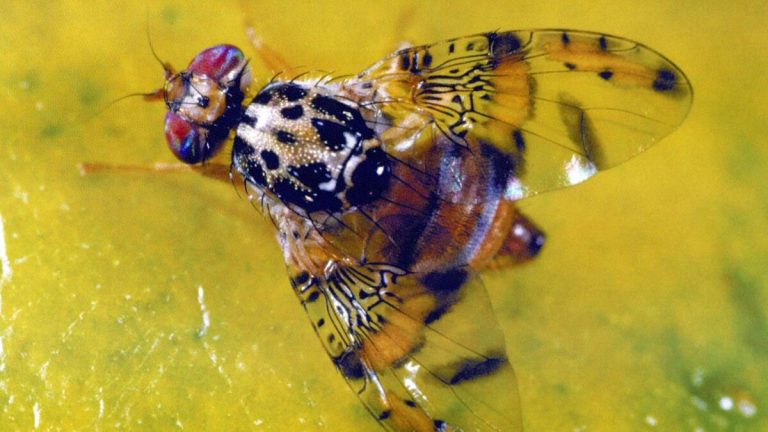
The full-grown insect looks like a common fly, but with transparent wings and separate yellow-brown and black stripes.
It is one of the most important pests of garden crops in tropical and subtropical regions of the world. This pest feeds on fruit in the larval stage. In addition to citrus, it also causes damage to other fruit trees. The fruit is crushed due to damage by this pest and rots due to fungal activities and eventually falls off. It is a multi-generational pest that has 2 to 16 generations per year and each insect lays 200 eggs that hatch two to three days later. After completing the larval period, the larvae leave the fruit and burrow into light, moist soil to a depth of 3 to 5 centimeters and turn into pupae. The pupae turn into full-grown insects after 110 to 40 days.
Citrus fruit fly management and control
Compliance with health and quarantine standards, chilling temperate fruits and cold, warming tropical fruits and immersing fruits in permitted compounds, collecting fruits from the garden completely and burying infected fruits at a depth of 50 centimeters, plowing after harvesting fruits. Spraying bait on tree trunks or some planting rows, the best citrus fruit fly poison for bait spraying is a mixture of protein hydrolysate 3 liters, small insect malathion 200 cc percent liter of water. The best time to spray bait is early in the morning or at dusk. You can also use traps and attractants of the mass fruit fly tracking and hunting program. Jackson traps, Delta McPhail traps and Tri-Medlor or Ceratrap attractants are suitable for citrus fruit flies. The number of traps is 30 to 50 per hectare and the time to install the traps is one month before harvesting the fruits until the end of the harvest.
Conclusion
In this article, we learned about various citrus tree pests such as citrus aphids, citrus thrips, whiteflies, various citrus scale insects, citrus mealybugs, the best poison for oranges, for orange leaf curl, the best poison for oranges, and methods for controlling citrus pests in Mazandaran and Fars.