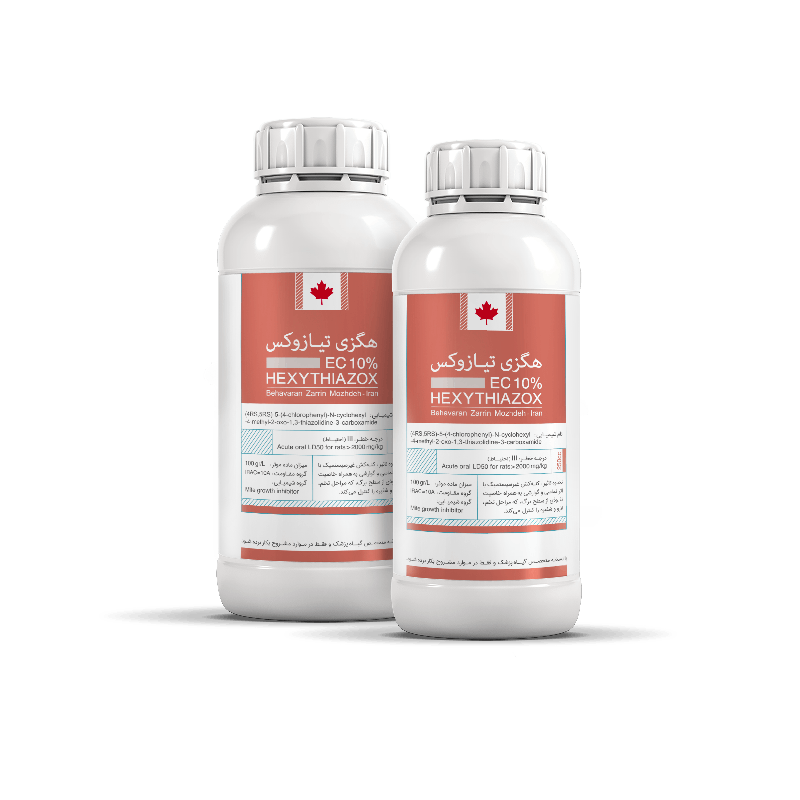
Hexythiazox is a specialized acaricidal active ingredient used for the management of plant-feeding mites in agricultural crops.
Hexythiazox 10% EC Behavaran is formulated as an emulsifiable concentrate containing
100 g/L of Hexythiazox.
Hexythiazox is classified in
IRAC Group 10A and acts mainly as a
mite growth regulator, with strong activity against eggs and immature stages of susceptible mites.
Product Specifications
| Specification |
Details |
| Active Ingredient |
Hexythiazox |
| Concentration |
10% |
| Formulation |
EC |
| Active Ingredient Content |
100 g/L |
| Product Type |
Acaricide / Mite Growth Regulator |
| IRAC Group |
10A |
| Packaging |
250 ml |
| Manufacturer |
Behavaran Zarrin Mozhdeh |
These specifications match the current Behavaran product page.
What Is Hexythiazox?
Hexythiazox is an acaricide primarily used against the immature stages of plant-feeding mites.
Its activity is strongest against:
The current Behavaran product information notes that it does
not have strong direct activity against adult mites, although eggs produced by treated females may be affected.
Because of this characteristic, Hexythiazox is particularly useful when applied
early in an infestation, before adult mite populations become dominant.
Hexythiazox Mode of Action
Hexythiazox interferes with the normal growth and development of mites by disrupting
chitin synthesis.
Chitin is an important structural component of the mite exoskeleton. By interfering with this process, Hexythiazox prevents successful development and molting of immature mite stages.
This mode of action makes Hexythiazox different from conventional adulticidal acaricides and allows it to play a useful role in resistance-management programs.
Main Benefits of Hexythiazox
Hexythiazox offers several useful characteristics in mite-management programs:
- strong ovicidal activity
- activity against larvae and nymphs
- specialized action against plant-feeding mites
- useful preventive activity
- suitable for early-season mite management
- useful in rotation programs with acaricides from different IRAC groups
- suitable for integrated pest-management programs
Hexythiazox for Spider Mites
One of the important uses of
Hexythiazox is the management of spider mites such as
Tetranychus species.
Spider mites can damage crops by feeding on leaf tissues, causing:
- stippling
- yellowing
- reduced photosynthesis
- premature leaf drop
- reduced plant vigor
- yield and quality losses under severe infestation
Because Hexythiazox targets eggs and immature stages, early detection and application are especially important.
Hexythiazox for Red Mites
Hexythiazox may also be used against red mites such as
Panonychus species where registered.
The current Behavaran page specifically lists red mites and other plant-feeding mite groups among its target pests.
Application should be based on monitoring and should occur before high adult populations are established.
Registered Uses
The current Behavaran product page lists the following crop uses and rates:
| Crop |
Target Pest |
Application Rate |
| Legumes and vegetables |
Spider mites |
500 ml per 1000 L |
| Date palm |
Mites |
500 ml per 1000 L |
| Citrus |
Red mites, Oriental mites and rust mites |
500–700 ml per 1000 L |
Always follow the registered product label and local recommendations for application rate, timing and crop use.
Best Time to Apply Hexythiazox
Hexythiazox is generally most effective when used early in the mite infestation cycle.
The Behavaran product page recommends application before adult populations increase substantially.
Good timing may include:
- early stages of infestation
- when eggs and immature mites are present
- before severe population buildup
- when monitoring indicates increasing mite activity
Hexythiazox in Integrated Pest Management
Hexythiazox can be useful in an
Integrated Pest Management (IPM) program because its activity is focused on immature mite stages.
An IPM program may also include:
- regular mite monitoring
- preserving predatory mites
- avoiding unnecessary insecticide applications
- reducing crop stress
- managing weeds and alternative hosts
- rotating acaricides with different modes of action
Resistance Management
Because
Hexythiazox belongs to IRAC Group 10A, repeated use should be managed carefully.
The current Behavaran page recommends avoiding continuous use and rotating with acaricides having different modes of action.
Recommended practices include:
- avoiding unnecessary repeated applications
- rotating with acaricides from different IRAC groups
- following the registered application rate
- applying at the correct mite-development stage
- incorporating non-chemical IPM practices
Pre-Harvest Interval
The current product information indicates a
14-day pre-harvest interval for fruit trees.
PHI may vary depending on crop and local registration, so always follow the official product label.
Environmental and Safety Considerations
Hexythiazox should be handled according to the approved product label.
During application:
- wear suitable personal protective equipment
- avoid contact with skin and eyes
- avoid contamination of surface water
- prevent pesticide entry into irrigation channels and waterways
- store the product securely in its original container
The current Behavaran page specifically notes the importance of preventing contamination of water sources.
Frequently Asked Questions About Hexythiazox
What is Hexythiazox?
Hexythiazox is an acaricidal active ingredient and mite growth regulator used mainly against eggs and immature stages of susceptible plant mites.
Is Hexythiazox effective against adult mites?
Its main activity is against eggs, larvae and nymphs. The current Behavaran page states that direct activity against adults is limited.
What IRAC group does Hexythiazox belong to?
Hexythiazox belongs to
IRAC Group 10A.
What formulation is Behavaran Hexythiazox?
It is formulated as
10% EC with
100 g/L active ingredient.
What is the package size?